






In the mid-twentieth century, there was an attempt by Indian art to find an individualistic style. The choice was tough. The Progressive Artists’ Group of Bombay engaged deeply with European modernist vocabularies while seeking to articulate the realities of a newly independent nation. However, in Bengal, artists went back to the Indian past and produced mild, traditional paintings. The belief was that Indian artists could only adopt two styles – either imitating the West or imitating the past.
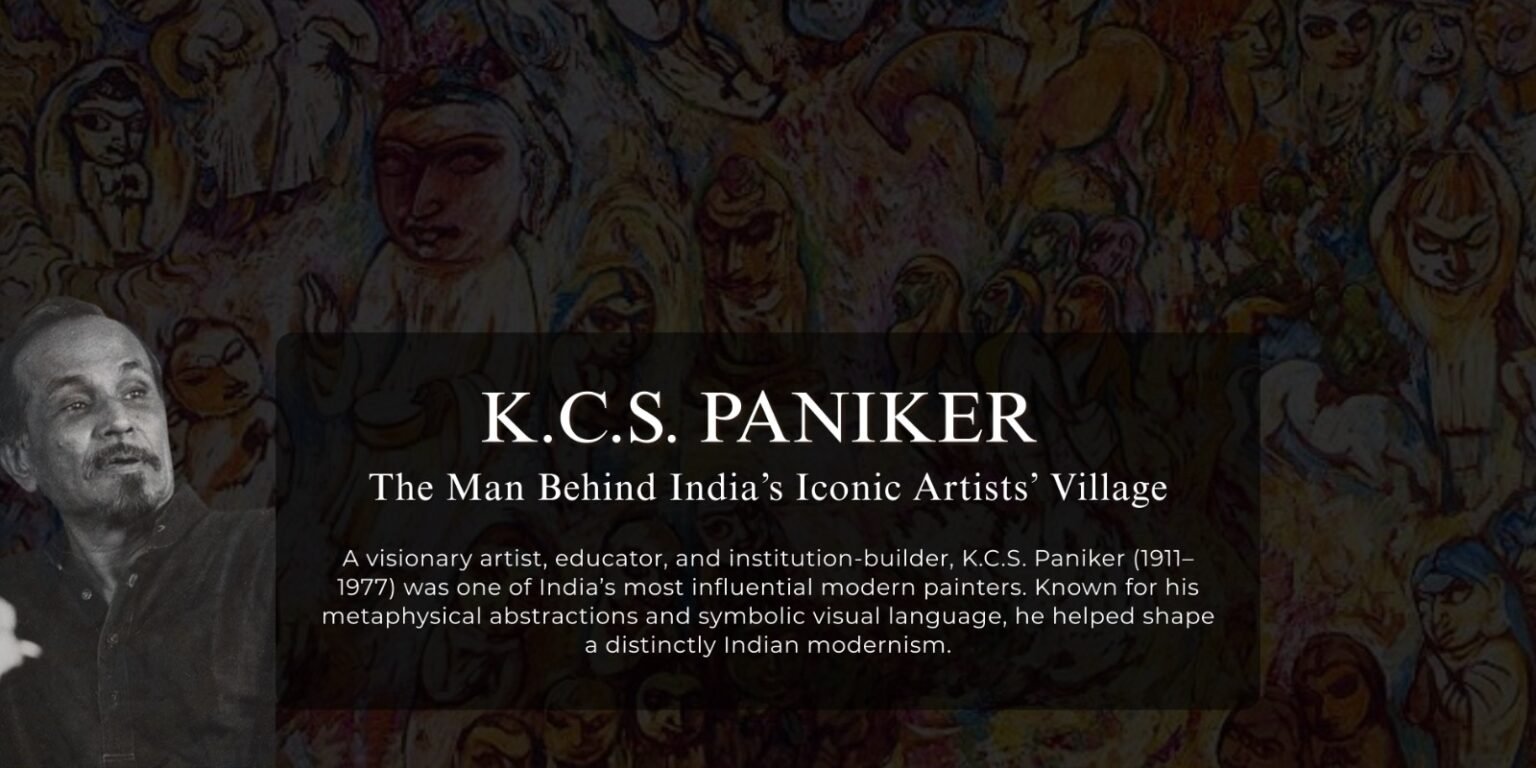
However, K.C.S. Paniker (1911-1977) proved otherwise. As an artist, educator and thinker, Paniker advocated that India did not have to borrow its modernist style from anywhere outside. For more than four decades, he was the intellectual voice of the Madras Movement. His innovative style of Southern Modernism emerged as unique yet highly rooted in Indian thought.
Contents:
- The Bureaucratic Interregnum
- The Madras Movement: Defining a Southern Modernism
- Cholamandal: A Self-Sustaining Creative Village
- From Landscapes to Scripts: The Art of Paniker
- Why Paniker Matters in Today’s Art Market
- Conclusion: A Lasting Legacy
The Bureaucratic Interregnum
Kerala-born Paniker demonstrated exceptional skills from an early age. Even at seventeen years old, he began showcasing his artworks at the Madras Fine Arts Society. However, his entry into the realm of fine arts was cut short by the difficulties of life. Following his father’s death, a young Paniker had no choice but to find employment to sustain his family. Thus, he took up a post in the Indian Telegraph Department as a clerk.
However, government service did not prevent him from pursuing his passion for art. For almost ten years, Paniker kept working on office routine while creating his masterpieces during his leisure hours. Eventually, in 1936, when he was only twenty-five years old, he quit his stable job and enrolled at the Government School of Arts and Crafts in Madras.
The Madras Movement: Defining a Southern Modernism
To understand Paniker’s importance, one must understand the Madras Movement. When Paniker became the Principal of the Government School of Arts and Crafts, he turned the school into a centre for new ideas.
Under Paniker’s guidance, artists associated with the Madras Movement pursued an alternative path to modernism, distinct from both the European-oriented experimentation of Bombay and the revivalist tendencies of the Bengal School. Paniker asked his pupils to study local crafts, lines, and symbols in order to come out with a modern product. The formation of the Progressive Painters’ Association (PPA) in 1944 by Paniker provided an arena for the Southern artists to exhibit their work.
Cholamandal: A Self-Sustaining Creative Village
Paniker founded Cholamandal Artists’ Village in 1966 on a secluded beach area near Chennai. However, while others may have viewed Cholamandal as simply an artists’ village, Paniker created a revolutionary enterprise that helped transform the art world in India.

It was unique in its complete financial independence. Four factors enabled Cholamandal to be so successful:
• Artist Ownership: The land was purchased solely by the artists and run only by them. Thus, there were no landlords or development companies involved.
• Self-Dependency of Finances: Every day, the artists would spend some time producing beautiful crafts, pottery, and batik textiles, thus earning enough money to pay for their living expenses.
• State Independence: Because artists were not dependent on any state aid for money, the government could not direct their artistry.
• Gallery Independence: Artists did not have to produce paintings based on what galleries asked. In fact, their art was not bound to anything other than themselves.
This example showed that artists could earn good incomes while retaining all of their creative freedom. Today, Cholamandal remains one of the most significant and enduring artist-led cooperatives in India.
From Landscapes to Scripts: The Art of Paniker
The personal painting style of Paniker also witnessed a massive change throughout his life. His journey in the field began when he started painting realistic landscape scenes from the countryside of Kerala. Although this phase depicted Paniker’s talent for capturing light and colour, he did not think that he was doing anything Indian yet.
His search finally led to Words and Symbols by the 1960s.
In these distinct paintings, the canvas takes on the appearance of an old scroll or manuscript. As opposed to using shapes found in Western abstract art, Paniker incorporated symbols from Indian traditional sources. These included mathematical grids, astrological diagrams of old, and written scripts, including Malayalam, Arabic, and Roman alphabets.
The words featured in these paintings were not intended to convey a story. Rather, Paniker chose to use the forms of these alphabets in designing his painting. In doing so, he came up with a form of abstract art that was distinctly modern and yet traditionally Indian at the same time.
Why Paniker Matters in Today’s Art Market
For a long time, art buyers and auctions favoured the dramatic paintings from the Bombay schools. However, the art market is now going through a major change, and Paniker is receiving the recognition he deserves.
Today, serious art collectors are looking for paintings with historical importance and genuine rarity. Paniker fits this description perfectly for a few reasons:
| Market Factor | Description |
| Extreme Rarity | Because Paniker spent most of his life teaching and building communities rather than selling to galleries, he produced a limited number of paintings. Masterpieces from his Words and Symbols era are hard to find, as most of them are in museums or private family collections. |
| Historical Importance | Just as global collectors value artists who started famous art schools, Paniker’s role as the father of the Madras Movement and Cholamandal makes his work highly prestigious. |
| A Shift in Taste | Smart collectors realise that Paniker’s art represents a truly authentic form of Indian abstract thought, making his paintings highly valued assets. |
Conclusion: A Lasting Legacy
The major accomplishment of K.C.S. Paniker was that he never dissociated his work from his conduct. He understood very well that in order for a new kind of art to develop, it had to have independent spaces such as Cholamandal and an independent community such as that of the Madras Movement.
Now, as the history of Indian modern art is being retold, Paniker emerges not only as one of India’s most significant modernists but also as the architect of an artistic ecosystem that enabled new forms of Indian modernism to flourish.