





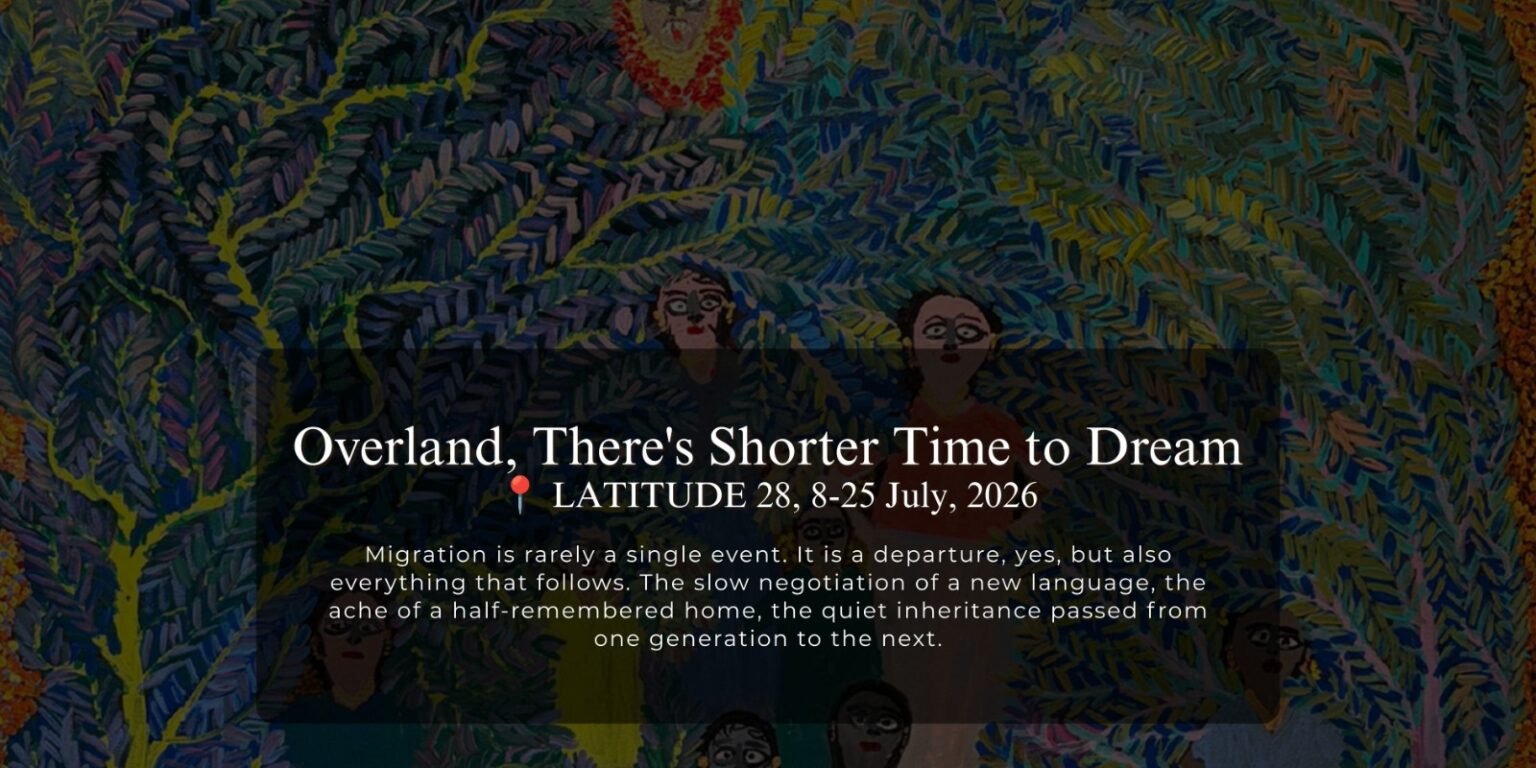

Migration is rarely a single event. It is a departure, yes, but also everything that follows. The slow negotiation of a new language, the ache of a half-remembered home, the quiet inheritance passed from one generation to the next. This is the platform that Latitude 28’s new group exhibition, Overland, There’s Shorter Time to Dream, sets out to explore between 8 – 25 July 2026.
Curated by Shristi Sainani, the exhibition brings together sixteen contemporary artists from a wide range of geographical and cultural backgrounds, working across painting, drawing, sculpture, installation, and textile. Rather than treating migration as a demographic statistic or a simple story of leaving and arriving, the show asks a harder question:” what does it mean to carry the loss of home within you, long after the journey itself has ended?”
That question shapes every layer of the exhibition. Sainani has described the project as an attempt to sit with the many shifts migration produces, in language, in the body, in one’s relationship to land and space. Prolonged exile, she suggests, does not just displace people; it distorts the very words they use to describe themselves. The fractures left behind by conflict and displacement become, in her framing, sites where new forms of expression and resilience take root.
Some pieces sit with the specific texture of individual memory; others speak to the broader histories of exile, resettlement, and cultural translation that connect diasporic communities across borders. Among the artists featured are Mihika Poddar, Sudipta Das, Firi Rahman, and Gaurang Naik, each bringing a distinct visual language to shared questions of belonging.
Across the exhibition, themes of surveillance, silence, and yearning recur alongside those of remembrance and continuity. The artists consider what migrants carry with them across borders, what gets left behind, and what persists, in memory, in ritual, in the objects and gestures passed down through families. Home, in this telling, is never fixed. It is continually rebuilt, reinterpreted, and renegotiated with each new geography a person moves through.
Sainani’s curatorial approach grows out of her own sustained engagement with diasporic narratives and migratory histories, blending research with lived experience. The result is an exhibition that resists offering a single, tidy narrative about migration. Instead, it opens a space for multiple, sometimes conflicting truths to coexist — an invitation to visitors to sit with the complexity of movement rather than resolve it.
In Overland, Sudipta Das renders displacement structurally, embedding loss within the work’s physical form; Khadim Ali and Samia Dzaïr weave storytelling and inherited memory into pieces shaped by ancestral exile; Kanchana Gupta and Gaurang Naik use tactile material process to mirror migration’s slow transformations; Juhikadevi Bhanjdeo’s textiles carry memory and identity across borders like fabric itself; Jyothidas K.V. explores belonging through food, geography, and community; and Firi Rahman links ecological upheaval to social displacement within the Anthropocene.
In bringing together sixteen distinct practices under one roof, Overland, There’s Shorter Time to Dream makes a quiet but firm argument: migration is not a chapter that closes upon arrival. It is an ongoing condition, one that continues to shape identity, memory, and belonging across generations.