





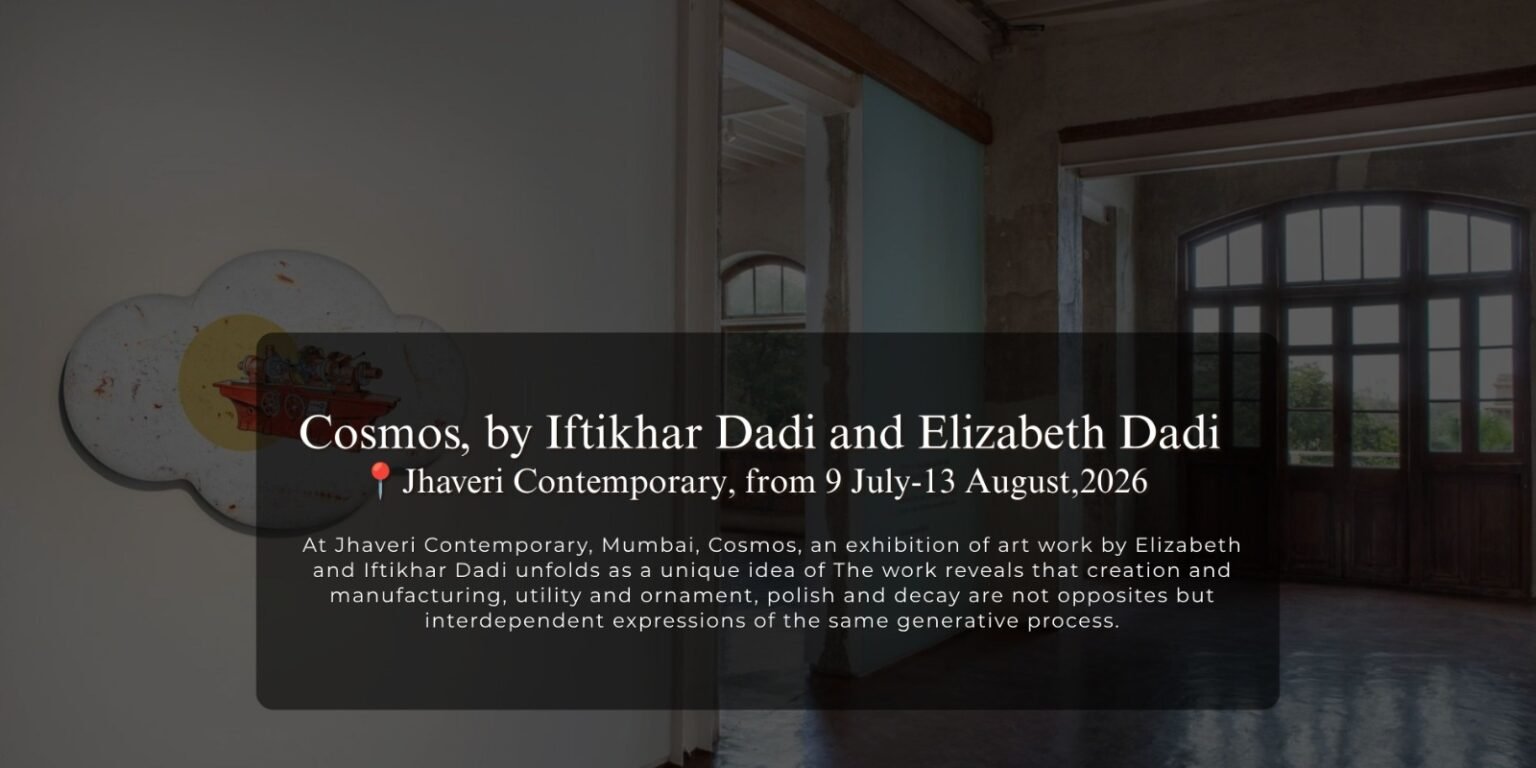

At Jhaveri Contemporary, Mumbai, Cosmos, an exhibition of art work by Elizabeth and Iftikhar Dadi unfolds as a unique idea of The work reveals that creation and manufacturing, utility and ornament, polish and decay are not opposites but interdependent expressions of the same generative process. On view from 9 July till 13 August 2026, the exihibition offers an interesting insight into the artist’s unique visual world.
“Everything that is created exists within time and is subject to changes initiated through a melding of its own internal processes and larger cosmic processes”
– Zahid R. Chaudhary, Cosmos, Jhaveri Contemporary, 2026(brochure)
Elizabeth and Iftikhar Dadi, with the idea mentioned, bring forth their work that brings the juxtaposing ideas that have always been a debate in the art scene; bringing together opposites, mechanical versus decorative, function versus decoration, to explore and engage with the very idea of value itself, both in its worldly, secular dimensions and in its more transcendent or spiritual ones. The idea is very novel and places the machine in the centre, as a bridge between creation in a cosmic sense and creation in a human sense. In a sense, here, function and ornament essentially become different products of the same process, creation.
“Cosmos” is a series of nine Diasec prints depicting hand-painted signage, each set against a distressed background and grounded by a single circular field of colour. The prints are cut into ornamental shapes that recall Art Deco architectural motifs, emblems, and trophies rather than conventional rectangular formats. The series is accompanied by two illuminated LED signs spelling “Cosmos” in English and “Kehkashan” in Urdu. Both signs are mounted on cloud-shaped bases that reference the ornamental framing devices found in Persian and Urdu illuminated manuscripts.
For more than twenty years, Iftikhar and Elizabeth Dadi have worked side by side, building a practice that refuses categorisation. Their work goes hand in hand with installation, neon signage, photography, and sculpture, always circling back to questions of identity, borders, and the quiet, often overlooked economies that keep cities across South Asia and the Global South running. There’s a clear dialogue with Pop and Conceptual Art in what they make, but it never feels borrowed, their attention to place and material keeps it grounded in something more specific and lived-in.
Iftikhar earned his Ph.D. at Cornell, where he now chairs the Department of History of Art as the John H. Burris Professor, and previously led the university’s Institute for Comparative Modernities. Elizabeth trained at the San Francisco Art Institute. Together, they live and work in Ithaca, New York , a partnership that’s shaped not just a shared body of work, but a distinct way of looking at the world.
Cosmos takes its title from the stars, naming ordinary tools and machines after celestial bodies to elevate labor that typically goes unseen. Iftikhar and Elizabeth Dadi turn their attention to the informal economies of the Global South, the workshops and hand-painted signage of cities like Mumbai, where fabrication sustains urban life yet remains largely invisible beyond it..


Rather than treating the machine as a neutral or purely functional object, the Dadis use it to interrogate how such binaries have historically been assigned value, elevating the rational, industrial, and formal, while frequently overlooking the decorative, artisanal, and informal. By situating machinery within ornamental, celebratory forms, their work resists this hierarchy, positioning function and decoration, precision and craft, not as opposing forces but as interdependent outcomes of a shared act, that is, creation.