





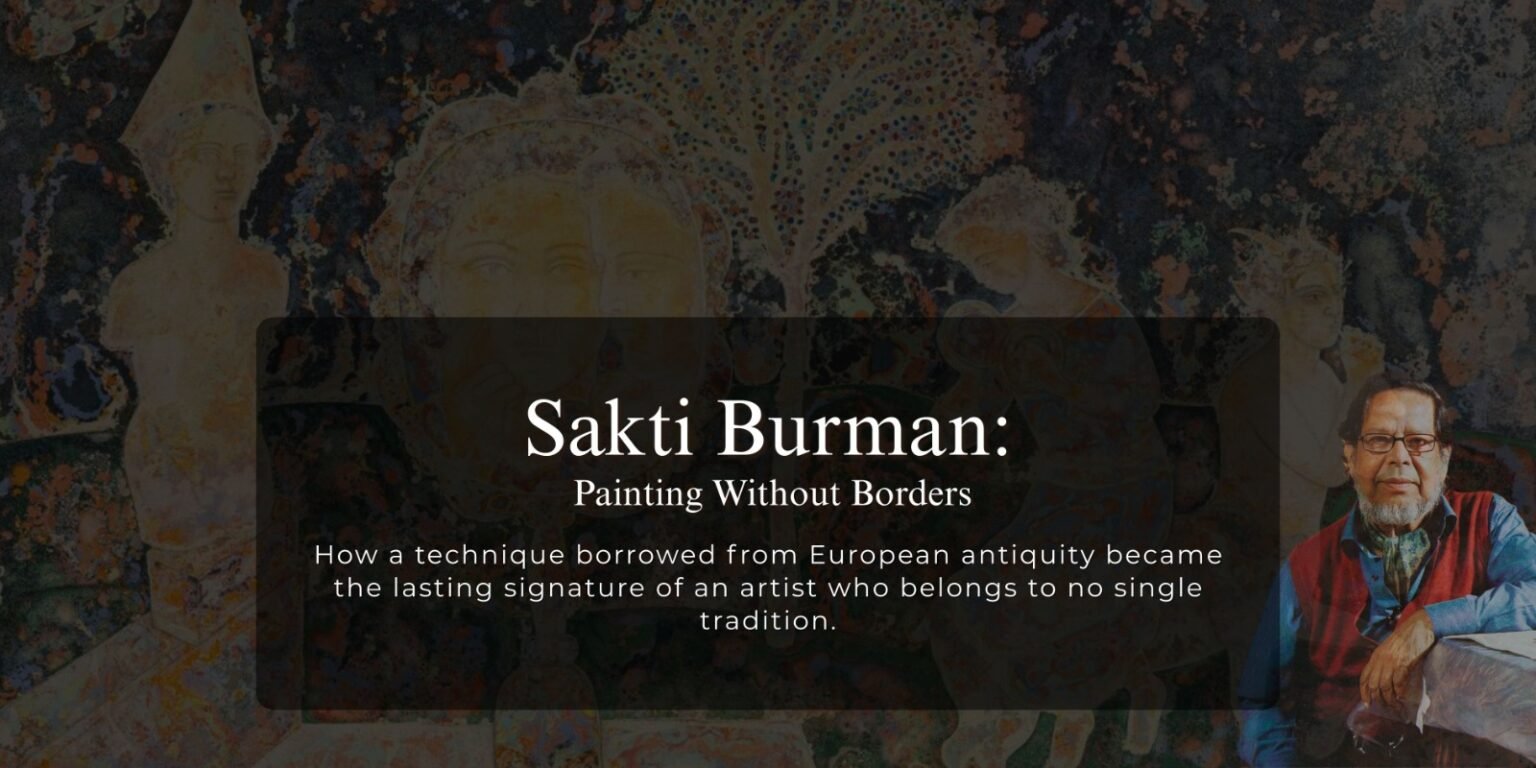

Sakti Burman is a contemporary Indian artist known for blending Indian mythology with the painting techniques of the European Old Masters. He picked up those marbled, fresco-like surfaces while living in Paris, and he brings them together with stories from Hindu mythology, especially Durga shows up again and again in his work. That mix of old European craft and Indian myth is really what defines how people talk about his art.
Born in Calcutta in 1935, Burman spent his formative years in family homes in present-day Bangladesh and Assam, a childhood shaped in part by the upheaval of Partition. Burman graduated from the Government College of Arts and Craft from Kolkata in 1956, in fine arts. After graduation, he moved to Paris, pursuing his studies further at Ecole Nationale Supérieure des Beaux-Arts, on a French government scholarship. He later settled in France, where he lived and worked for several decades, married French painter Maïté Delteil, and remained closely engaged with India through regular exhibitions of his work.
Travel has always been at the heart of Sakti Burman’s artistic journey. Moving across countries and cultures, he treated each new place as a learning; from the grace of classical Greek sculpture, the grandeur of imperial Rome, and the quiet spirituality of Indian Buddhist art. These experiences didn’t just add to his knowledge; they reshaped how he saw the world. Rather than settling into one fixed identity, Burman let his travels carry him across borders, blending what he absorbed into something distinctly his own. That’s what makes his work feel so alive, it doesn’t belong to any single tradition, but draws freely from many, creating art that feels at home everywhere. Burman’s practice is distinguished by two signature techniques, a disciplined pointillist method, built from countless small points of colour to create shimmering depth and luminosity across the surface; and a marbling technique discovered in Paris, where accidentally spilled water produced delicate, feathered pigment patterns. Refined over years of deliberate study, this marbling lends his canvases a fluid, fresco-like quality.
During his time in Paris, Burman received “Prix des Étrangers(1956)” which is a recognition by the school for his outstanding artistic merit as an international student. In the same year, he was also awarded with “Medaille d’Argent au Salon de Montmorency”. In 2016, he also received “hevalier de la légion d’honneur”, a knighthood honory award by the government of France.
His international reputation grew through the French Biennales in Paris (1965) and a group show at the Grand Palais a decade later. By 1997, he’d earned a place among modern masters, exhibiting alongside Picasso, Chagall, and Miró in Japan. In India, his work has been celebrated through solo shows at the Lalit Kala Akademi, Victoria Memorial Hall, and DakshinaChitra between 2011–12, while India’s French Connection (DAG, New Delhi and New York, 2018–19) spotlighted his role as an artist moving between two cultures. His momentum hasn’t slowed. exhibitions like Life Is A Theatre (2022) and Sculpted Sagas (2023) at Art Alive Gallery, and In the Folds of Time at Akara Art, Mumbai (2025), show his work still resonates with new audiences today. Pundole Art Gallery and Apparao Galleries handle his estate, with works circulating through Piccadilly Gallery, London.
Burman’s auction market centers on Indian salerooms rather than the international majors. The highest price found for his work is La Comedie Humaine(2008) which sold for approximately INR 25.19 crore at ARTIANA — South Asian Art, on 09 Jul, 2026 – 13 Jul, 2026, reported as his top recorded auction result till 18 july, 2026. His painting, Durga, was sold for approximately INR 7.2 crore at Saffronart’s 25th Anniversary Sale in Mumbai on 2 April 2025. A separate Durga canvas sold for roughly INR 4.15 crore at AstaGuru’s ManiFest auction later that year, in August 2025, suggesting sustained demand near the top of his price range.