






In the context of global art events, the concept of biennales continues to be bound by the constraints of wealth generated by metropolitan cities and the insulation offered by air-conditioned exhibition spaces. Be it Venice or Basel, the exhibitions of contemporary art continue to use the concept of the “white cube”, a space created to shield the work of art from the harshness of the outside world.
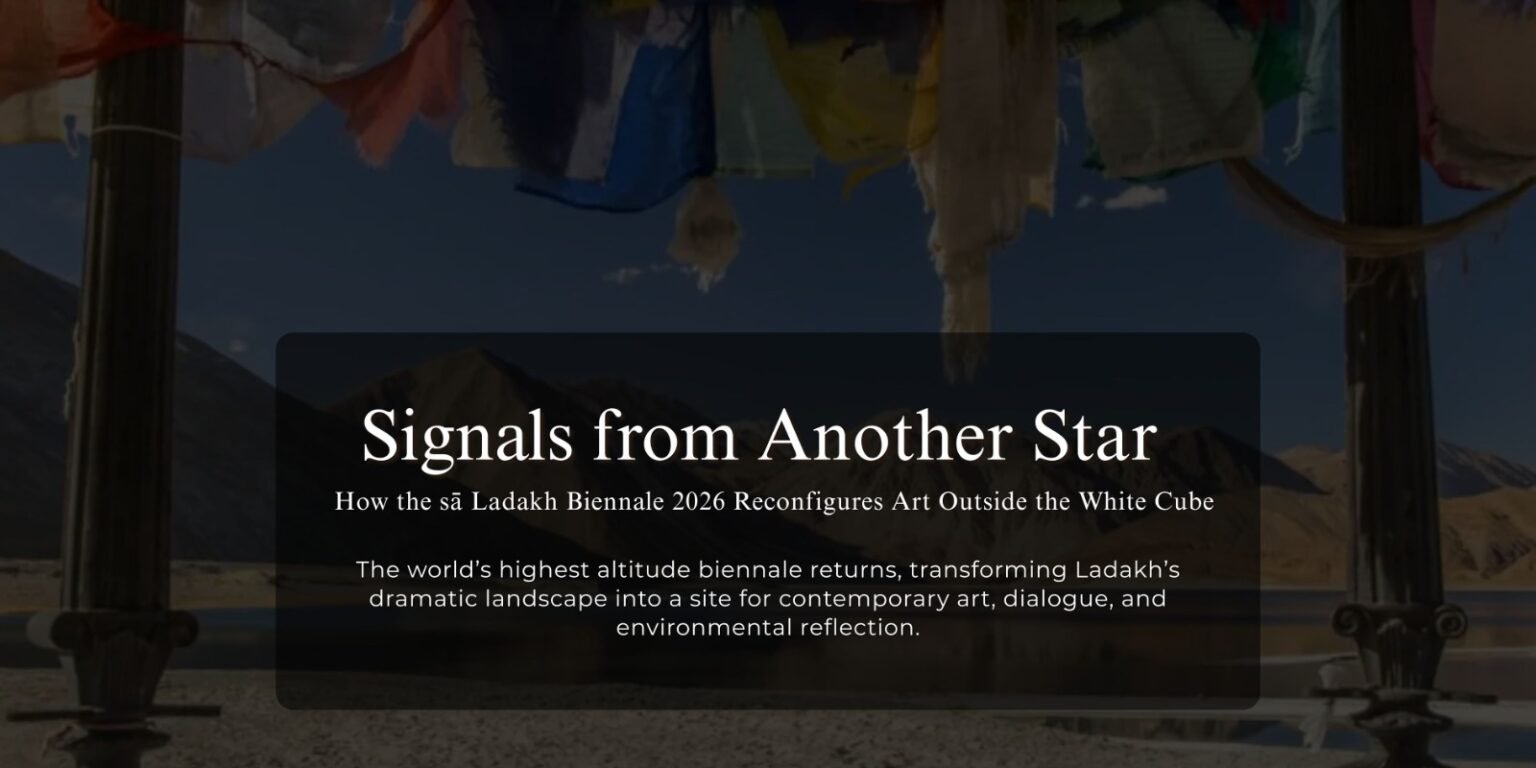
From August 1 to August 10, 2026, however, the sā Ladakh Biennale stands as a radical deviation from this well-established paradigm.
For its third edition, which is held in the dispersed landscapes of the Leh-Kargil corridor, the biennale is located above the altitude of 3,000 meters and becomes the highest biennale in the world. With the theme of Signals from Another Star and curated by artist-curator Vishal K. Dar and his associate curator Tsering Motup Siddho, the biennale of 2026 departs completely from conventional gallery spaces. It repositions contemporary art practices through their site-specific engagement in a fragile Himalayan ecosystem.
Contents
- The Spatial Strategy: Distributed Topographies vs. The White Cube
- The Trans-Himalayan Frontline: Art as an Ecological Metric
- Curatorial Mechanics: Signals from Another Star
- Institutional Critique and the Autarkic Model
- Reconfiguring the Market: The Value of Ephemeral Site-Specificity
- Conclusion: The Horizon After the White Cube
The Spatial Strategy: Distributed Topographies vs. The White Cube
The conventional structure of a biennial depends on an architectural model that creates a rigid format for viewing art. The sā Ladakh Biennale shatters the geometry of such structures through its approach in hosting its 2026 edition.
| Architectural & Spatial Vectors | The Institutional Gallery Model | The sā Ladakh Biennale Model (2026) |
| Environmental Control | Climate-stabilised, static lux levels | Unpredictable mountain weather, extreme UV exposure |
| Spatial Hierarchy | Centralised, urban, indoor white cube | Distributed, rural, high-altitude open terrain |
| Audience Engagement | Ticketed, insular, passive spectatorship | Organic integration with lived, working landscapes |
By removing the protective boundaries of the gallery, the biennale subjects the artwork to the physical realities of the landscape. Installations must contend with extreme wind pressures, thermal expansion, and vast open space. This spatial strategy alters the role of the landscape from a passive backdrop into an active, unpredictable material collaborator in the artistic process.
The Trans-Himalayan Frontline: Art as an Ecological Metric
Choosing to work with the environment of Ladakh is a conscious environmental choice. The fact that the land is situated over 3,000 meters above sea level means that they are already living in an unstable climate situation. The rapid retreat of Himalayan glaciers, erratic water tables, and changing ecosystems are immediate local realities rather than distant projections.
The idea of “climate optimism” has been formulated from the inception of the biennale. Established by Raki Nikahetiya in order to inspire the future generation who will be responsible for taking care of the land, the biennale takes advantage of the landscape both as a storehouse of memories and warnings. Rather than creating documentation for the end of nature, artworks are created as measurement tools for its fragility.
Curatorial Mechanics: Signals from Another Star
The 2026 curatorial framework, Signals from Another Star, uses the isolation of the high-altitude desert to explore ideas of deep time, cosmic memory, and human survival. Dar and Siddho have selected an international and regional cohort of artists whose practices focus on:


- Material Historiography: The utilisation of local, non-toxic, or biodegradable mediums that naturally degrade, leaving zero permanent physical trace on the terrain.
- Displaced Memory and Migration: Projects that examine how indigenous knowledge systems and oral traditions shift under the pressure of changing environments.
- Interdisciplinary Synthesis: Artworks developed in collaboration with climate scientists, local farmers, and regional scholars, blending contemporary art with environmental data.
This curatorial approach prevents the project from becoming a form of cultural import. By anchoring global perspectives within the specific memory of the Leh–Kargil corridor, the exhibition ensures that the art reads as an organic extension of the land itself.
Institutional Critique and the Autarkic Model
High-level cultural exhibitions usually impose the burden of extraction on the regional infrastructure and the dangers of over-tourism and environmental degradation. Given that Ladakh is home to a fragile high-altitude desert landscape, this biennale aims to provide a regenerative framework embedded within the community.
Consistent with past structural challenges, the artists are required to use only those circular or indigenous materials that are obtainable in Ladakh. Far from imposing alien elements that would remain after the exhibition, materials are systematically returned to the local community for construction and educational use, or left to dissolve back into the soil.
In addition to providing various cross-disciplinary activities like film showings and localised performances, this biennale does not depend on the usual corporate sponsorships and thus retains its independent status.
Reconfiguring the Market: The Value of Ephemeral Site-Specificity
In today’s art market, serious collectors and major institutions are showing a clear shift in priority. While traditional, object-based luxury commodities remain stable, the vanguard of the market is moving toward historical gravity, institutional rigour, and non-extractive practices.
The works produced for the sā Ladakh 2026 challenge standard art collecting by being intrinsically tied to their site. Because these installations are often ephemeral, constructed from local earth, ice, or stone, they cannot be unbolted and shipped to a private home. Instead, their value is captured through documentation, conceptual blueprints, and institutional acquisition of the artist’s research. This aligns with a growing global demand among smart-money collectors for art that prioritises intellectual weight and ecological integrity over mere material accumulation.
Conclusion: The Horizon After the White Cube
Sā Ladakh Biennale 2026 shows us that there is no loss in the sharpness of contemporary art once it leaves the economic centres of our cities; it rather becomes more urgent than ever before. With Signals from Another Star employing the Leh-Kargil corridor as a place of research, it provides us with an alternative to exhibitions.
With its inauguration this August, Signals from Another Star demonstrates that the most important conversations regarding contemporary art and human survival do not require the protection of gallery walls; they require the clear perspective found by standing above the clouds.