






The global biennial circuit did not lose its edge overnight; it was slowly institutionalised.
Big international biennales that were introduced to the sphere of culture in the late 1990s and early 2000s appeared at a time when postcolonial theories were already entrenched. Such concepts became embedded in academia, while their fundamental aesthetics found their place in established institutions, Western museums, and prestigious collections. In the case of biennales that emerged independently from the Euro-American axis, the challenge came in the form of having to function in a language of global contemporary art created elsewhere before that.
Rather than adopting Western aesthetic templates, some innovative institutions opted for an alternative route. Rather than immersing themselves in already existing markets, they started creating parallel discourses. The Kochi-Muziris Biennale is a result of such a move.
Yet, across the global art world, a subtle yet profound shift eventually occurred from radical critique to performative curating.
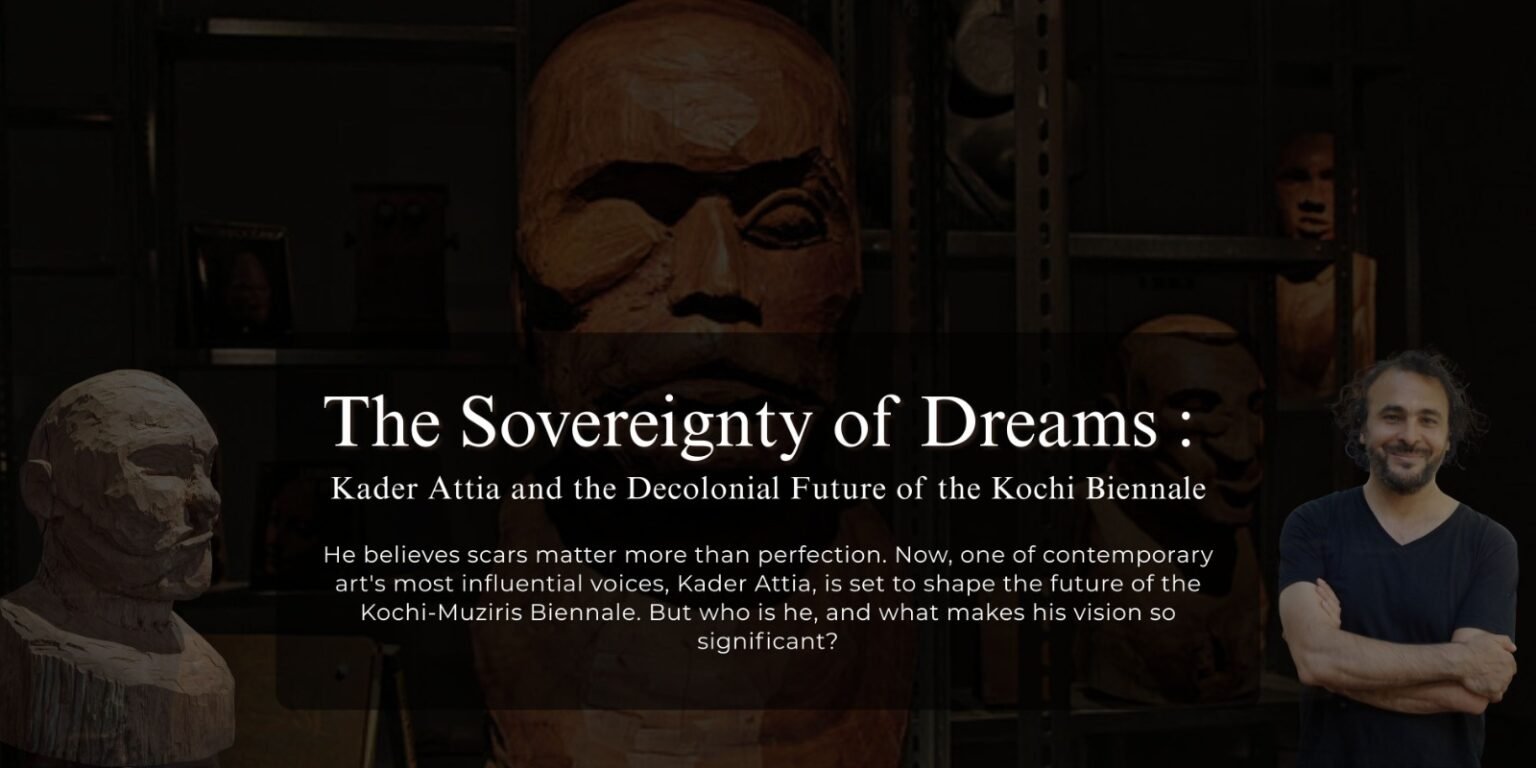
In response to the high degree of commercialisation seen in contemporary art, the strict structures created by political urgency were replaced by narratives dictated by the market. Peer review was replaced by PR, and visibility came to substitute for value. It could not have been more apt, then, when French-Algerian artist, writer, and professor Kader Attia took up the mantle as curator of the Seventh Edition of the Kochi-Muziris Biennale.
As the first non-Indian curator at India’s most prestigious biennale, Attia comes into his role at a vital time, and his curation will take place within a process based on a philosophy of depth over superficiality.
What comes next is a direct reversion back to the roots of artistry: from preservation to restoration.
The Materiality of the Scar: Decoding Attia’s Practice
Knowing the evolution of Attia’s artistic practice means knowing the construction of an archive grounded in the traces of history left physically and psychologically on him. Born in 1970 in France to Algerian immigrants, Attia grew up amid cultural divides separating the banlieues of Paris from the war-torn country of his parents. The nature of his upbringing defined the medium used by Attia, which ranged from sculptures and photography to installations and films.
“The injury is real, but the Western obsession with perfect erasure is an illusion.” — Kader Attia.
The core of this vast body of work is formed by his hallmark theme, “Repair.” The Repair from Occident to Extra-Occidental Cultures (2012).


Premiered during documenta (13), this massive installation is still considered one of the most powerful critical reflections on modern history. Attia populated industrial shelves with a shocking combination of archival photos of mutilés de guerre, French First World War soldiers with terrible facial injuries, next to traditional African wooden masks with rough metal staples, buttons, and coins used to mend them.
The profound philosophical message of this work is that there is an absolute contrast between the Western and non-Western understanding of repair. For the West, repair is nothing but erasure, an attempt to restore an object to its perfect, pristine state. Meanwhile, for the non-Western world, it is the evolution of that object.
Independence Disillusionment (2014) & The 12th Berlin Biennale (2022)
Attia’s connection with Kochi has been established since he featured his work called “Independence Disillusionment” at Kochi, which was a very sharp look at the melancholia after colonial rule through blue-tinted mirrors modelling the modernist architecture of Algeria. Then in 2022, while curating the 12th Berlin Biennale titled Still Present! Attia moved away from looking back into history and focused on the need for decolonisation.
Sovereignty Over Dreams: What Attia Brings to Kochi
The consequences of introducing a thinker of Attia’s calibre to the South Asian art ecosystem are far-reaching. One of the most significant outcomes will be the distortion of local-global hierarchies. Today, biennials often find it difficult to distinguish between urgent political discourse and well-marketed contemporary trends. Attia’s pedagogic sensibility, honed through his tenure as a professor at the University of Fine Arts Hamburg (HFBK), seeks to restore that lost context.
• 1970: Born in France to Algerian parents; lives between Paris and Berlin.
• 2012: Exhibits “The Repair” at documenta (13).
• 2014: Participates in the 3rd Kochi-Muziris Biennale.
• 2016: Wins the Prix Marcel Duchamp; founds ‘La Colonie’ in Paris.
• 2022: Curates the 12th Berlin Biennale.
• 2026: Named curator of the 7th Kochi-Muziris Biennale.
Kochi, a city defined by centuries of maritime trade, colonial occupations, and migratory patterns, mirrors the exact themes of cultural friction that Attia has spent his life untangling.
“Dreams repair us, like Art… and the Biennale will give us the space-time to reclaim our sovereignty over our dreams.”- Kader Attia.
One can anticipate an edition that views conversation on an equal footing with material objects, abandoning the pristine white cube concept to investigate the “phantom limb syndrome” of society, the notion that the pain of past atrocities continues to affect societies far beyond the time period when they actually occurred.
The Real Work of the Biennale
However, as the art community becomes increasingly commercialised, there arises a need to fabricate importance through narrative. That is why the importance of Attia’s point of view emerges, which necessitates a move from performance to radical stewardship. Rather than the traditional biennials stepping forward as the custodians of cultural tourism, Attia suggests that they should step forward as the locus where intellect is rekindled.
To restore our common sense will be to differentiate between storytelling and information through critical analysis, the inclusion of difficult critical apparatuses, and a recognition of the supreme importance of historical context. This is because, for now, as history has been rewritten through convenience, we must restore truth out of fragments of history.