





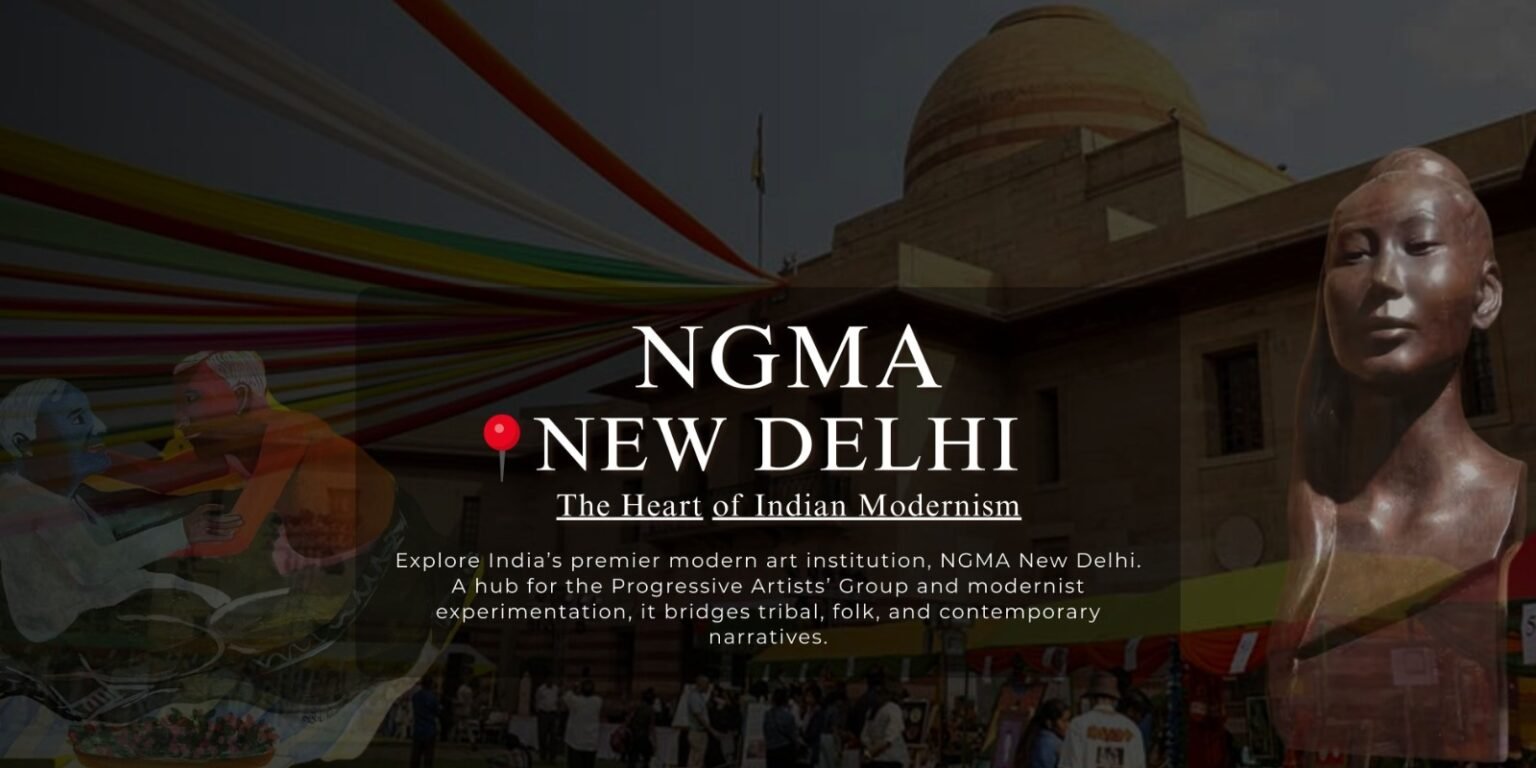

At the intersection of India’s artistic traditions and global modernist currents stands the National Gallery of Modern Art (NGMA), New Delhi, a cultural institution that has, for decades, defined, preserved, and exhibited the nation’s modernist journey. Nestled within the historic Jaipur House near India Gate, NGMA is not just a repository of paintings and sculptures; it is a living archive of India’s evolving artistic consciousness. Its galleries chart the transformation from colonial and revivalist aesthetics to the bold experimentation of the post-independence era, showcasing how Indian artists interpreted and reimagined modernity on their own terms.
A Legacy Built on Modernist Vision
Founded as the premier institution for modern and contemporary art in India, NGMA maintains a collection of over 17,000 works of art encompassing paintings, sculptures, prints, and photographs created from the mid-19th century to the present. Its mandate is not merely custodial but educational and discursive, facilitating public engagement with art while fostering research and critical thought.
In its early years, NGMA laid the foundation for modern Indian art by acquiring seminal works that exemplified the country’s artistic response to colonial encounters and the search for indigenous expression. From early contributions such as Bengal School icons to the explosive visual language of post-independence art, the collection articulates the narratives of artists who resisted colonial aesthetic norms and reoriented Indian visual culture towards autonomy and experimentation.
The Progressive Artists’ Group and Indian Modernism
Central to NGMA’s narrative of Indian modernism is its extensive representation of the Progressive Artists’ Group (PAG), a collective founded in Bombay in 1947 by artists intent on breaking away from academic realism and nationalist revivalism. The PAG embraced international modernist idioms such as cubism, expressionism, and abstraction, while remaining rooted in the cultural particularity of post-colonial India.
Among the most influential figures in this movement was Maqbool Fida Husain, widely regarded as one of India’s foremost modern painters. Husain’s Horses series, dynamic, rhythmic, and iconic—captures the spirit of energy, freedom, and national vitality. His use of bold lines and vibrant palettes pushes Indian narrative art toward a universal visual language.
F.N. Souza, another founding member, represents a different strand of modernism, one that interrogated human psychology and existential tension. His painting Birth (1955), renowned for its stark portrayal of human form and raw emotion, shattered previous auction records and reaffirmed his international stature.

Alongside these luminaries, S.H. Raza revolutionized modern Indian abstraction with his Bindu motif, a meditative point symbolizing the genesis of form and consciousness. Raza’s progression from expressive landscapes to philosophical abstraction demonstrates how modern Indian artists synthesized global influences with indigenous philosophical thought.
Masters of Form, Myth, and Meaning
The NGMA’s collection extends beyond the Progressive Group to include artists whose work shaped the broader contours of Indian modernism:
Tyeb Mehta, whose Mahishasura reinterprets mythological narrative with stark expressionist power, embodies the tensions of post-independence identity and human struggle.
Akbar Padamsee explored figurative and abstract realms with works like Mother and Child, where the interplay of form and colour evokes emotional depth and universal human experience.
G.R. Santosh’s Devi series delves into sacred iconography with modernist sensibilities, blending mythic resonance with formal innovation.
K.G. Subramanyan drew on folk traditions and indigenous visual idioms, bridging the vernacular and the avant-garde through works that celebrate everyday life and cultural memory.
Ram Kumar carved a niche with his contemplative urban landscapes—subtle, lyrical, and evocative of the existential rhythms of city life.
A.A. Almelkar engaged deeply with tribal and folk studies, foregrounding indigenous motifs and cultural forms that challenge hierarchical modernist narratives.
Bhupen Khakhar’s Two Men exemplifies a personal, narrative style that foregrounds identity and social discourse, extending modernism into intimate realms of human experience.
Bridging Traditions: Folk, Tribal, and Modern Discourses
NGMA’s strength lies not only in modernist experimentation but in its capacity to contextualize modernism within India’s diverse artistic traditions. By exhibiting works influenced by folk, tribal, and classical forms alongside avant-garde creations, the gallery situates Indian modernism within a larger cultural continuum. This curatorial approach underscores the hybridity of Indian artistic practice, where local narratives and global vocabularies converge in dynamic interplay.
Moreover, NGMA’s engagement with art beyond painting, encompassing sculpture, printmaking, photography, and installations, reflects the multiplicity of artistic expression that characterizes modern and contemporary Indian art. These varied media expand interpretive possibilities and invite scholars, practitioners, and audiences to interrogate art beyond traditional disciplinary boundaries.
A Platform for Dialogue and Discovery
Beyond its permanent collection, NGMA remains a vibrant forum for cultural exchange and intellectual discourse. Its programming spans curatorial exhibitions, lectures, seminars, and publications that deepen public understanding of art history and its contemporary relevance. Through these initiatives, the gallery fosters not just appreciation but active engagement with evolving artistic languages.
In recent years, NGMA has also hosted international collaborations, such as cross-cultural exhibitions that resonate with broader dialogues in global art history. These efforts amplify India’s artistic narratives within world contexts, underscoring the gallery’s role as a conduit for intercultural understanding and aesthetic exchange.
A Living Narrative of Indian Modernism
In its expansive galleries and storied halls, NGMA New Delhi offers more than a historical record, it presents a living narrative of Indian modernism. The institution’s collection, deeply rooted in the nation’s cultural psyche, captures the myriad ways artists grappled with identity, form, and meaning in a rapidly changing world. From the radical vision of the Progressive Artists’ Group to the nuanced explorations of form, myth, and tradition, NGMA stands as a testament to India’s rich modernist heritage and its ongoing evolution.
For collectors, scholars, and connoisseurs alike, NGMA remains an indispensable site of discovery, where modernism is not merely preserved but continuously reinterpreted.