






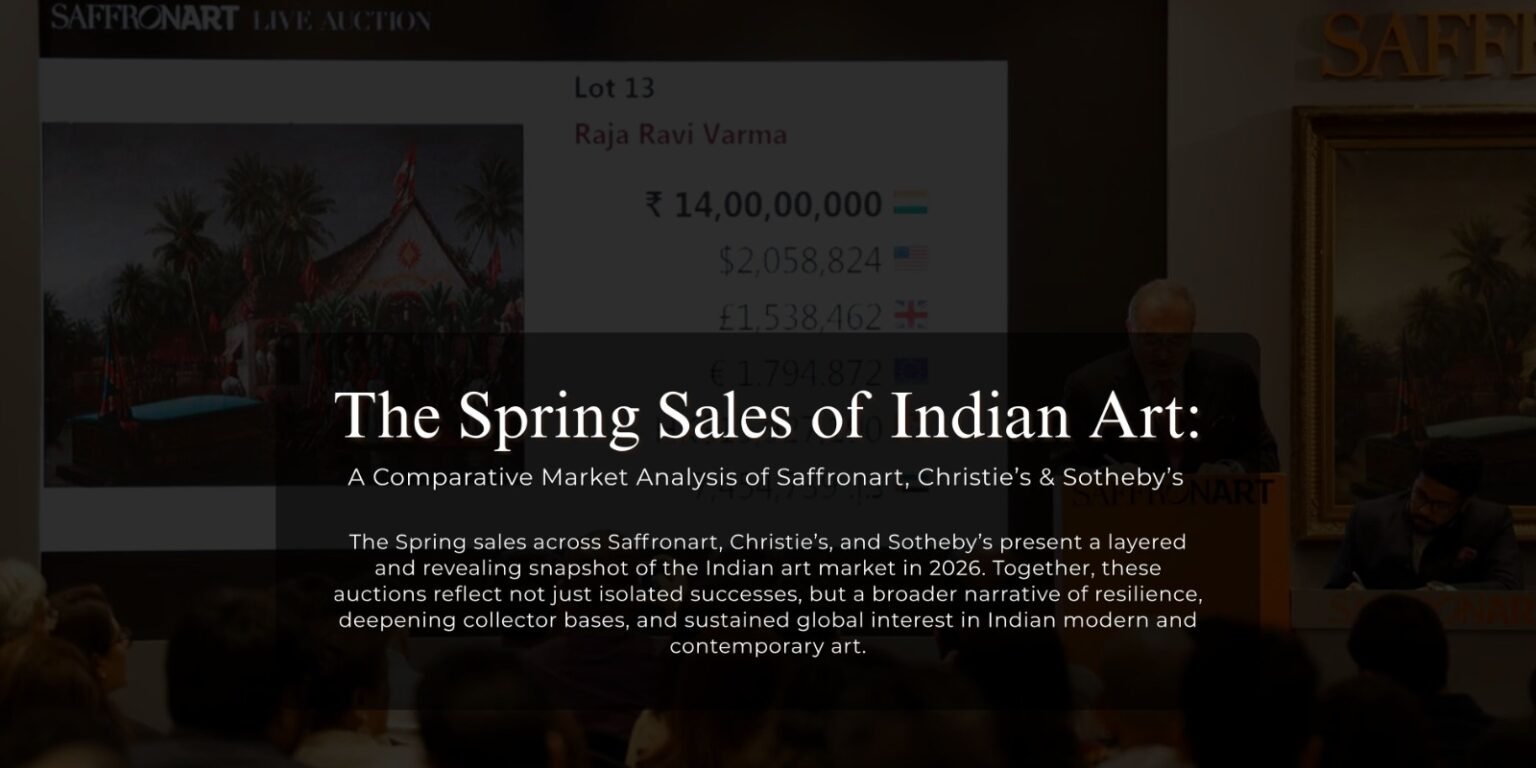

The Spring sales across Saffronart, Christie’s, and Sotheby’s present a layered and revealing snapshot of the Indian art market in 2026. Together, these auctions reflect not just isolated successes, but a broader narrative of resilience, deepening collector bases, and sustained global interest in Indian modern and contemporary art.
Across all three platforms, one theme remains consistent: strong demand for blue-chip masters continues to anchor the market, while secondary and previously under-recognised artists are witnessing increasing attention. This dual movement signals both maturity and expansion within the ecosystem.
At Saffronart, the Spring sale was defined by headline-grabbing results led by Raja Ravi Varma, whose record-breaking ₹167.2 crore sale reaffirmed the enduring significance of museum-grade historical works. His market strength underscores how provenance, rarity, and historical importance continue to command premium valuations. Alongside him, stalwarts such as M. F. Husain, S. H. Raza, and V. S. Gaitonde maintained their positions as core market drivers, with multiple works achieving strong realisations. These results highlight the continued liquidity and trust associated with established names.
Beyond the top tier, Saffronart also demonstrated increasing depth. Artists such as Jagdish Swaminathan and Manjit Bawa recorded notable percentage jumps over estimates, suggesting widening collector participation beyond marquee names. Furthermore, the growing visibility of artists like Jangarh Singh Shyam and Ganesh Haloi reflects a meaningful shift toward tribal, folk, and non-mainstream modernisms. This indicates that collectors are increasingly willing to explore diverse narratives within Indian art history, broadening the scope of demand.
At Christie’s, the results revealed a more selective but equally telling market dynamic. Ganesh Pyne emerged as a standout, pointing to renewed interest in psychologically nuanced, narrative-driven modernism. His performance suggests that collectors are valuing depth, mood, and introspection, especially in works that carry strong thematic coherence. Meanwhile, Ram Kumar achieved new benchmarks, reinforcing his growing stature in the contemporary modern segment, while Jehangir Sabavala continued to demonstrate steady upward momentum.
However, Christie’s also highlighted the impact of supply constraints. Artists such as S. H. Raza and M. F. Husain experienced moderated growth, not necessarily due to demand weakness but because of limited availability of high-quality works. This reinforces an important market principle: liquidity and supply play a critical role in price realization. At the same time, artists like F. N. Souza maintained stability, while others such as Sohan Qadri and Avinash Chandra showed strong upward movement, indicating selective rediscovery and revaluation.
Conversely, softer results for artists like Anjolie Ela Menon and weaker demand for Ambadas Khobragade suggest that the market is becoming more discerning. Collectors appear to be filtering works more critically, prioritizing distinctiveness, provenance, and relevance over general recognition.
At Sotheby’s, the Spring sale reinforced global demand for Indian masters, with M. F. Husain leading the segment with a $5.1 million result. This performance underscores Husain’s continued international appeal and his position as a cornerstone of the Indian modern art market. Interestingly, Sotheby’s also highlighted the strength of smaller-format works, where artists like Bimal Dasgupta and Paramjit Singh achieved disproportionately strong results relative to size, indicating that collectors are increasingly evaluating works on conceptual and compositional merit rather than scale alone.

Further, artists such as K. C. S. Paniker, G. R. Santosh, and Vivan Sundaram recorded strong performances, reflecting growing institutional and scholarly interest. Alongside them, consistent demand for Bhupen Khakhar and Shanti Dave points to a market that continues to value narrative-driven and historically significant practices beyond the most visible names.
Overall, the Spring auctions collectively illustrate a market that is both consolidating and expanding. While blue-chip artists continue to dominate and provide stability, there is a clear and growing appetite for diversity, experimentation, and rediscovery. The interplay between global platforms, evolving collector preferences, and limited supply of quality works is shaping a more nuanced and layered ecosystem. Far from being speculative, the Indian art market today reflects depth, resilience, and a sustained trajectory of growth anchored in both legacy and emerging narratives.