





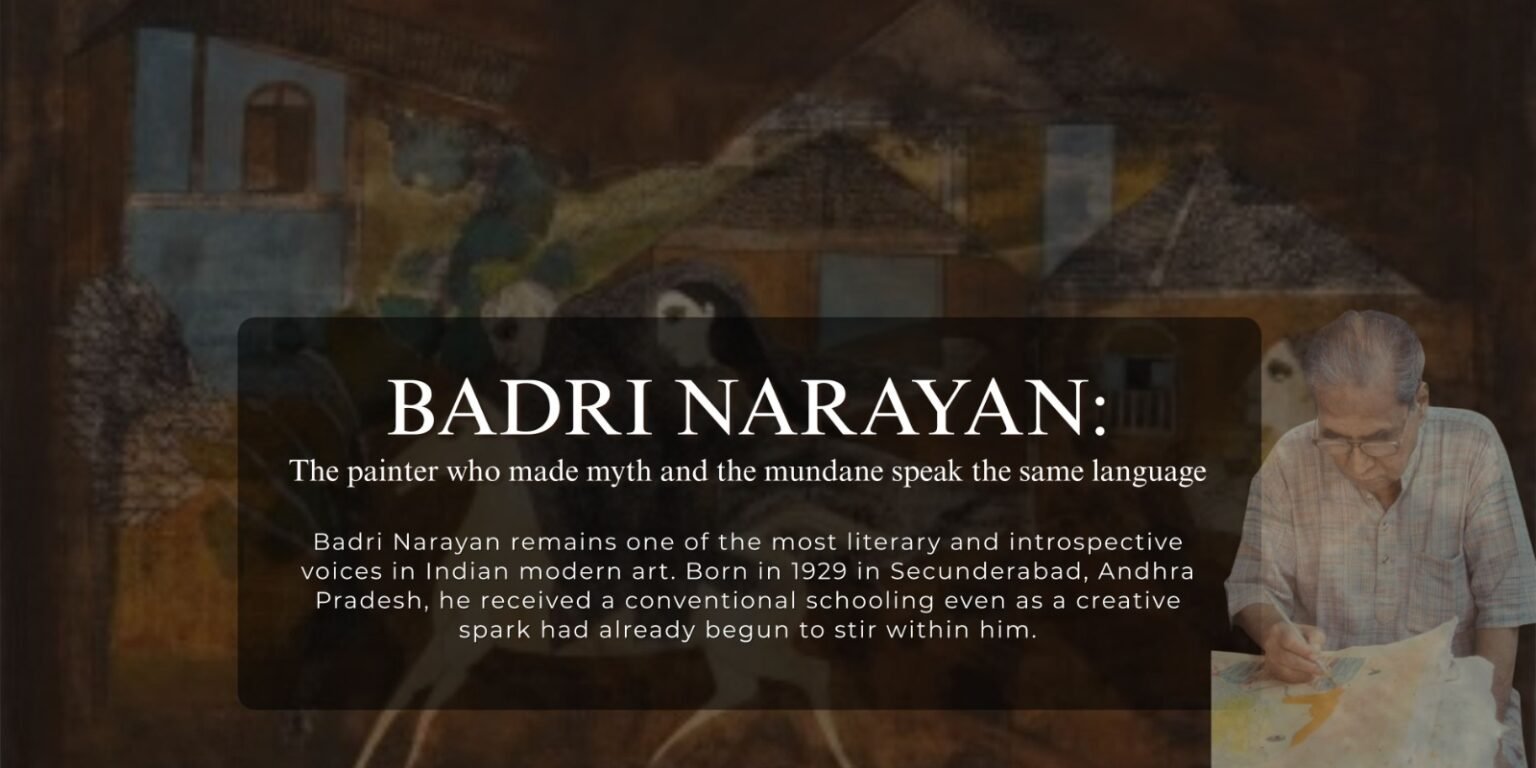

Badri Narayan remains one of the most literary and introspective voices in Indian modern art. Born in 1929 in Secunderabad, Andhra Pradesh, he received a conventional schooling even as a creative spark had already begun to stir within him. Entirely self-taught, he began drawing and painting in oils without formal training, drawing early inspiration from temple murals and folk art, which he attempted to recreate on canvas. Stories from the Puranas and epics, heard from elders in childhood, offered a further source of inspiration.
Coming from modest circumstances, Narayan turned to freelance journalism before he was twenty, around the same time he won a prize for the very first painting he submitted to an exhibition, a moment that helped him settle on his path: he would paint and write. He began as a storyteller for children, often illustrating his own tales, and a self-cultivated intellectual foundation, paired with dedicated effort, gradually earned him wider recognition. Having refined his style and consolidated his technique, he went on to explore woodcuts, linocuts, and ink-resist drawings, a method that became distinctly his own.
Narayan’s work is striking for its range. He painted Hindu gods and biblical scenes alike with stark, stone-cut compositions that feel almost apocalyptic, yet softened by the delicacy of miniature painting traditions, which kept even his most symbolic work approachable. Ganesha and other popular icons recur throughout his oeuvre, carrying an autobiographical undertone and rendered with quiet simplicity. At his most sombre, he painted figures lying in bed, ill or near death, held in a dreamlike stillness that feels contemplative rather than mournful. Loyal to two-dimensionality and small formats, his paintings reveal their intricacies slowly, with figures like Ganesha serving as vessels of layered meaning, as seen in Queen Khemsa’s Dream of Hamsa.
His world brims with everyday life, chirping birds, bristling cats, scampering dogs, and wide-eyed fish, alongside temples, courtesans, mendicants, and fruit sellers going about their day, their houses revealing quiet, intimate moments within. Alongside this sits another realm entirely, populated by gods, goddesses, and mythological figures drawn from palm leaf manuscripts and oral tradition: Parvati and her sons, Krishna, sages, kinnaras, the Buddha, and heroes from Sanskrit classics. His work feels like a journey through India’s cultural past. While contemporaries turned toward Abstract Expressionism and Pop Art, Narayan remained devoted to figurative, national art, believing Indian tradition alive and valid for anyone able to make it their own.
Narayan first exhibited publicly in 1949 and held his first solo show five years later, in 1954. Over the course of his career, his work travelled to more than fifty solo exhibitions and countless group shows across India’s major cities and abroad, including appearances at the Paris and Tokyo Biennales.
Badri Narayan’s paintings have repeatedly sold well above estimate at auction. At Christie’s London’s Sublime Shadows: South Asian Art from a Distinguished Collection sale (June 11, 2026), his signed Still Life (30 1⁄8 x 40 1⁄8 in.), estimated at GBP 12,000–18,000, realised GBP 152,400 (USD 203,227), over 8x its high estimate. In the same sale, his signed Untitled (47 7⁄8 x 47 7⁄8 in.), carrying the same GBP 12,000–18,000 estimate, sold for GBP 114,300 (USD 152,421).
Earlier, at AstaGuru’s Modern Indian Art sale (September 8–9, 2021), a signed Untitled (59 x 59 in., ca. 1960), estimated at INR 2,500,000–3,000,000, fetched INR 10,738,094 (USD 145,453), over 3.5x its high estimate. Across all three sales, his works consistently outperformed pre-sale expectations, reflecting strong and sustained market demand.

Narayan’s contributions to the arts earned him India’s Padma Shri in 1987, the Maharashtra Gaurav Puraskar in 1990–91, and a Senior Fellowship for Outstanding Artists in 1984–86, among other honours. His works reside in the collections of New Delhi’s National Gallery of Modern Art and National Museum.
Narayan passed away in 2013, but his canvases continue to reward close attention, revealing an artist who was as much a thinker and observer as he was a painter.