





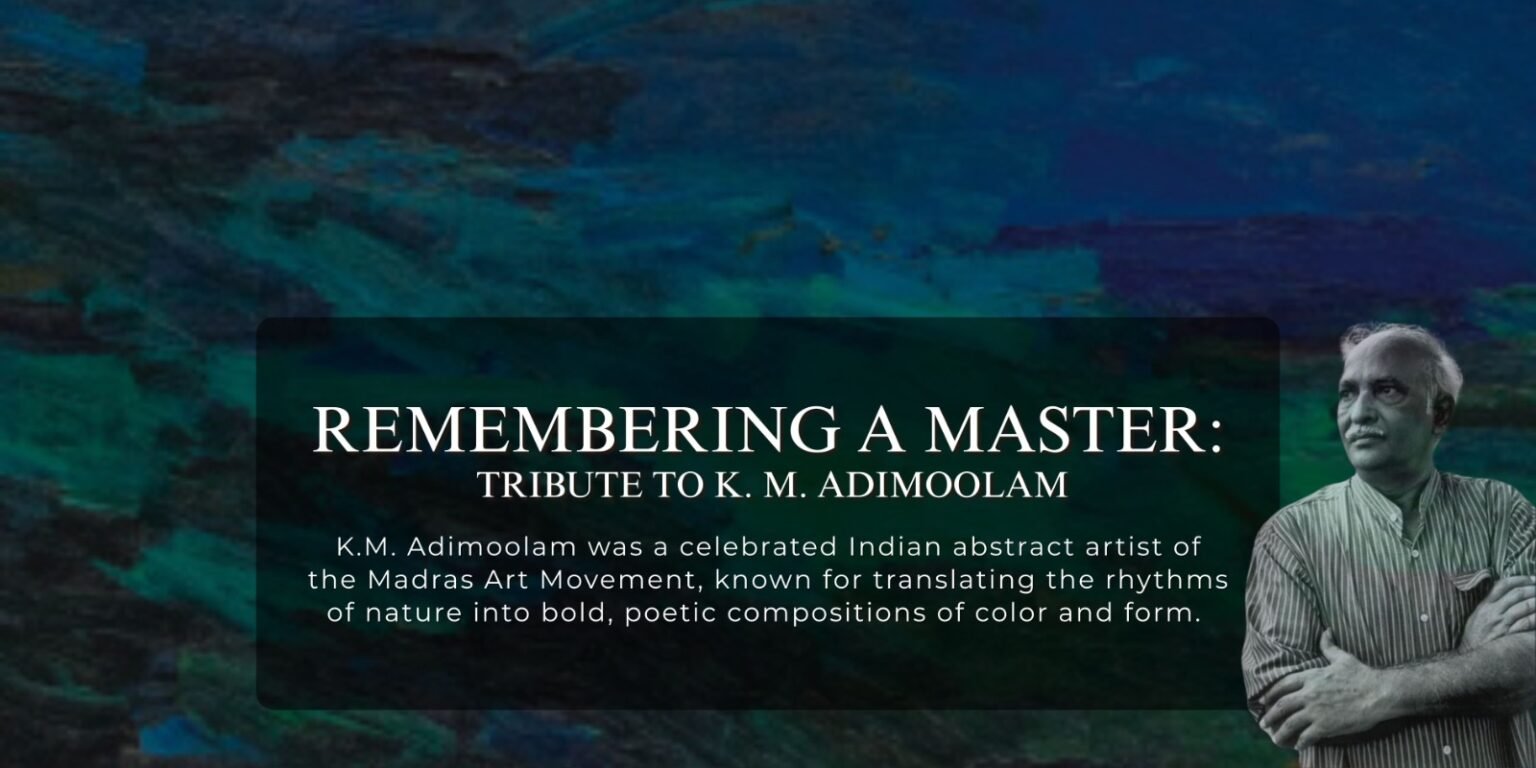

K.M. Adimoolam was a celebrated Indian abstract artist of the Madras Art Movement, known for translating the rhythms of nature into bold, poetic compositions of color and form. Born in 1938 Tiruchirapalli, Tamil Nadu, he moved to Chennai in 1959 to pursue formal training in art, enrolling at the Government School of Arts and Crafts, an institution that served as a formative ground for many artists associated with the Madras Art Movement.
His development as an artist was shaped in dialogue with influential figures, including the sculptor Dhanapal, and within a broader circle of artists engaged in defining a modern Indian visual language distinct from prevailing Western traditions.
Among the most significant works in Adimoolam’s early career is his series, “100 Drawings on Mahatma Gandhi.” The series demonstrates not only his technical command of the pen-and-ink medium, but a deeper interpretive ambition. Rather than pursuing likeness alone, Adimoolam used the nearly one hundred works to trace the interior dimensions of Gandhi’s life, his introspection and moral character, establishing the series as a study of humanity rather than a conventional portrait cycle.
A defining characteristic of Adimoolam’s abstraction is its independence from European and American modernist traditions. As a participant in the Madras Art Movement, alongside artists such as K. C. S. Paniker, Adimoolam contributed to a collective effort to establish a distinctly Indian modernist idiom, one informed by indigenous tradition, mythology, and sensibility rather than imported form.
This synthesis is evident throughout his body of work: even in his most abstract compositions, a cultural specificity remains present beneath the surface of colour, situating his practice within a broader dialogue between tradition and modernity, the spiritual and the philosophical, the literary and the visual.
K.M. Adimoolam’s three most recent auction outings show a striking pattern of realised prices far outpacing pre-sale estimates. At Giftex’s Modern & Contemporary Art Auction (26-27 June 2026), an untitled 2006 oil on canvas estimated at just 1,50,000-2,00,000 INR sold for 11,11,005 INR, exceeding the high estimate by roughly 455%. Just weeks earlier, at Saffronart Mumbai’s Summer Online Auction (15-16 June 2026), two untitled works carrying identical estimates of 4,00,000-6,00,000 INR fetched 24,00,000 INR and 15,60,000 INR respectively, translating to premiums of about 300% and 160% over their high estimates. Across all three sales, hammer prices cleared the top of the estimate range by substantial margins, suggesting strong and sustained collector demand for Adimoolam’s work that auction houses have yet to fully price into their estimates, a pattern that, if it continues, could see future estimates revised upward to reflect actual market appetite better.
Among K. M. Adimoolam’s top-selling artworks at auction, the highest price was achieved by “Untitled (Diptych),” a 2005 oil on canvas measuring 63.5 x 59.5 inches, which was estimated at 6,00,000 to 8,00,000 INR (7,117 to 9,489 USD) but ultimately sold for 27,59,406 INR (32,731 USD) at AstaGuru Auction House’s Iconic Masters sale, held from November 7 to 9, 2024. Close behind was “Blues & Greens Of Andaman,” a 1989 oil on canvas measuring 34 x 44 inches, estimated at 4,00,000 to 6,00,000 INR (4,781 to 7,172 USD), which realised 24,64,477 INR (29,459 USD) at AstaGuru’s Stroke & Structure auction, held on June 20 and 21, 2024. The third top-performing work, “Mystical Land,” a 1987 oil on canvas measuring 36.0 x 44.1 inches, carried a modest estimate of 1,00,000 to 2,00,000 INR (1,201 to 2,401 USD) but far exceeded expectations, fetching 24,45,354 INR (29,363 USD) at AstaGuru’s Iconic Masters sale held from October 27 to 28, 2023. Notably, all three works were sold through AstaGuru Auction House and achieved final prices many times higher than their initial estimates, reflecting strong collector demand for Adimoolam’s paintings.
Adimoolam passed away in 2008, yet his work continues to generate scholarly and curatorial interest. Each engagement with his paintings, whether by a visitor encountering them for the first time or a researcher studying the Madras Art Movement, extends a body of work that remains vital to the history and future of Indian modernism.



A significant retrospective, “K M Adimoolam: A Retrospective,” was held at Jehangir Art Gallery, Mumbai, in 2010, two years after his death, which is a strong indicator that institutions and the market continued to actively engage with his legacy rather than letting it fade. He’s still actively represented and sold today. Galleries like Art Motif (New Delhi), South Asian Art Gallery, Bengaluru Art House, Gallery Dotwalk, and Gallery Silver Scapes currently list his work, and he continues to feature in gallery shows; for instance, one listing shows works in a Mar-Apr 2026 presentation at Gallery Art Motif.
K.M. Adimoolam’s recent auction results reveal a market that has yet to align with his institutional standing. Realised prices have consistently and significantly exceeded pre-sale estimates, reflecting demand that current valuations have not fully captured.
The conservative estimates set by auction houses likely stem from limited trading volume and cautious pricing methodology, rather than any decline in critical or historical standing. Adimoolam’s institutional credentials remain well established, affirming his place within the canon of Indian modernism.
His market trajectory suggests continued strength. Sustained gallery representation, active secondary-market participation, and no evidence of institutional neglect together point to an ongoing price correction, with valuations gradually converging toward his established reputation.
His legacy remains well preserved: his work resides in major museum collections, has been examined in published scholarship, and was the subject of a significant retrospective as recently as 2010. These factors reflect a legacy that continues to receive active engagement from institutions, galleries, and collectors, positioning the current gap between estimate and realized price as an emerging market opportunity rather than a sign of declining relevance.