




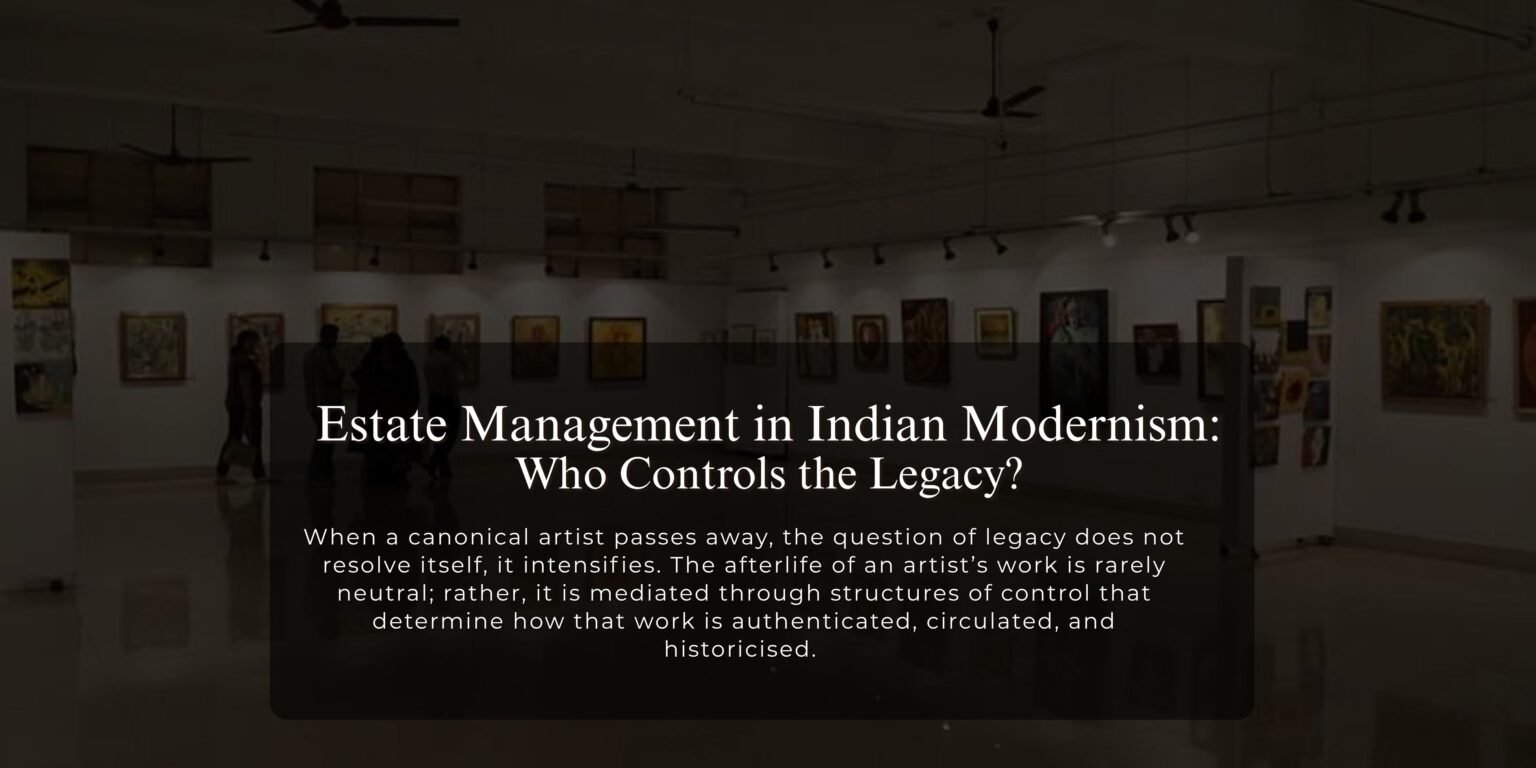

When a canonical artist passes away, the question of legacy does not resolve itself, it intensifies. The afterlife of an artist’s work is rarely neutral; rather, it is mediated through structures of control that determine how that work is authenticated, circulated, and historicised. In the context of Indian modernism, estate management has emerged as a decisive, if under-examined, force in shaping both market value and art historical memory. The question is not merely who inherits the works, but who assumes authority over meaning itself.
An artist’s estate, in its most comprehensive sense, extends far beyond material inheritance. It encompasses intellectual property rights, archival materials, catalogues raisonnés, authentication protocols, and exhibition permissions. These mechanisms collectively determine the conditions under which an artist’s work is encountered, whether in the marketplace, the museum, or the scholarly domain. In a rapidly expanding Indian art market, where questions of provenance and authenticity remain critical, the role of estates has become particularly consequential.
The case of M. F. Husain is instructive. Following his death in 2011, the management of his vast and geographically dispersed body of work became a complex undertaking involving family members, legal representatives, and institutional collaborators. Given Husain’s prolific output and international presence, issues of authentication and copyright have remained central to his posthumous market. The absence of a singular, universally recognised catalogue raisonné has, at times, led to ambiguity, highlighting the extent to which estate structures can either stabilise or complicate an artist’s legacy.
A different but equally revealing model can be observed in the legacy of Bimal Das Gupta. Here, family-led initiatives have taken on the responsibility of cataloguing works, preserving archives, and facilitating exhibitions. Such efforts, while invaluable, also underscore the intimate relationship between familial stewardship and historical framing. Decisions regarding which works are foregrounded, how periods are defined, and which narratives are emphasised inevitably shape the scholarly reception of the artist. The estate, in this sense, becomes both custodian and interpreter.
Similarly, the oeuvre of A. A. Almelkar has been sustained through mechanisms of estate oversight that seek to preserve stylistic integrity and regulate market circulation. Almelkar’s distinctive engagement with indigenous and folk idioms presents particular challenges in authentication, especially in a market susceptible to stylistic imitation. Here, the estate’s authority functions as a gatekeeping mechanism, determining which works are admitted into the canon and which are excluded.
Why does this concentration of authority matter? The answer lies in the interdependence of authentication and value. In the absence of credible verification, a work’s market viability can diminish significantly, regardless of its aesthetic merit. Auction houses, galleries, and collectors rely heavily on estate-issued certificates or recognised expert opinions to establish legitimacy. Consequently, the entity that controls authentication exerts considerable influence over both financial valuation and historical inclusion. For art advisory practices, this dynamic necessitates a rigorous engagement with estate protocols as part of due diligence.
Yet the implications extend beyond the market. Estates play a pivotal role in shaping art historical narratives by controlling access to archives and determining the terms of scholarly engagement. Researchers depend on estate cooperation to access letters, sketches, and unpublished materials that illuminate an artist’s process and context. Restrictions, whether motivated by preservation concerns or reputational considerations, can significantly influence the scope and direction of academic inquiry. In this regard, estates do not merely preserve history; they actively construct it.

Museums and public institutions occupy an intermediate position within this ecosystem. While they are often perceived as neutral arbiters of cultural value, their programming is frequently contingent upon estate collaboration. Retrospectives, loans, and publications require permissions that estates are empowered to grant or withhold. This interdependence raises important questions about curatorial autonomy and institutional responsibility. To what extent can museums critically engage with an artist’s work if access is mediated by vested interests? Conversely, how might estates balance the imperative of preservation with the need for open scholarly discourse?
The Indian context presents additional complexities. Unlike some Western counterparts, where estate management has been institutionalised through well-funded foundations and clearly defined legal frameworks, Indian artist estates often operate within less formalised structures. Family members, sometimes without professional training in archival practices or market regulation, assume significant responsibilities. While this can allow for deeply informed and committed stewardship, it can also result in inconsistencies in documentation, authentication, and public engagement. The gradual emergence of artist foundations and professional estate managers in India signals a shift towards more structured approaches, yet the field remains uneven.
For collectors and advisors, these conditions underscore the importance of provenance research and institutional alignment. Works supported by well-documented estate records and recognised authentication processes tend to command greater confidence in both primary and secondary markets. Conversely, gaps in documentation can introduce risk, even when the work itself is of high quality. Estate management, therefore, is not a peripheral concern but a central determinant of value and credibility.
At a broader level, the question of legacy invites reflection on authorship itself. Once an artist is no longer present to articulate their intentions, others inevitably assume that role. Estates, markets, and institutions each contribute to this process, sometimes in collaboration, sometimes in tension. The narrative that emerges is rarely singular; it is the product of negotiation, interpretation, and, at times, contestation.
In Indian modernism, where the canon is still being actively constructed, these dynamics acquire particular urgency. The stories that are told, or omitted, will shape not only market trajectories but also the intellectual foundations of the field. Estate management, in this sense, is not merely administrative; it is historiographical.
Thus, the question persists with renewed significance: who controls legacy? The answer, it seems, is neither singular nor stable. It resides at the intersection of familial stewardship, market validation, and institutional authority. For those engaged in art advisory, consultancy, and representation, recognising this interplay is essential. Legacy is not an afterthought; it is an ongoing process, one that demands both critical attention and ethical responsibility.