





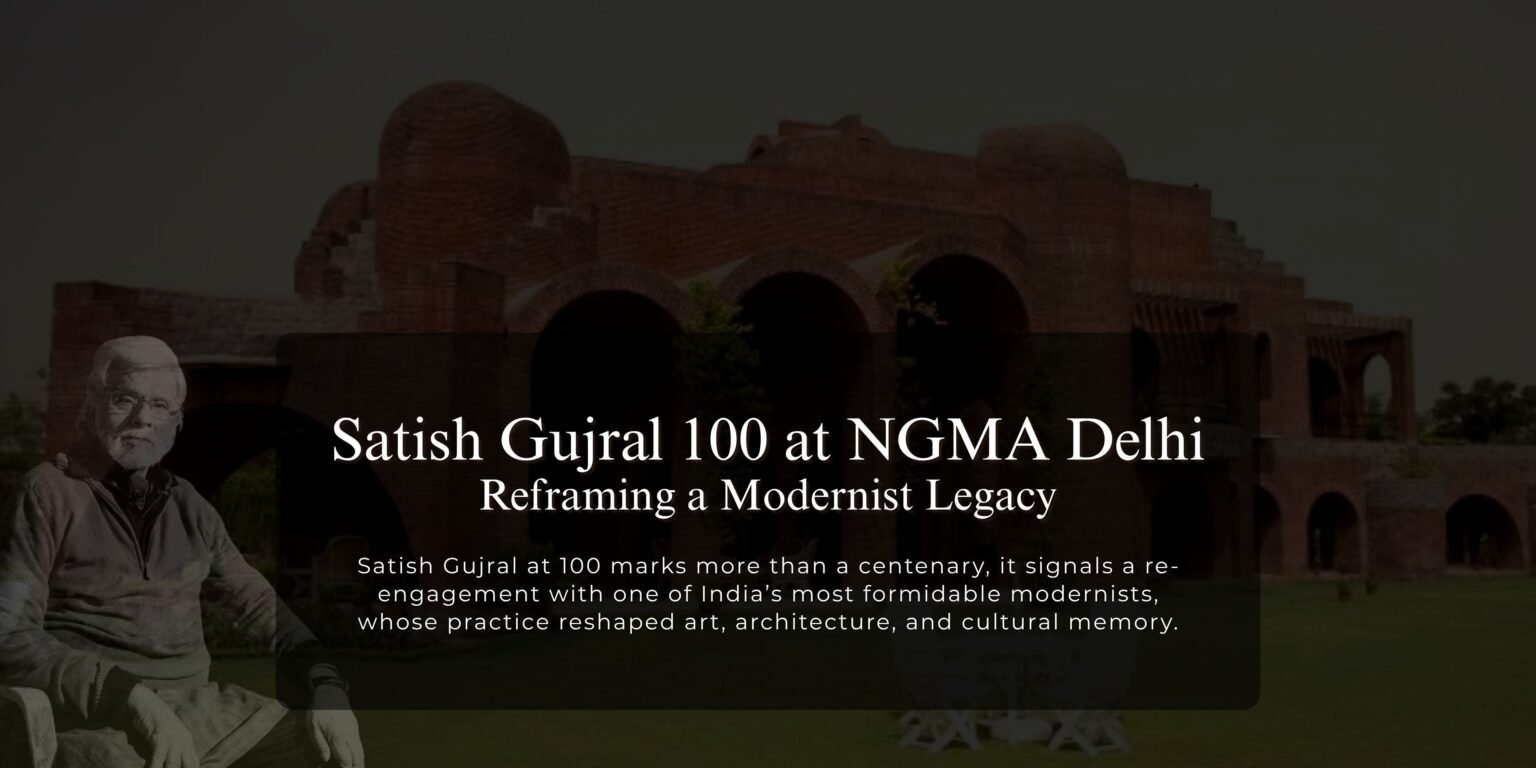

Centenary exhibitions are rarely neutral commemorations; they are acts of historical recalibration. Satish Gujral 100: A Centenary Exhibition, currently on view at the National Gallery of Modern Art, is emblematic of this function. Conceived not merely as a tribute but as a museum-scale reassessment, the exhibition repositions Satish Gujral within the broader arc of Indian modernism, foregrounding the complexity, plurality, and enduring relevance of his seven-decade-long practice.
Organised in collaboration with The Gujral Foundation, the exhibition brings together over 150–165 works spanning painting, sculpture, murals, drawings, and mixed media. This breadth is not incidental; it reflects Gujral’s refusal to be confined within a single disciplinary framework. Painter, sculptor, architect, and thinker, Gujral occupies a singular position in Indian art history, one that resists categorisation even as it invites sustained scholarly engagement.
Curated by art critic Kishore Singh, the exhibition unfolds as a carefully structured narrative rather than a chronological display. It traces the evolution of Gujral’s artistic language through key historical and personal moments, beginning with early figurative works and extending to later experiments in material and form. The curatorial approach privileges depth over spectacle, allowing the viewer to encounter not only the finished work but the processes and experiences that shaped it.
Central to this narrative is the profound impact of Partition on Gujral’s artistic consciousness. Born in undivided Punjab in 1925, Gujral witnessed the violence and displacement of 1947 firsthand, an experience that would leave an indelible mark on his visual vocabulary. His early paintings, often characterised by anguished figures and fractured compositions, function as both personal testimony and collective memory. Within the exhibition, these works are not isolated artefacts but part of a broader inquiry into nationhood, trauma, and reconstruction.
Equally significant is the role of silence in Gujral’s practice. A childhood accident left him deaf, fundamentally altering his sensory engagement with the world. The exhibition foregrounds this aspect through immersive installations and contextual materials, suggesting that Gujral’s visual intensity emerged, in part, from a heightened reliance on observation and inner reflection. In this sense, his work can be read as a translation of silence into form, a sustained negotiation between absence and expression.
What distinguishes Satish Gujral 100 from conventional retrospectives is its emphasis on material experimentation. Gujral’s practice traversed an extraordinary range of mediums, from oil painting and bronze sculpture to ceramics, glass, and architectural design. The exhibition highlights this multiplicity, presenting works that challenge the boundaries between fine art and applied practice. Such an approach is particularly relevant in contemporary discourse, where interdisciplinary practices increasingly define artistic innovation.
The spatial design of the exhibition further reinforces this thematic complexity. Spread across multiple levels of the NGMA, the display is organised into thematic zones that correspond to different phases of Gujral’s career.Rather than adhering to a linear progression, the exhibition encourages a recursive viewing experience, one in which earlier and later works resonate across time. This curatorial strategy not only reflects the non-linear nature of artistic development but also invites viewers to reconsider established periodisations within Indian modernism.
From an art advisory perspective, the exhibition assumes particular significance. It operates as a canon-forming intervention, reaffirming Gujral’s position within the upper echelons of Indian modern art while also expanding the parameters through which his work is evaluated. By foregrounding lesser-known works alongside canonical pieces, the exhibition challenges market-driven hierarchies that often privilege a narrow segment of an artist’s oeuvre. In doing so, it opens new avenues for scholarship, collection, and institutional acquisition.
Moreover, the collaboration between a public institution and a private foundation underscores the evolving dynamics of legacy management in India. The Gujral Foundation’s involvement reflects a growing trend in which artist estates and foundations play an active role in shaping posthumous narratives. This partnership enables access to archives, facilitates research, and ensures the preservation of works that might otherwise remain dispersed or inaccessible. At the same time, it raises important questions about authorship and authority: who determines the narrative of an artist’s life, and to what extent is that narrative open to reinterpretation?
The exhibition’s temporal framing, from January to April 2026, coincides with a broader series of centenary events across India, positioning Gujral not merely as a historical figure but as a contemporary point of reference. This simultaneity of past and present is perhaps the exhibition’s most compelling aspect. It resists the closure often associated with retrospectives, instead presenting Gujral’s work as an ongoing dialogue, one that continues to inform current artistic and curatorial practices.
Ultimately, Satish Gujral 100 is less about commemoration than about re-engagement. It invites viewers, whether scholars, collectors, or practitioners, to reconsider the frameworks through which Indian modernism is understood. In an art ecosystem increasingly shaped by market imperatives, such exhibitions perform a vital corrective function. They remind us that legacy is not a static inheritance but a dynamic construct, continually reshaped through acts of viewing, interpretation, and discourse.
For those engaged in art advisory, consultancy, and institutional programming, the exhibition offers both a resource and a provocation. It underscores the importance of archival depth, curatorial rigour, and interdisciplinary thinking in shaping artistic value. More importantly, it reaffirms the necessity of returning to the work itself, its materiality, its context, its unresolved questions, as the ultimate site of meaning.