





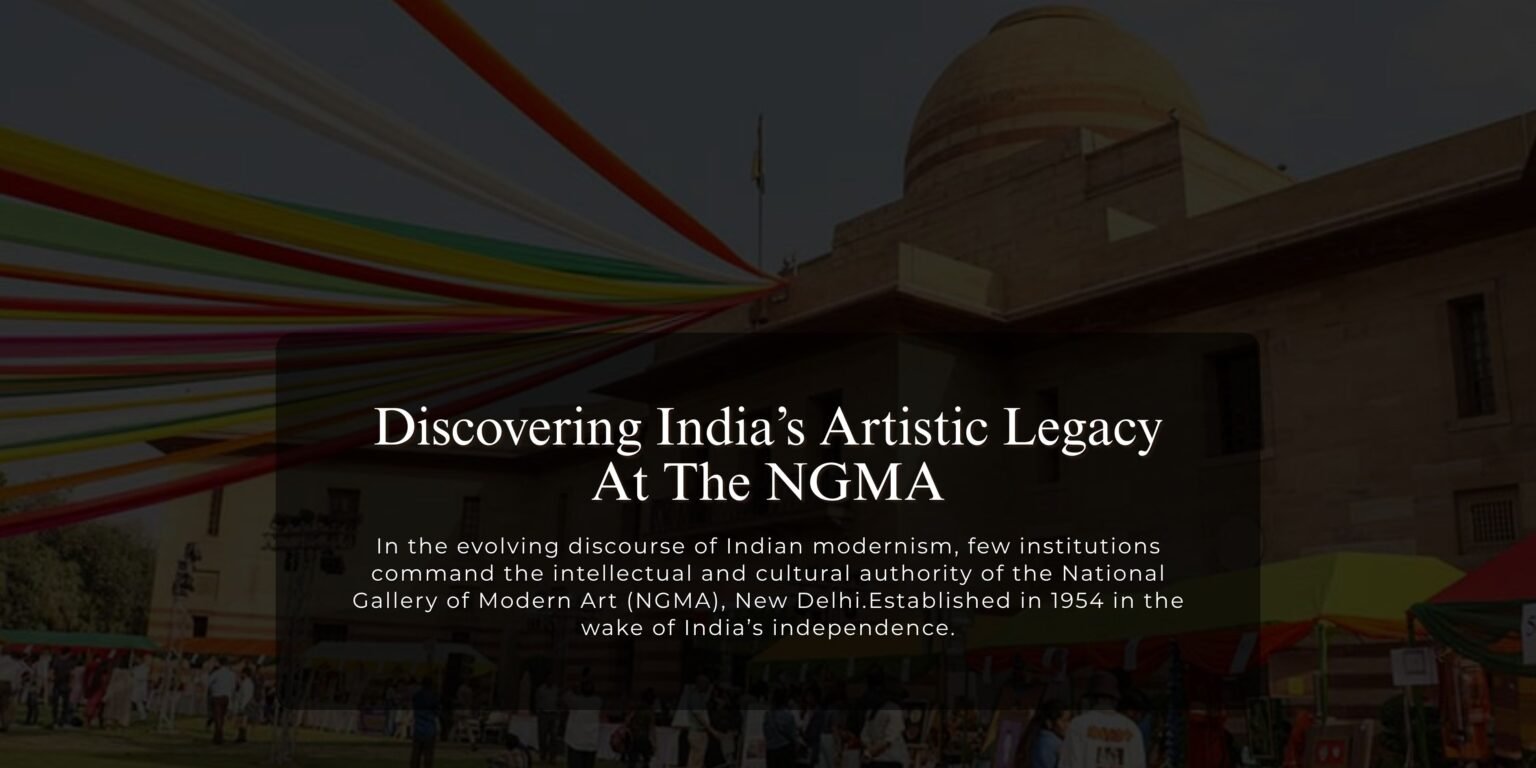

In the evolving discourse of Indian modernism, few institutions command the intellectual and cultural authority of the National Gallery of Modern Art (NGMA), New Delhi. Established in 1954 in the wake of India’s independence, the NGMA was envisioned not merely as a repository of art, but as a nation-building project, one that would articulate a visual language commensurate with the aspirations of a newly sovereign republic. Housed in the erstwhile Jaipur House near India Gate, the gallery embodies a compelling synthesis of imperial architecture and postcolonial cultural re-inscription, making it an apt site for examining India’s artistic trajectory.
To encounter the NGMA is to traverse a meticulously curated narrative of Indian art spanning over one and a half centuries, from the mid-nineteenth century to the contemporary moment. Its expansive collection, comprising more than 17,000 works, maps the transition from colonial academic realism to indigenous modernisms, and ultimately to global contemporary practices. This chronological and stylistic breadth renders the NGMA indispensable not only as a museum but as a pedagogical archive for scholars, curators, and cultural practitioners alike.
At the heart of the NGMA’s curatorial vision lies its commitment to canonical figures who shaped the contours of Indian modernism. The presence of artists such as Raja Ravi Varma, whose synthesis of European techniques with Indian mythological themes redefined pictorial conventions, signals the beginning of a distinctly Indian engagement with modernity. Similarly, the works of Abanindranath Tagore and the Bengal School foreground a nationalist aesthetic that sought to resist colonial visual paradigms through revivalist strategies.
The gallery’s narrative advances through the contributions of Rabindranath Tagore, Jamini Roy, and Nandalal Bose, each of whom articulated alternative modernisms rooted in indigenous traditions. This trajectory culminates in the radical experiments of artists such as Amrita Sher-Gil, whose oeuvre negotiates identity, gender, and form with a striking cosmopolitan sensibility. The inclusion of post-independence modernists, V.S. Gaitonde, Tyeb Mehta, and Ram Kumar, further demonstrates the diversification of artistic language in response to a rapidly transforming socio-political landscape.
What distinguishes the NGMA, however, is not merely the depth of its collection but the institutional ethos underpinning its programming. Conceived under the patronage of figures such as Jawaharlal Nehru and Maulana Abul Kalam Azad, the gallery was intended as a dynamic cultural space, one that would foster research, dialogue, and public engagement. Its mandate extends beyond preservation to include the organization of exhibitions, seminars, and educational initiatives, thereby situating art within a broader intellectual ecosystem.
Indeed, the NGMA’s exhibition history reflects a sustained engagement with both national and international artistic currents. From retrospectives of Indian masters to cross-cultural exhibitions featuring European modernists, the gallery has consistently positioned Indian art within a global framework. More recent exhibitions, such as centenary retrospectives and thematic showcases, underscore its role in revisiting and recontextualizing artistic legacies for contemporary audiences.
Equally significant is the gallery’s spatial and experiential design. The adaptation of Jaipur House into a modern exhibition space creates a dialogue between historical architecture and contemporary display practices. Visitors move through a sequence of galleries that encourage both chronological reading and thematic interpretation, enabling a layered understanding of artistic evolution. The integration of sculpture gardens, new media installations, and archival displays further enhances the sensory and intellectual engagement of the viewer.


From an art advisory and consultancy perspective, the NGMA serves as a critical benchmark for assessing artistic value and historical significance within the Indian context. Its collection functions as a canon-forming mechanism, influencing market trends, institutional acquisitions, and curatorial frameworks across the country. For artists, inclusion within the NGMA’s ambit often signifies a form of institutional validation, while for collectors and galleries, it provides a reference point for situating works within broader art historical narratives.
Yet, the NGMA is not without its challenges. As with many state-run cultural institutions, questions of accessibility, curatorial innovation, and audience engagement remain pertinent. While the gallery has made strides in expanding its programming and outreach, there exists an ongoing need to recalibrate its strategies in response to a rapidly digitizing and globalized art world. The integration of digital archives, interactive exhibitions, and interdisciplinary collaborations could further enhance its relevance for younger and more diverse audiences.
Nevertheless, to dismiss the NGMA on these grounds would be to overlook its enduring significance. As a custodian of India’s artistic heritage, it performs a vital function in preserving, interpreting, and disseminating the visual culture of the nation. More importantly, it offers a space for critical reflection, inviting viewers to consider how art both shapes and is shaped by historical forces.
In conclusion, discovering India’s artistic legacy at the NGMA is not a passive act of viewing but an active engagement with history, identity, and creativity. For those invested in the fields of art advisory, consultancy, and cultural production, the gallery provides not only inspiration but also a framework for understanding the complexities of Indian art. It stands as a testament to the power of institutions in shaping cultural memory and, in doing so, continues to define the contours of India’s artistic imagination.