





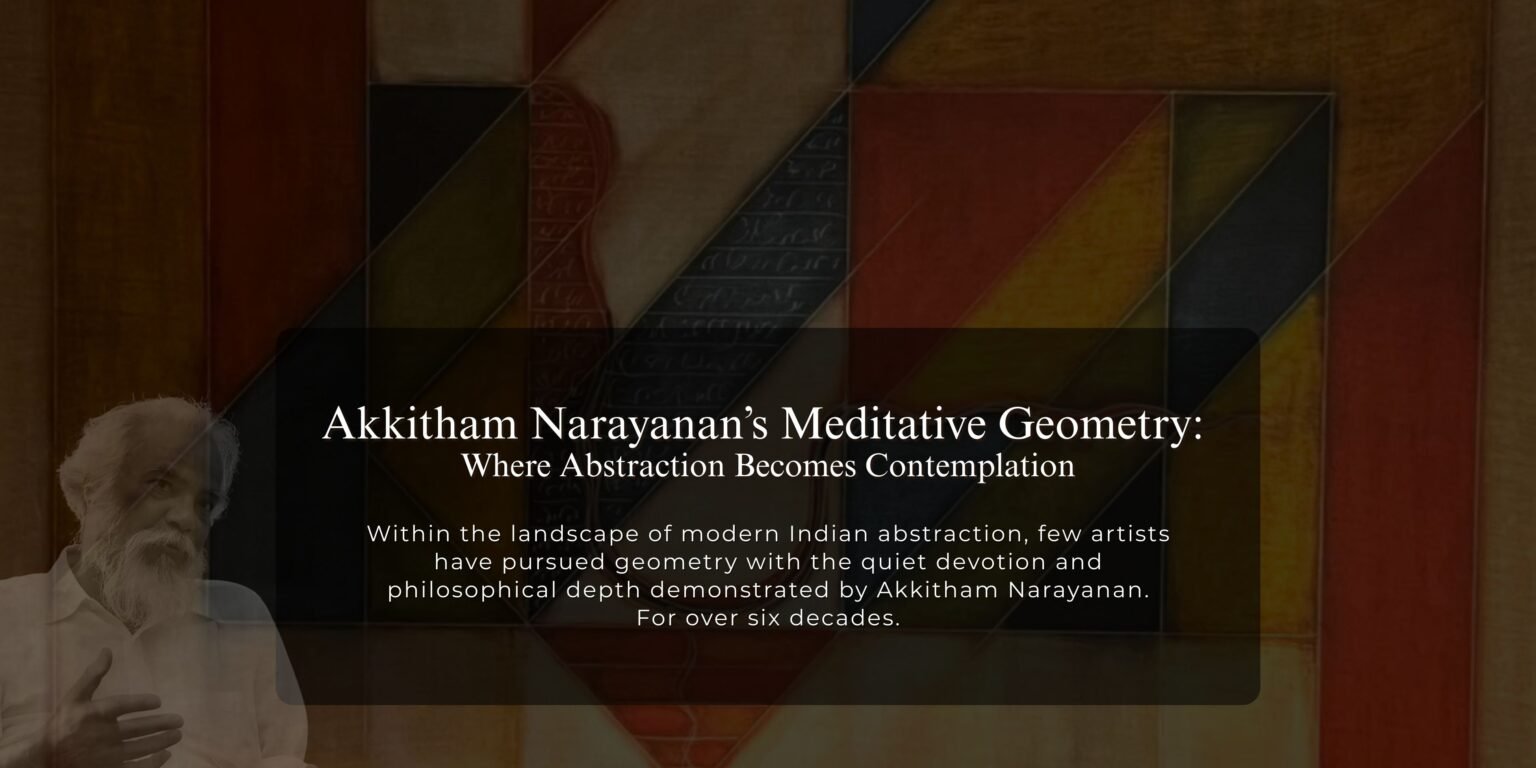

Within the landscape of modern Indian abstraction, few artists have pursued geometry with the quiet devotion and philosophical depth demonstrated by Akkitham Narayanan. For over six decades, Narayanan has explored the expressive potential of geometric form, transforming circles, triangles, and grids into visual fields of contemplation. His paintings are not merely exercises in formal abstraction; rather, they operate as meditative structures, spaces in which geometry becomes a language of inner reflection and spiritual inquiry.
For art advisory practices and galleries concerned with contextualising Indian modernism, Narayanan’s work presents a compelling case study of how abstraction can engage simultaneously with spiritual tradition, modernist aesthetics, and cross-cultural dialogue.
Origins of a Geometric Language
Born in Kerala in 1939, Narayanan’s artistic sensibility was shaped early by a cultural environment steeped in ritual, symbolism, and sacred visual traditions. His formal training at the Government College of Arts and Crafts in Madras under the influential artist and educator K. C. S. Paniker proved pivotal in shaping his philosophy of art. Paniker encouraged a generation of artists to develop a distinctly Indian modernism, one that could engage with international abstraction while remaining rooted in indigenous metaphysical traditions.
Narayanan later moved to Paris on a government scholarship and studied at the École des Beaux-Arts between 1967 and 1970. Exposure to European modernist movements, particularly geometric abstraction and constructivism, expanded his visual vocabulary while reinforcing his interest in structural order.
The result was a unique synthesis: a visual language that fused the metaphysical symbolism of Indian tantric diagrams with the disciplined formalism of European geometric abstraction.
Geometry as Spiritual Structure
At the centre of Narayanan’s practice lies the conviction that geometry is not merely a formal device but a cosmic principle embedded in nature and consciousness. His paintings frequently deploy elemental shapes, triangles, circles, squares, and rectangles, arranged in balanced configurations that evoke the structure of mandalas and yantras.
These shapes resonate with ancient symbolic systems. In tantric visual traditions, geometric diagrams often represent the underlying order of the universe. Narayanan’s compositions echo this lineage while avoiding literal representation. Instead of reproducing traditional sacred diagrams, he constructs abstract geometric environments that invite contemplative engagement.
Critics often note that his works possess a rhythmic quality akin to chanting or meditative repetition. The repetition of shapes and carefully modulated colour fields creates a visual cadence that encourages prolonged viewing, allowing the viewer to experience the painting almost as a meditative object.



In this sense, Narayanan’s geometry operates not as rigid mathematical order but as a fluid visual meditation on balance, energy, and transcendence.
Colour, Surface, and the Illusion of Light
Although geometry structures his compositions, colour plays an equally significant role in shaping the atmosphere of Narayanan’s paintings. His palette often draws inspiration from traditional Indian mural painting, deep reds, luminous yellows, and dense blacks, reinterpreted through modernist abstraction.
Technically, Narayanan employs a distinctive layering method. Thin applications of oil paint are often partially erased or scraped, allowing pigments to settle into the weave of the canvas and creating subtle tonal variations. This technique produces an almost translucent effect reminiscent of watercolour while preserving the material density of oil paint.
Occasionally, the artist inscribes lines or script-like markings into the wet paint using a knife, introducing delicate textual traces that echo ancient manuscripts or ritual diagrams. These gestures add another layer of meaning, suggesting the presence of language without prescribing specific interpretation.
The resulting surfaces possess a remarkable tactile depth, where geometry appears to emerge gradually from layers of colour and texture, rather than being imposed mechanically.
Abstraction as a Form of Meditation
Narayanan himself has often resisted overt philosophical explanations of his work, preferring to allow viewers to encounter the paintings in their own contemplative terms. For the artist, abstraction is less about narrative meaning and more about creating an experiential field in which viewers can pause and reflect.
This sensibility was particularly evident in the recent retrospective Geometries of the Infinite, which traced more than five decades of his artistic evolution. The exhibition emphasised how Narayanan’s practice has remained remarkably consistent: rather than undergoing dramatic stylistic shifts, his work has deepened gradually over time, refining a vocabulary of geometric meditation.
Each canvas can be understood as a visual meditation, an invitation to stillness. The careful orchestration of shape, colour, and texture creates an atmosphere of quiet equilibrium, encouraging viewers to engage with the painting slowly rather than consuming it instantaneously.
Between Indian Metaphysics and Global Modernism
Narayanan occupies a distinctive position within the history of modern Indian art. While many post-Independence artists engaged with figurative narratives of nationhood and identity, Narayanan pursued a more introspective path through abstraction.
His work demonstrates that Indian modernism was never merely derivative of Western modernism. Instead, artists like Narayanan articulated a parallel modernity rooted in philosophical traditions such as tantra, cosmology, and sacred geometry.
At the same time, his long residence in Paris and participation in international exhibitions placed his work within a global context. Over the decades he has exhibited widely across Europe, Asia, and India, establishing a cross-cultural dialogue between Eastern spiritual symbolism and Western formal abstraction.
Relevance for Contemporary Collecting and Advisory
From an art advisory perspective, Narayanan’s oeuvre represents an important chapter in the evolution of Indian abstraction. His work demonstrates how formal innovation, cultural philosophy, and international modernism can coexist within a single artistic language.
For collectors, his paintings offer more than aesthetic appeal; they embody a sustained philosophical inquiry into order, consciousness, and the nature of perception. As interest in Indian modernism continues to expand globally, artists like Narayanan are increasingly recognised for their contribution to shaping a distinctly intellectual form of abstraction.
Akkitham Narayanan’s meditative geometry reminds us that abstraction need not be detached from meaning. In his hands, geometric form becomes a vessel for contemplation, transforming the canvas into a space where mathematical order meets spiritual intuition.
Within these carefully balanced structures of colour and line, viewers encounter not a rigid system but a living rhythm, an invitation to pause, observe, and perhaps glimpse the quiet harmony underlying the visible world.