






Few figures in Indian modernism embody both emotional intensity and sustained creative evolution as convincingly as Manu Parekh. A third‑generation modernist whose career spans more than six decades, Parekh’s artistic journey is inseparable from the places he inhabited and the experiences that shaped him, from the vernacular idioms of Gujarat to the spiritual and visual dynamism of Banaras. Yet to reduce him to a painter of cities is to understate his achievement: Parekh is a painter of human energy, emotional turbulence, and existential inquiry.
Roots in Vernacular Culture and Early Formation
Born in Ahmedabad in 1939, Parekh grew up amid the rich tapestry of Gujarat’s popular arts, such as rangoli, embroidery, and craft traditions, which would later inform his visual vocabulary. He enrolled at the Sir J. J. School of Art, Mumbai, graduating in 1962 with a Diploma in Drawing and Painting. It was here, under the guidance of figures including S. B. Palsikar, that he absorbed foundational modernist principles. During this period, Parekh also encountered the literary and painterly legacy of Paul Klee, whose influence is discernible in Parekh’s synthetic approach to colour, rhythm, and form.
Parekh’s early career traversed multiple arenas. After graduating, he briefly worked in theatre as an actor and stage designer, a formative experience that enriched his understanding of dramatic composition and spatial tension. Soon after, he joined Pupul Jayakar’s Weavers’ Service Centre as an art designer and travelled extensively across India. This exposure to diverse craft traditions, material cultures, and rural aesthetic idioms expanded his formal repertoire and deepened his appreciation for rhythm, repetition, and pattern, qualities visible later in his mature canvases.
Kolkata, Delhi, and the Search for Visual Language
Parekh’s move to Kolkata in 1965 marked his entry into rich intellectual and artistic networks, including friendships with artists like Jogen Chowdhury and Ganesh Pyne. The ambience of the city, its density, colonial history, and artistic ferment, offered Parekh a complex visual environment for experimentation. Yet it was not until a profound personal turning point in 1980 that his visual language began to take its most recognisable form. Following the death of his father, Parekh travelled to Banaras (Varanasi), a city whose emotional and spiritual energy transformed his art.
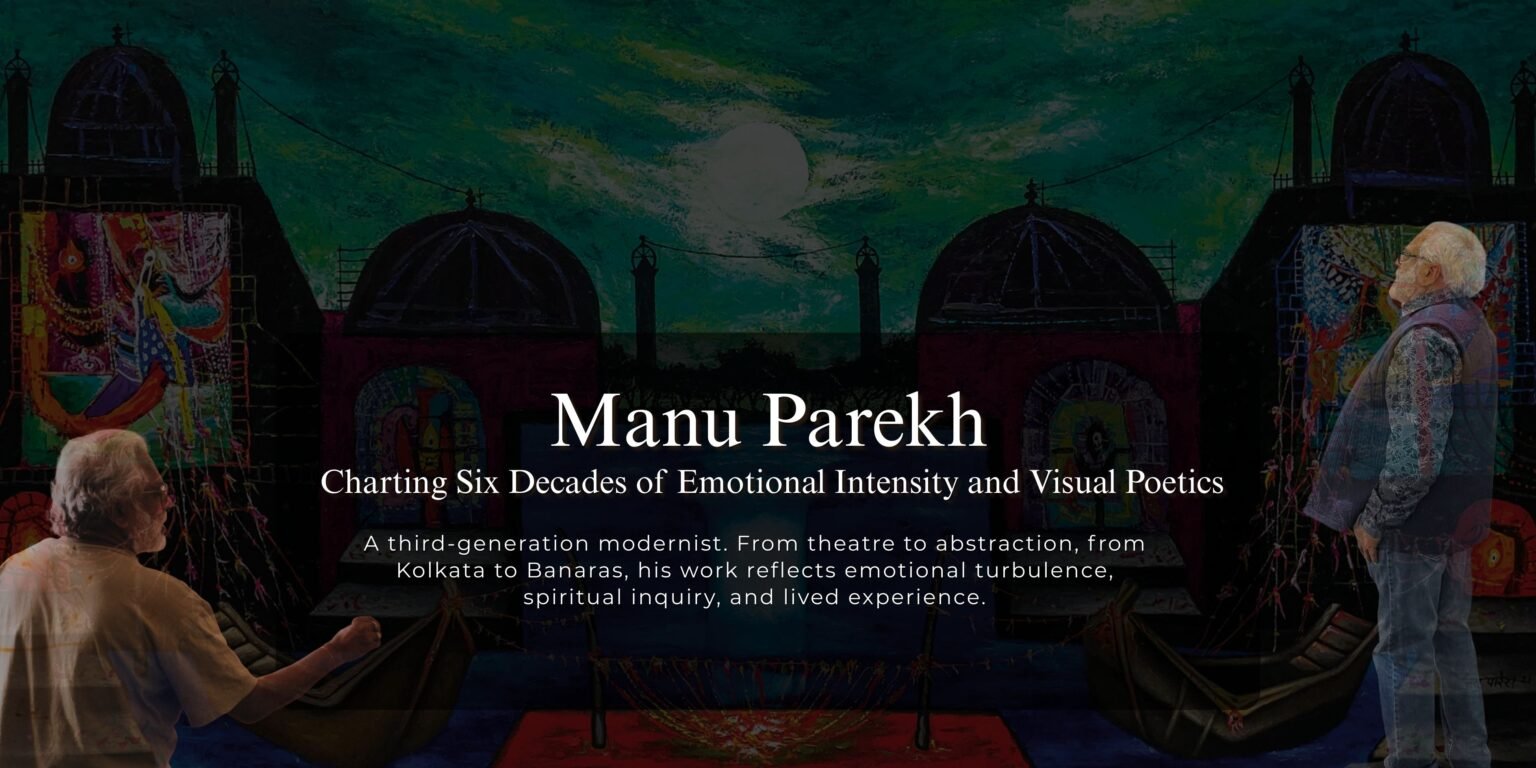
Banaras, with its ghats, rituals, riverine life, and constantly shifting skies, became Parekh’s defining subject for over three decades. Unlike literal cityscapes, his Banaras series synthesises architecture, human activity, and transcendent emotion. These works are distinguished by vibrant hues, charged geometry, and sweeping brushstrokes, compositional devices that convey not only the visual spectacle of the city but also its spiritual intensity and cyclical vitality.
Thematic Depth: Emotion, Ritual, and Abstraction
Parekh’s canvases are never mere records of place; they are psychological landscapes marked by vivid colours and expressive line. In works such as those from the Banaras series, including Moonlight Prayer in Banaras and Banaras in Moonlight, the sky is at once a spatial field and a metaphoric locus of emotion, while the river becomes both a physical presence and a symbol of continuity and flux. These paintings pulse with an energy that transcends topographical representation, inviting viewers into a dialogue between lived experience and interior resonance.
Parekh’s art also synthesises influences from folk traditions and tribal idioms, which he encountered during his travels, with broader modernist concerns. This confluence of vernacular energy and modern abstraction gives his work its distinct voice, one that is both rooted in Indian ethos and open to global dialogues.
Recognition and Institutional Engagement
Parekh’s sustained innovation did not go unnoticed. In 1972, he received the President of India’s Silver Plaque and the All India Fine Arts and Crafts Society Award. A decade later, he was honoured with the Lalit Kala Akademi National Award (1982). In 1992, the Government of India conferred upon him the Padma Shri, one of the country’s highest civilian honours, recognising his contribution to modern Indian art.
His exhibition record underscores both the depth and breadth of his practice. Parekh has exhibited extensively in India and abroad, from solo shows at Vadehra Art Gallery (Banaras, New Delhi, 2004) to international presentations in London and at distinguished venues such as the Smithsonian Institution’s Hirshhorn Museum in the USA. Retrospectives, including the 1992 Sixty Years of Selected Works at the National Gallery of Modern Art (NGMA), have mapped his shifting concerns and reaffirmed his place in Indian modern art history.


Market Reception and Collector Interest
In recent years, Parekh’s reputation has translated into significant market traction. Auction records reveal a steady appreciation for his work, particularly large, expressive Banaras compositions. According to auction databases, Parekh’s paintings have achieved results ranging from modest works on canvas to highly prized triptychs that have realised over USD 280,000, indicating robust secondary market interest among serious collectors.
Smaller and mid‑sized works continue to trade actively on platforms such as Saffronart and AstaGuru, reflecting a broad base of demand. Market commentators attribute this interest not merely to visual appeal but to the deep cultural resonance and narrative continuity embedded in Parekh’s thematic explorations, qualities that distinguish mature modernism from ephemeral trends.
Legacy and Contemporary Relevance
As Indian modernism is continually reassessed within global art histories, Parekh’s work retains strong relevance. His ability to merge figurative abstraction with spiritual inquiry situates him beyond the confines of any single school or period. More than a painter of Banaras, he is an artist of endurance, a practitioner whose sustained commitment to exploration, emotion, and form exemplifies how visual art can articulate both the particularities of place and the universality of human experience.
For collectors, advisors, and institutions, Parekh’s oeuvre serves as a model of how persistent thematic depth and conceptual evolution can underpin both scholarly recognition and market confidence. In an art world often enamoured with novelty, Parekh’s lifelong engagement with his subjects, borne of lived experience and artistic conviction, reminds us that mature art is not defined by momentary visibility but by enduring resonance.