





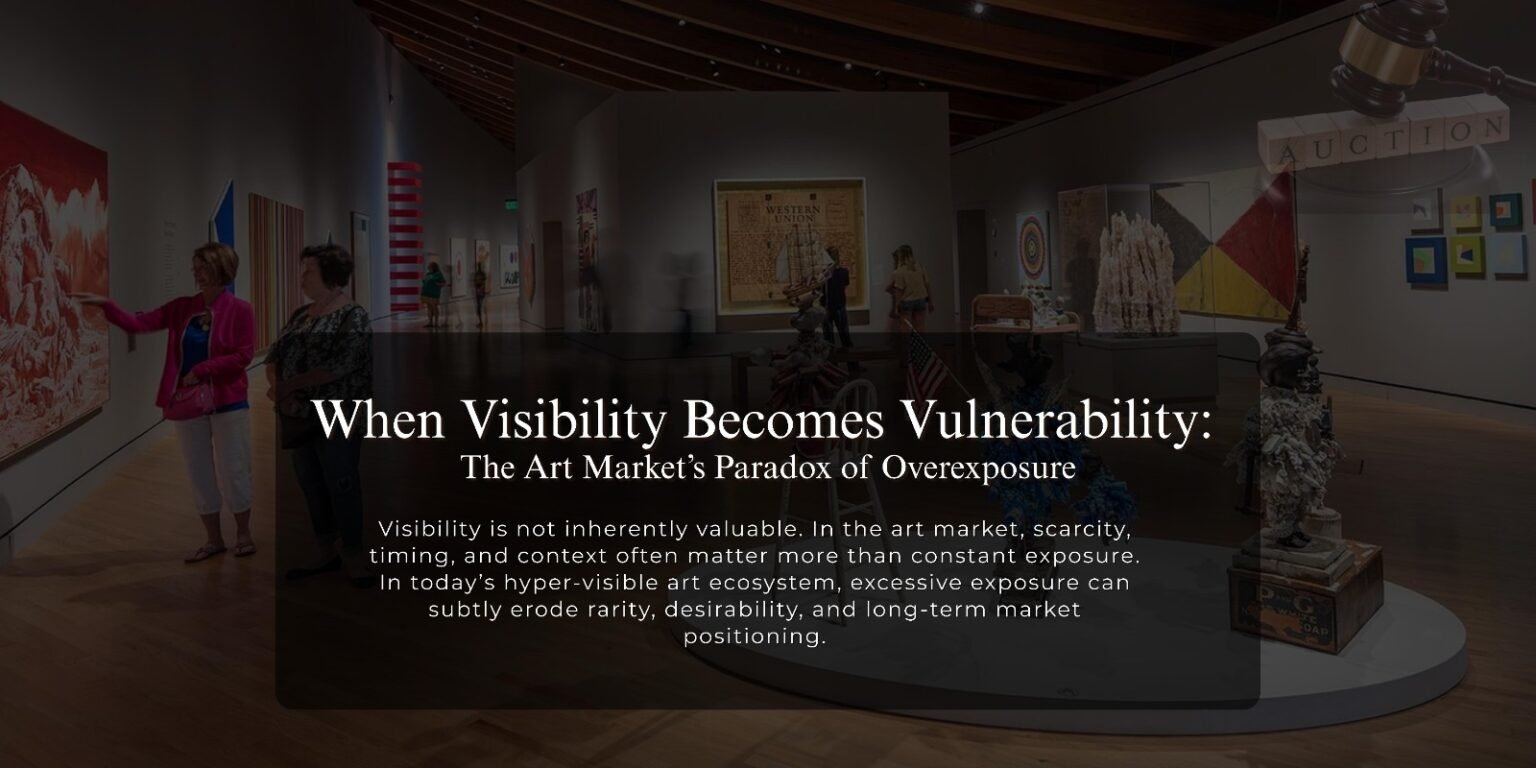

In the contemporary art ecosystem, visibility is often celebrated as the summit of success. Yet this prevailing notion overlooks a paradox at the heart of cultural economics: excessive exposure can dilute the very value it seeks to amplify. In an age defined by constant digital circulation, omnipresent auction listings, and high‑frequency fair appearances, the art market, like luxury goods and branded commodities, depends as much on controlled scarcity, strategic narrative shaping, and contextual presentation as it does on visibility itself. Understanding how overexposure can undermine artistic value is essential for advisors, collectors, and institutions committed to long‑term intellectual and market integrity.
The Economics of Scarcity and Perception
Unlike liquid financial assets, where price movements are driven by transparent supply and demand curves, the value of art is profoundly shaped by reputation, exclusivity, and selective accessibility. The underlying economic principle here is scarcity: artworks that are rare or limited in circulation often command premiums because their availability is restricted. For example, historically unique pieces, such as the few known works by Vermeer, derive much of their astronomical auction valuations from this very scarcity.
Scarcity is not merely a statistic; it is a psychological and social construct in the art world. Collectors seek not only beauty or cultural significance but also a sense of ownership over something inherently rare. When works become omnipresent, displayed across multiple fairs, repeatedly offered at auction, or endlessly circulating online, that aura of singularity can recede. The consequence can be subtle yet profound: an artwork becomes familiar rather than coveted, ubiquitous rather than exceptional.
The Risks of Over‑Abundance
The art market’s structure magnifies this effect. Auction houses, galleries, and fairs operate within an opaque system of pricing and exposure. Price records established through repeated offerings, especially for unsold lots, can create permanent benchmarks that reflect market saturation rather than latent demand. In other words, an artwork repeatedly presented at auction may accumulate “price scars” from unsold attempts, which can complicate future resale strategies and signal weakness rather than strength.
Digital saturation intensifies these dynamics in unforeseen ways. Social media algorithms prioritize repetition over context, encouraging images of artworks to circulate widely without the accompanying narrative depth that situates them historically or conceptually. The result is a de‑contextualised audience engagement where works are visually familiar but intellectually detached. This phenomenon is more than superficial: repeated exposure without interpretive frameworks often leads to diminished emotional and cognitive engagement, a central insight from psychological research on overexposure effects. While direct studies on art perception are limited, broader research into repetition effects consistently shows that repeated stimuli eventually lose their novelty and emotional impact, a concept directly applicable to visual works that saturate public view.
The Market’s Structural Realities



Compounding this is the art market’s persistent information asymmetry and opacity, which exacerbate mispricing and overvaluation risks. Because artworks are heterogeneous “credence goods”, where quality and authenticity are not fully verifiable before purchase, collectors often make decisions based on reputation signals, exhibition history, and limited comparative pricing data. When these signals become overly abundant or diluted by excessive exposure, the reliability of valuation anchors weakens.
Moreover, the art market is structurally inefficient. Economic research shows that auction prices fail to reflect true value due to unobserved reserves, missing sales data, and opaque transaction mechanisms. In such a context, repeated offerings without careful market strategy can further distort price expectations.
Digital Dynamics: Algorithms and Artistic Meaning
Digital platforms have expanded the reach of art beyond galleries and fairs, enabling artists to achieve visibility they might never have enjoyed in a traditional market. This democratisation is a milestone worth celebrating. Yet algorithm‑driven exposure often privileges quantity over quality, repetition over scholarship, and clicks over critical engagement. A single work can be hashtagged, reposted, and remixed across platforms, transforming it into a visual commodity detached from its intellectual frame. In this environment, the very mechanisms that enable visibility can paradoxically diminish the artwork’s narrative and conceptual gravity.
The increasing circulation of digital art and NFTs especially highlights this tension. While tokenized scarcity mechanisms attempt to preserve exclusivity in the digital realm, research shows that excessive trading frequency relative to scarcity can actually reduce the artwork’s long‑term trading value.
Toward Strategic Visibility
For collectors, advisors, galleries, and institutions committed to sustaining artistic value beyond transient hype, the answer is not obscurity but strategic visibility. Visibility must be contextualised within curated narratives, scholarly engagement, and disciplined timing. Exhibitions anchored in research, publications framing historical significance, and carefully timed market placements all contribute to sustaining a work’s cultural and economic worth.
Measured exposure can reinforce an artwork’s story, embedding it within academic discourse and curatorial understanding. For artists, this means thinking beyond mere frequency of exposure to consider how, where, and when their work is seen. For collectors, it means valuing interpretive depth as highly as visual access.
Restraint as a Market Strategy
In economic terms, the art market thrives on controlled scarcity, not continuous oversupply. Rarity, whether through edition limits, selective exhibition schedules, or strategic auction timing, remains a central driver of value. By aligning visibility with meaning and scholarship, the art world can resist the deleterious effects of overexposure, ensuring that rarity remains a living, intentional force rather than a casualty of constant circulation.
In conclusion, the art market’s paradox of visibility affirms that overexposure can diminish artistic value when it erodes rarity, contextual depth, and emotional engagement. As stewards of cultural heritage and market integrity, practitioners and collectors must embrace visibility that is strategic, narrative‑rich, and intellectually anchored, safeguarding both aesthetic significance and long‑term market strength.