





The human form, unadorned and bare, has been a subject of artistic inquiry since the dawn of visual culture. Across continents and epochs, artists have treated nudity not as a matter of prurience, but as a profound expression of beauty, spirituality, and existential inquiry. From the sublime frescoes of the Ajanta caves in India to the monumental nudity of Michelangelo’s “David”, the naked body has evoked admiration rather than obscenity. Yet, in modern times, a paradox has emerged: the same nudity that once stood at the heart of artistic achievement increasingly meets resistance, bans, and bureaucratic intervention. Such reactions are not rooted in art history or cultural literacy but appear to stem from what can only be described as a cold-minded aversion to human embodiment in its purest form.
A Cultural Continuum of the Nude
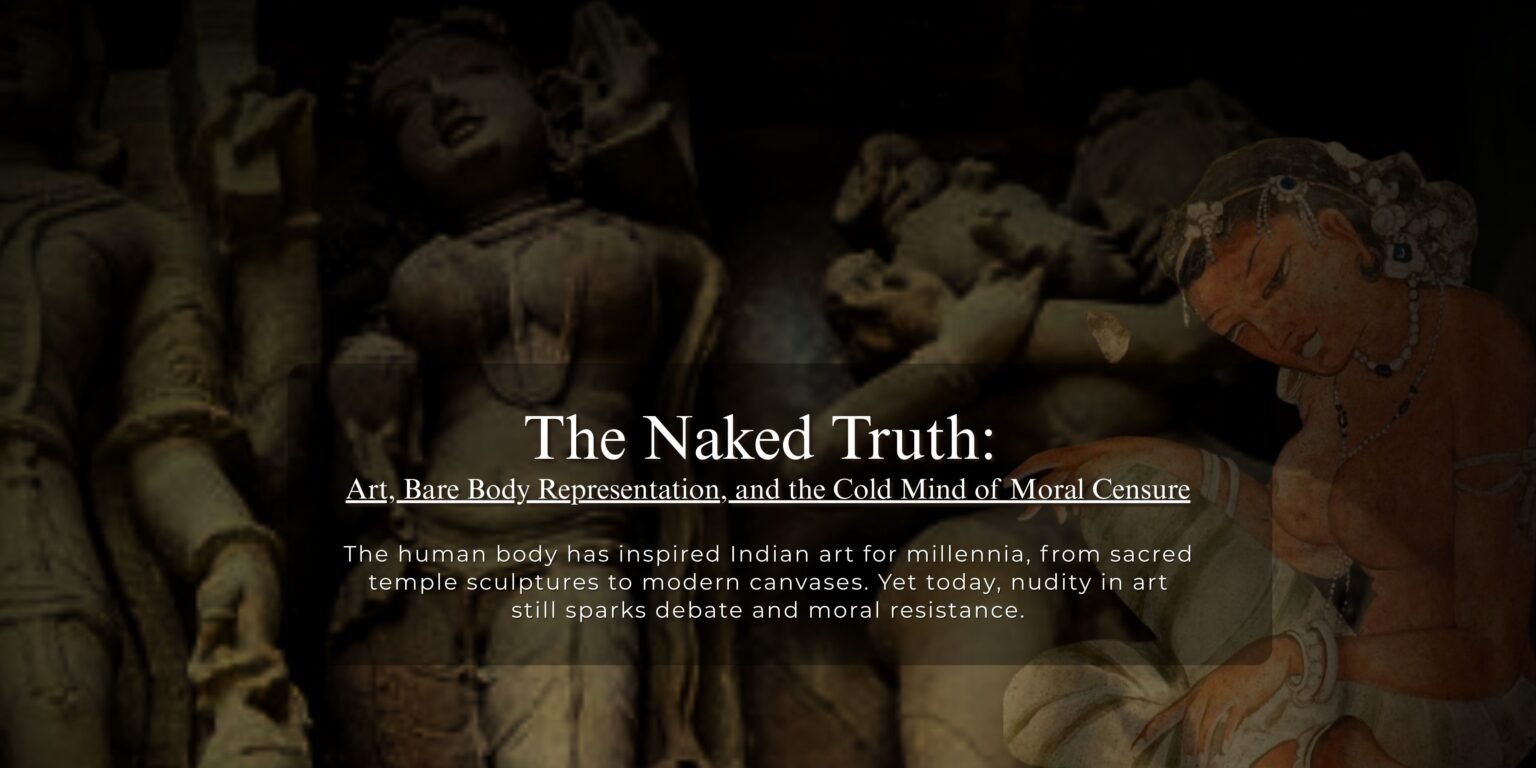
The tradition of nude representation is ancient and global. In India, the Ajanta cave paintings, dating between the 2nd century BCE and 6th century CE, depict human figures in various states of undress, celebrating both aesthetic beauty and spiritual narrative without embarrassment or taboo. These painted figures embody narrative grace and lived presence, reflecting an early cultural familiarity with the unclothed form as an artistic subject rather than an object of shame.
Similarly, the temple complexes of medieval India, such as those at Khajuraho and Ellora, do not shy away from representations of the body in its nude state. Sculptured friezes and erotic reliefs articulate a rich symbolic language connecting sensuality, spirituality, and life’s generative energies. These carvings were not peripheral or hidden; they adorned major sanctuaries, integrating the body into a cosmology of meaning beyond mere sensual appeal.
Beyond India, the Renaissance heralded arguably the greatest celebration of the nude in Western art. Michelangelo’s “David”, a masterwork of the early 16th century, stands as an iconic testament to the expressive potential of the unclothed human form. The statue’s nudity was not gratuitous but an embodiment of classical ideals rooted in humanism and the dignity of man. Likewise, Michelangelo’s “The Last Judgment”, a monumental fresco in the Sistine Chapel, depicts dozens of nude figures in states of spiritual exaltation and existential struggle. At the time of its unveiling, these figures elicited strong criticism, with some clerical authorities decrying the nudity as inappropriate for sacred space. Yet, the artwork remained and was later adapted through historical compromise, including the application of fig leaves and drapery long after its creation, revealing the persistent tension between artistic intent and rising moral conservatism.
The Modern Backlash: Fear, Ignorance, and the Police of Morality
Despite such rich heritage, contemporary artistic practice repeatedly encounters what might be termed cold-minded resistance, responses premised less on informed critique and more on reflexive moral discomfort. In India, the 21st century has seen repeated attempts to classify nude art as obscene. In 2023 and 2024, customs officials in Mumbai seized drawings by leading moderns F. N. Souza and Akbar Padamsee, labelling them automatically “obscene” upon import solely due to their nude subject matter. These actions were eventually overturned by the Bombay High Court, which firmly stated that every nude painting cannot be styled as obscene and that sex and obscenity are not synonymous. The Court criticised the seizure as rooted in personal prejudice rather than any judicious standard of artistic evaluation.
These episodes are not isolated. In Delhi in 2013, an exhibition titled The Naked and the Nude, featuring works by artists including M. F. Husain, K. H. Ara, Jamini Roy, and Souza was disrupted when fringe activist groups threatened to shut it down, calling the works “provocative” and “insulting.” Exhibition organisers were compelled to close early under heavy police presence before reopening, underscoring the fraught space that nude art occupies in the public domain.


The resistance is not merely institutional but rooted in social discomfort: a collective inability to distinguish artistic nudity from pornography, and art from perceived indecency. This conflation stems not from aesthetic reasoning but from a moral panic that treats the unclothed body as inherently shameful rather than as a legitimate subject of artistic inquiry.
Artistic Freedom and Legal Protections
Legally and constitutionally, artistic expression enjoys protection in democratic societies. Indian courts have repeatedly upheld the right to create and display art irrespective of nudity. In the case of Souza and Padamsee’s seized works, the High Court noted that officials lacked the authority to act as arbiters of community standards without reference to expert opinion or legal precedent, and that such acts violate fundamental freedoms.
This judicial affirmation is critical not only for legal practice but for cultural consciousness. It reminds us that art’s role is not to comfort the sensibilities of the most prudish but to challenge, expand, and deepen human understanding.
Why Does Resistance Persist?
The resistance to nude art today often reflects a broader social malaise rather than an informed critique. It is a resistance shaped by cultural anxieties, religious literalism, and enduring colonial legacies that equate nakedness with sin rather than artistic inquiry. Such attitudes betray a fundamental misunderstanding of both art history and the philosophical purposes of representation.
Nudity in art has been a vehicle for expressing vulnerability, heroism, divinity, and the phenomenology of presence. To exclude the body from artistic consideration is to diminish the artist’s capacity to engage with the full spectrum of human experience. The refusal to accept the human form in its entirety, its strengths, its fragilities, its sublime geometry, is symptomatic of a culture reticent to confront embodied existence without fear or discomfort.
Reclaiming the Body for Art
The artistic nude is not a relic of history nor a transgressive novelty; it is a foundational motif that traverses cultures and centuries. From Ajanta’s painted cavaliers to Renaissance masterpieces and modern Indian modernism, the nude has affirmed art’s capacity to mirror life’s most profound forms. Opposition rooted in moralism and cold-minded discomfort undermines this lineage and betrays a refusal to acknowledge the body as a locus of artistic and cultural truth.
Art thrives in openness, in the fearless interrogation of form, and in a willingness to embrace the human condition without reduction. To censor nudity is not to protect morality but to constrict the very freedoms that allow art to flourish.