






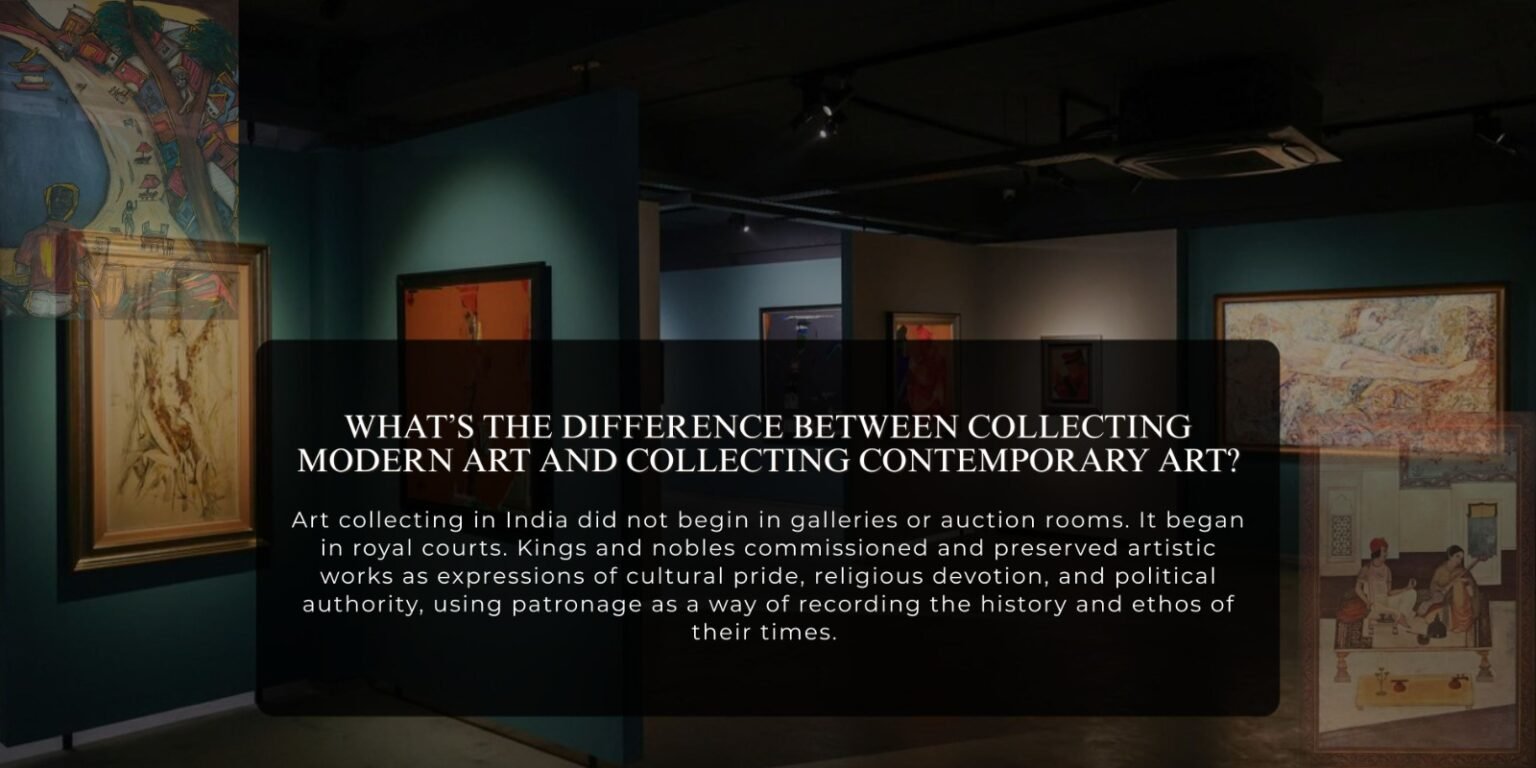

Art collecting in India did not begin in galleries or auction rooms. It began in royal courts. Kings and nobles commissioned and preserved artistic works as expressions of cultural pride, religious devotion, and political authority, using patronage as a way of recording the history and ethos of their times. That instinct, to collect as a way of asserting identity, has never really left Indian art culture. It has simply changed form. Today, it shows up in two very different collecting philosophies: modern art collecting and contemporary art collecting.
Understanding the difference between them requires looking beyond dates on a timeline. It means understanding two different relationships with history, two different ways of reading meaning, and two very different roles a collector plays.
Modern Indian Art, Collecting a Settled History
Modern art, broadly spanning the 1860s to the late 1960s, emerged as a radical break from academic tradition, unbound by the conventions that had governed art for centuries before it. Globally, this era gave rise to movements like Impressionism, Fauvism, Cubism, and Surrealism, artists reimagining the very purpose of their craft in response to the sweeping social, cultural, and technological shifts of the post-Industrial Revolution. The focus moved from narrative to abstraction, from replication to reinvention.
In India, this global current took on a distinct shape, filtered through colonial history and the path to independence. It began with the Bengal School, led by figures such as Abanindranath Tagore and Raja Ravi Varma, who consciously revived indigenous aesthetics and rejected British academic realism in favour of traditional Indian themes and spirituality. This was followed by theProgressive Artists’ Group, formed in Bombay in 1947, whose members, including F.N. Husain, F.N. Souza, S.H. Raza, and Vasudeo Santu Gaitonde, fused Western modernist techniques with distinctly Indian narratives and motifs, creating an Indian voice within modernism itself.
For collectors, acquiring this work was never a purely aesthetic decision. As India approached independence, art collecting became an act of cultural reclamation, a way of asserting a national identity that colonial institutions had long overshadowed. Owning a Bengal School painting or a Husain canvas meant aligning oneself with a cultural and political statement: that Indian tradition and spirituality held their own value, without needing Western validation.
This is what makes modern Indian art collecting distinct today. Artistic styles only exist in retrospect, and modern art has had the benefit of that retrospect. Its movements are named, its key figures established, its place in history settled. Collectors approach it as closed history, evaluating each work against a known movement, a finite body of an artist’s output, and decades of exhibition record and provenance that scholars and institutions have already validated. It is collecting rooted in legacy, and it tends to reward patience, research, and reverence for what has already been proven.
Contemporary Indian Art, Collecting an Unfolding Story
Contemporary art tells a different kind of story, one that is still being written. Emerging from the 1970s onward, in the aftermath of the Second World War and alongside global shifts toward conceptual, minimalist, and postmodern practice, contemporary art is, in essence, art of the moment. Process often matters as much as the finished object. Typically created by living or only recently deceased artists, it reflects present-day ideas, society, and an artistic practice still very much in motion.
Where modern artists asked “what is art?”, experimenting with form, colour, and technique, contemporary artists ask “why is this art?” and “what does this art mean today?” Concept takes precedence over aesthetics, and much of the work is built to challenge perception and spark dialogue rather than to simply be admired.


Indian contemporary art carries this same spirit, characterised by versatility of medium and a strong emphasis on current societal issues, drawing influence from pop culture and mass media. Visually, it often shows up through bold gestures, textured surfaces, and contrasting palettes, with compositions built around identity, politics, and cultural narrative, layered with symbolism and emotional depth.
For the collector, this changes everything about the process. Instead of relying on decades of provenance and critical consensus, they must read an artist’s relevance in real time, often years before institutional validation catches up. This form of collecting tends to be deeply personal and identity-driven, with Indian collectors frequently drawn to work that navigates the tension between tradition and modernity. It also carries a participatory dimension: collectors become contributors to an artist’s career, supporting living practitioners as they build reputations rather than acquiring reputations already made. Indian contemporary artists have spent well over a decade quietly earning credibility in international collector circles, even as the wider ecosystem, shaped by recurring demand and supply patterns among galleries and auction houses, continues to face real constraints around innovation and diversity.
The Philosophical and Practical Divide
The difference between the two collecting cultures is not just about which century a work belongs to. It reflects two fundamentally different relationships with time, meaning, and risk. Modern art represents a completed chapter with known movements and outcomes, so collectors approach it as settled history, while contemporary art is still being written, with no fixed ending, so collectors approach it as an unfolding story. Modern art is read through the lens of clear movements, the Bengal School, the Progressive Artists’ Group, whereas contemporary art resists easy categorisation, pushing collectors to evaluate individual artists and ideas rather than movements. Modern works arrive with decades of exhibition history and critical writing already attached, while contemporary works are often acquired close to the moment of creation, meaning collectors themselves become part of building that provenance. Institutions and art historians have already decided who mattered in the modern era, but in the contemporary space, collectors must make that judgment themselves, often years ahead of consensus. Collecting modern art aligns a collector with an already-validated legacy, especially significant in movements tied to national identity such as India’s post-independence modernism, while collecting contemporary art aligns a collector with present-day cultural relevance, a way of staying attuned to what is happening in Indian culture right now. And where modern art collecting tends to favour long-term, relatively stable appreciation, treated more like a conservative asset, contemporary art collecting is more speculative by nature, some works gain significant value within a few years, others lose it just as quickly, which demands active engagement with trends, exhibitions, and critical reception.
A Shared Root, Two Different Branches
Despite their differences, both forms of collecting in India trace back to the same instinct that began with royal patronage: art as an assertion of identity. Post-independence, this role passed to industrialists and business families who took on the mantle of cultural custodianship, using art to celebrate India’s heritage while engaging with the modernist and contemporary movements that challenged traditional boundaries. India’s economic liberalisation in the 1990s marked a further turning point, with the rise of auction houses, galleries, and fairs making art more accessible, and international interest in Indian art growing alongside it.
What has changed is not the impulse to collect, but what that collecting represents. Choosing modern Indian art is choosing to be a custodian of a legacy already written. Choosing contemporary Indian art is choosing to participate in one still being shaped. Both are, in their own way, acts of cultural stewardship, just aimed in opposite directions along the same timeline.