




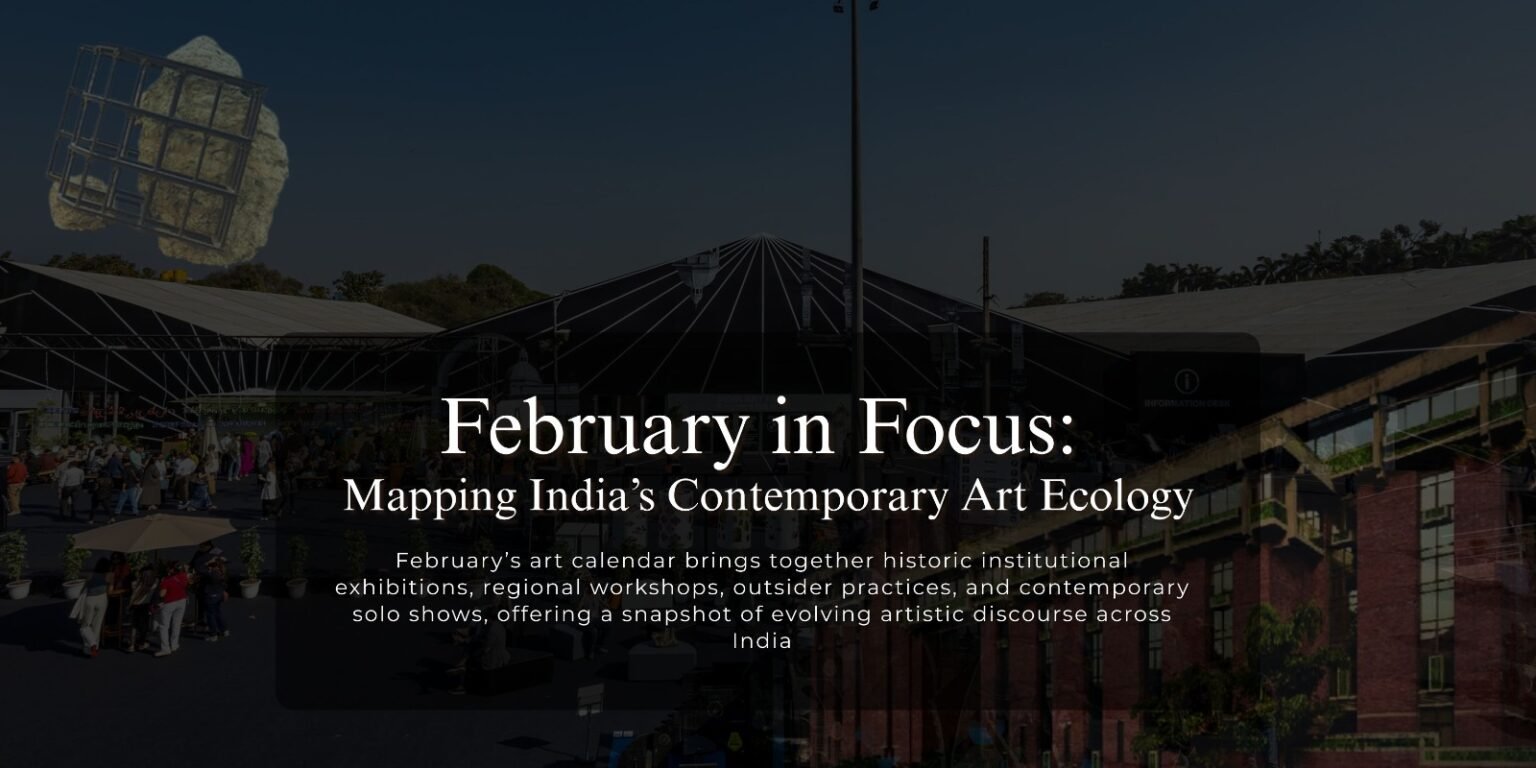

As winter gives way to spring, February 2026 offers an unparalleled window into India’s diverse artistic landscape. From historic institutional exhibitions to regional workshops, self-taught practices, introspective solo shows, and one of South Asia’s most consequential art fairs, this month encapsulates the multilayered trajectories shaping Indian art today. What unites these disparate events is not merely chronological coincidence, but a shared engagement with evolving discourses around place, pedagogy, authorship, and artistic legitimacy.
Bombay Art Society’s 134th All India Annual Art Exhibition
The Bombay Art Society’s 134th All India Annual Art Exhibition at the Jehangir Art Gallery in Mumbai is a venerable institution in the Indian art world. Founded in 1888, the Society has fostered successive generations of artists and acted as a crucible for artistic experimentation since the late colonial era. The 134th edition, running from 24 February to 2 March 2026, continues the Society’s historic juried tradition, bringing together works from across India’s regions and practices.
Unlike commercial fairs that foreground market visibility, this annual exhibition operates as a survey of current artistic practices, bridging modernist legacies with emergent voices. Its juried structure enables a rigorous aesthetic dialogue, revealing shifts in media, material strategies, and regional expression. For collectors, students, and scholars alike, it offers a barometer of contemporary art’s pluralities within the subcontinent’s institutional frameworks.
This exhibition continues to function as both a survey and gateway for emerging and established artists, reflecting shifts in media, regional aesthetics, and evolving curatorial frameworks within Indian modern and contemporary art.
Vasantotsav Art Workshop, Patna
In contrast to the metropolitan scale of the Jehangir stage, the Vasantotsav Art Workshop, organised by the Bihar Lalit Kala Academy and the Department of Art and Culture in Patna (5–8 February), foregrounds community practice and skills transmission among younger generations. Held at the Bihar Lalit Kala Academy, this four-day workshop invites participants aged 11–29 to engage deeply with traditional craft forms such as Tikuli and Sikki, which have historic roots in local cultural economies.
Beyond technique and material exploration, Vasantotsav serves as a knowledge-sharing platform, nurturing regional artistic networks and fostering dialogue between academic training and lived practice. At a moment when mainstream contemporary art often privileges urban centres and gallery platforms, such initiatives anchor creativity in locality, underscoring the necessity of intergenerational transmission in sustaining living traditions.


Outsider Art Exhibitions at India Habitat Centre, New Delhi
Simultaneously in New Delhi, the Outsider Art Exhibitions (2–9 February) at the India Habitat Centre highlight the often-neglected work of self-taught and marginalised artists, many of whom operate outside academy-based paradigms. These exhibitions bring the visual language of non-traditional creators into critical view, challenging received definitions of artistic legitimacy and academic canon.
By foregrounding vernacular modes of expression, idiosyncratic narrative structures, and materially intuitive practices, these shows enrich contemporary conversations about neurodiversity, art-making beyond formal training, and expressive autonomy. They chart a counter-archive to mainstream histories, expanding interpretive frameworks for what constitutes art and who gets to define it.
Sonika Agarwal: What Remains Awake
From 30 January to 10 February 2026, Bikaner House in New Delhi hosts What Remains Awake: Dream, Depth, and the Fourth, a solo exhibition by contemporary artist Sonika Agarwal. Far from a conventional survey, the exhibition is a philosophical inquiry into states of consciousness derived from Indic thought, Jagrat (waking), Swapna (dream), Sushupti (deep sleep), and Turiya (the transcendent fourth). Rather than literal figuration, Agarwal’s abstraction operates through colour, spatiality, painting, sculpture, and installation, inviting sustained attention and introspection.
The exhibition’s curatorial framework, advised by Myna Mukherjee, situates Agarwal’s work within broader philosophical and phenomenological paradigms. Here abstraction becomes a mode of exploration, less about representation and more about subjective experience, presence, and memory. Agarwal’s practice, with international recognition and institutional acquisition, exemplifies how contemporary Indian abstraction can interweave cultural lineage with global artistic inquiry.
India Art Fair 2026: Platform and Prognosis
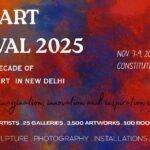
No account of India’s art calendar in February would be complete without foregrounding India Art Fair 2026, the country’s most expansive contemporary art platform. Taking place at the NSIC Exhibition Grounds, New Delhi, from 5–8 February, the fair’s 17th edition features a record exhibition of galleries, institutions, and design studios, reportedly over 123 exhibitors from India and abroad.
This edition deliberately expands its remit beyond market transactions. Talks, curated discourses, outdoor art projects, and site-specific commissions animate the fair as a site of knowledge production, aesthetic inquiry, and intellectual exchange. Panels supported by JSW, for instance, foreground questions such as “What Makes Art Happen?”, engaging with issues of access, accountability, and the socio-political conditions shaping artistic production today.
The fair’s scope is international and plural: galleries from Dublin, Berlin, and across South Asia join Indian stalwarts such as Nature Morte, Experimenter, and Galleryske. Solo presentations and Focus sections foreground artists like Bharti Kher, Jayasri Burman, and Khadim Ali, while major outdoor commissions and collaborations with institutions including the Kiran Nadar Museum of Art and the National Gallery of Modern Art extend the fair’s imprint across the city.
In curatorial terms, the fair functions as both market site and critical forum. It assembles collectors, curators, and public audiences around expansive thematic concerns, from ecological entanglements to technological mediation in art, asserting that contemporary Indian art cannot be disentangled from global dialogues and material conditions.
Inference
Viewed together, February’s art events compose a rich, layered narrative about the state of art in India. Institutional shows like the Bombay Art Society exhibition reflect historical continuity; regional workshops such as Vasantotsav gesture toward reconnection with indigenous forms and pedagogy; outsider exhibitions contest hegemonic definitions of artistic worth; and major platforms like India Art Fair articulate forward-looking visions for practice, discourse, and engagement. It is this plurality, of place, voice, and for, that defines Indian art’s current ecology.