




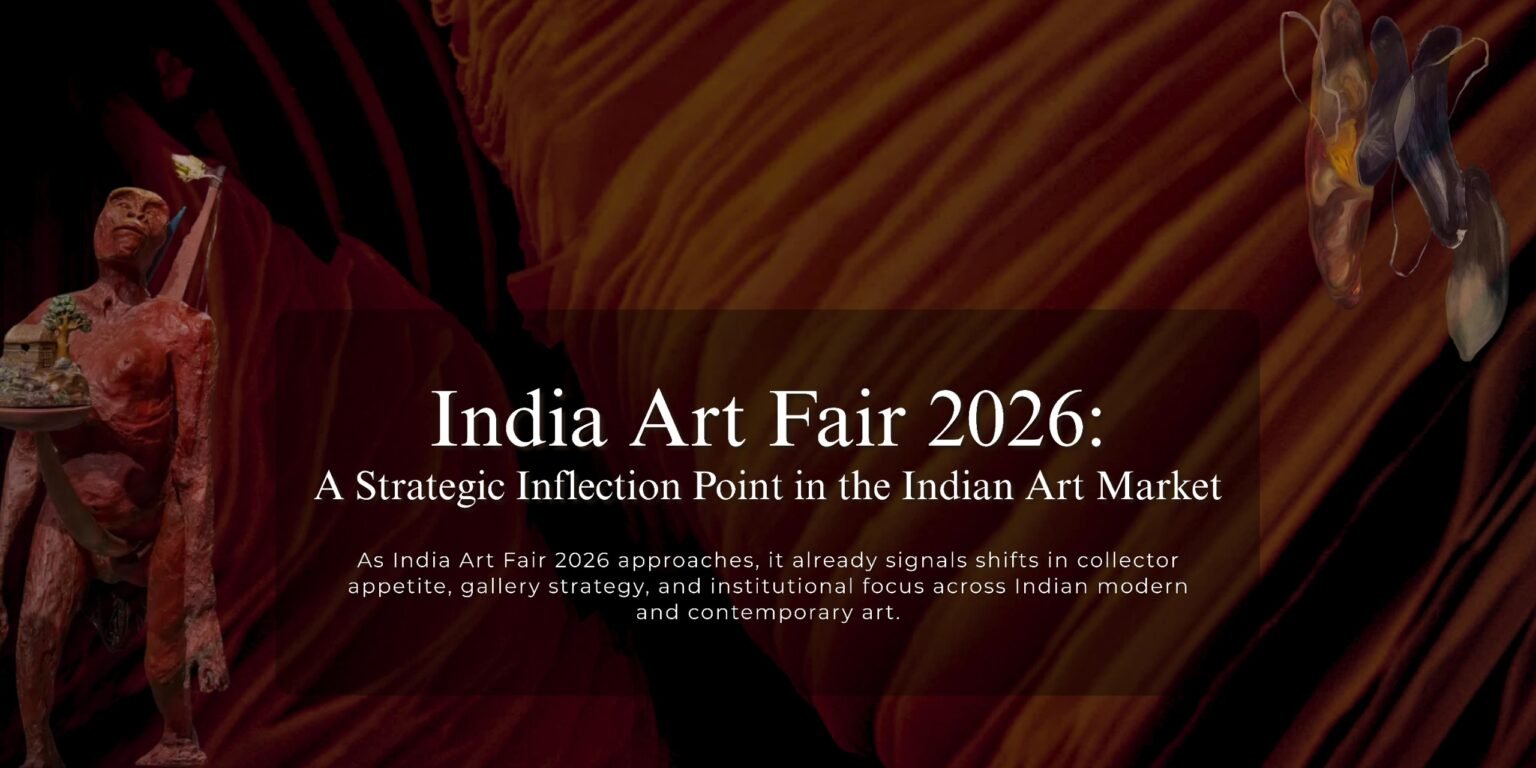

Since its inception in 2008, the India Art Fair has been the pre-eminent annual event for modern and contemporary art in South Asia, but India Art Fair 2026 marks a particularly significant moment in the evolution of India’s art ecosystem. Now in its 17th edition, the fair scheduled from 5-8 February 2026 at the NSIC Exhibition Grounds in New Delhi, features a record 123 exhibitors, including 87 galleries, 24 art institutions, and an expanded design section with multiple design studios. This unprecedented scale underscores the fair’s growing influence as a nexus of market dynamics, artistic visibility, and institutional engagement.
For professionals engaged in art advisory and representation, India Art Fair’s importance extends far beyond a four-day showcase: it functions as a strategic barometer for market trends, collector behaviour, and the trajectories of artistic practice. By concentrating a wide spectrum of stakeholders, from blue-chip galleries and international participants to emerging talent and private collectors, the fair creates a crystallised view of the forces shaping the Indian and global art markets.
A Platform for Positioning: Galleries and Artists
One of the most palpable effects of India Art Fair 2026 is the visibility it confers on participating galleries and artists, both domestic and international. The presence of major international exhibitors, including galleries such as David Zwirner, Galleria Continua, and Carpenters Workshop Gallery, alongside prominent Indian institutions like Gallery Espace, Latitude 28, Exhibit 320, DAG, Emami Art, and Project 88 demonstrates the fair’s capacity to situate Indian artistic discourse within broader transnational currents.
For established Indian artists and historical modernists, this provides an opportunity to reaffirm critical stature. Works by figures associated with Indian modernism, such as members of the Progressive Artists’ Group or internationally recognised contemporaries, are contextualised alongside emerging practices, enabling both academic and market reappraisals. For emerging and mid-career artists, fair visibility often precedes institutional acquisitions, museum exhibitions, or international representation strategies, thereby amplifying visibility in ways that extend long after the event has concluded.
Moreover, curated sections such as the Focus segment, which in IAF 2026 features solo presentations by artists including Bharti Kher, Jayasri Burman, Shailesh B.R., Ravinder Reddy, Thandiwe Muriu, and Khadim Ali, allow for deeper narrative framing. Such presentations elevate artistic practice by prioritising conceptual coherence and thematic depth, rather than placing emphasis solely on transactional display.
Market Signals and Pricing Dynamics
From a market perspective, India Art Fair 2026 operates as a controlled environment for price discovery and trend analysis. Unlike auctions, where bids determine value in real time, art fairs facilitate comparative assessment across galleries and practices. In the current climate, characterised globally by greater emphasis on documented provenance and institutional validation, the fair’s infrastructure allows collectors and advisors to triangulate prices, gallery reputations, and quality in a concentrated setting. The expanded design section and institutional participation likewise broaden the category of art objects being evaluated, reflecting the diversified interests of contemporary collectors.


Market analysts have noted that this evolution coincides with broader shifts in Indian collecting patterns. Following robust auction results in 2025, including high sale totals for works by modern Indian masters, the fair is expected to reflect intensified interest in quality consignments and disciplined pricing rather than speculative escalation. A reduction in GST on fine art in 2025 has further contributed to an environment in which collectors are keenly aware of documentation, condition, and pedigree, making India Art Fair a critical site for reinforcing market confidence.
Collector Behavior and Engagement
For collectors, both established and nascent, India Art Fair 2026 offers a rare opportunity to engage with a broad spectrum of artistic practices within a singular temporal and spatial frame. The compressed format of the fair encourages comparative viewing, accelerating acquisition decisions that might otherwise unfold over months of gallery visits. For advisors, this intensifies the need for pre-fair preparation, including detailed research on artists’ exhibition histories, price histories, and prospective valuation trajectories.
Importantly, the fair also generates a discursive environment in which market decisions are informed by critical programming and public engagement. Talks, panels, and performance programmes allow collectors to participate in broader conversations about art history, cultural politics, and material innovation. Such intellectual engagement enriches the collector’s experience, aligning purchases with cultural as well as financial valuation frameworks.
Institutional Presence and Cross-Cultural Dialogue
India Art Fair 2026’s roster of institutional participants underscores its role as a meeting point for curators, museum professionals, and foundations. Institutions frequently use the fair to scout artists and projects for future programming, acquisitions, and collaborative research. This institutional gaze, often translated into exhibitions, biennale participation, or museum collections, significantly enhances an artist’s visibility and contributes to a cumulative cultural capital that far exceeds immediate sales figures.
The presence of international galleries and pavilions further facilitates cross-cultural exchange, allowing South Asian artistic narratives to interact with global discourses. This dialogue is essential for positioning Indian contemporary art within larger frameworks of art history and practice, enabling practices rooted in regional contexts to gain resonance among international audiences.
Narrative Visibility and Media Amplification
In addition to physical visibility on the fair floor, India Art Fair 2026 benefits from significant media amplification, both through traditional art press and digital platforms. Strategic coverage, whether through interviews, critical reviews, or social media documentation, extends the fair’s reach beyond New Delhi, engaging audiences nationally and internationally. While digital attention can sometimes privilege spectacle over substance, the fair’s curatorial rigour and diverse programme help balance visibility with meaningful interpretation, encouraging public engagement that is both informed and reflective.
A Nexus of Strategy, Market, and Culture
For practitioners in art advisory, consultancy, gallery representation, and show coverage, India Art Fair 2026 represents a strategic nexus where cultural narratives and market logics converge. Its expansive roster of exhibitors, international participation, and curated sections offer a multifaceted snapshot of where Indian art stands in 2026, not as a static marker, but as a dynamic field responding to institutional interests, collector sensibilities, and global artistic dialogues.
The fair’s significance lies less in any single transaction and more in its capacity to generate visibility, valuation, and critical engagement that shape artistic trajectories for years to come. In an era where markets and museums increasingly intersect, India Art Fair remains indispensable for understanding contemporary art’s evolving landscape and for advising clients with precision, foresight, and cultural sensitivity.