





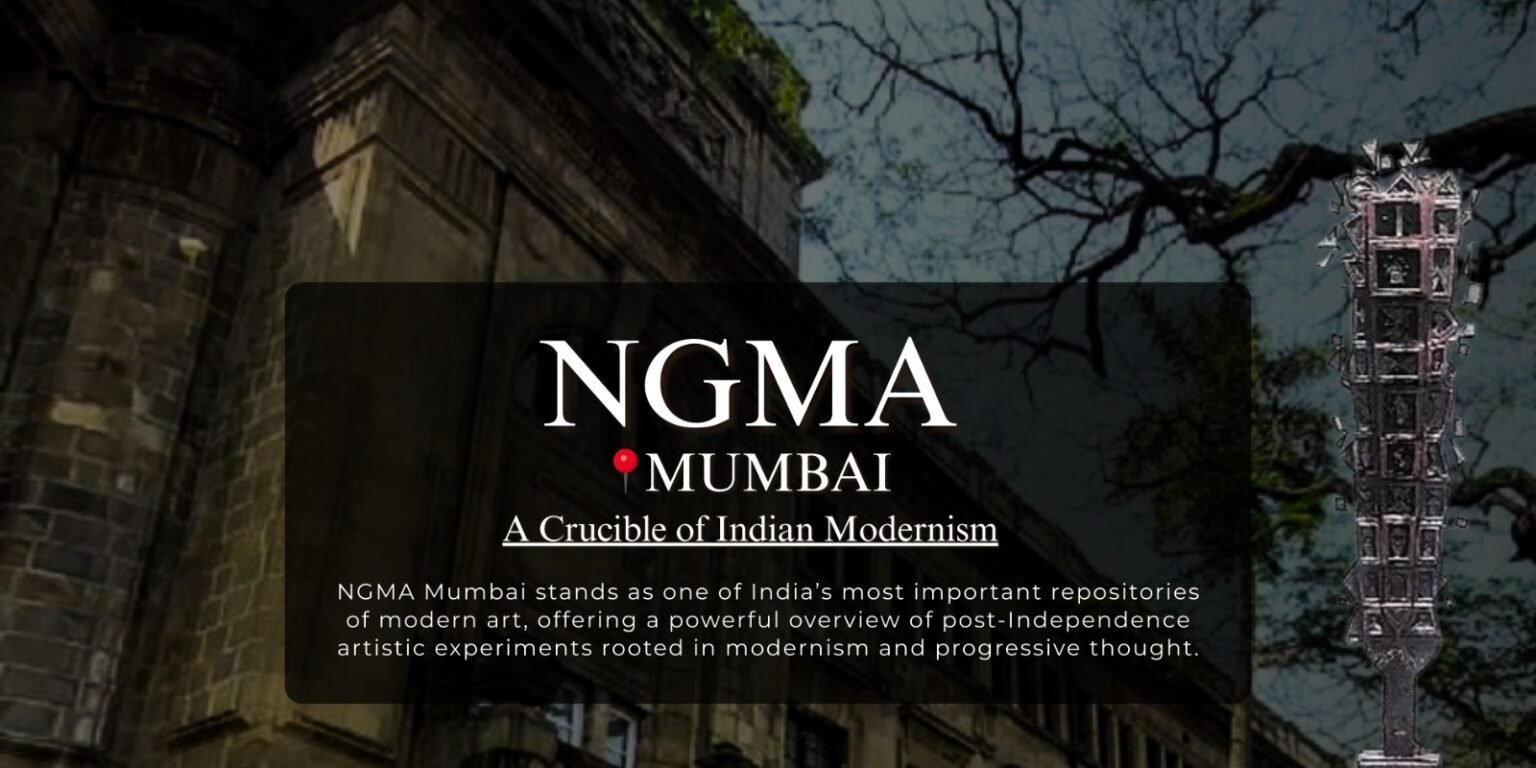

The National Gallery of Modern Art (NGMA), Mumbai stands as one of India’s foremost institutions devoted to the preservation, interpretation, and dissemination of modern and contemporary artistic practice. Inaugurated on 23 December 1996, this distinguished gallery is a subordinate office of the Government of India’s Ministry of Culture, located in the precincts of the Sir Cowasji Jehangir Public Hall (C.J.P. Hall) and the Institute of Science in Fort, Mumbai. Its establishment marked a decisive moment in the city’s cultural landscape, converting a historic urban edifice into a living repository of modern visual expression.
The architectural narrative of NGMA Mumbai itself is emblematic of the gallery’s conceptual ambition. Originally constructed in 1911 by British architect George Wittet, the former public hall bore witness to a range of civic spectacles, from symphony concerts and political rallies to annual art society exhibitions. After decades of neglect and ad-hoc utilitarian use, the hall was meticulously reimagined by architect Romi Khosla, who preserved the elegant façade while introducing a spiralling interior structured around a central stairway connecting semi-circular galleries at multiple levels. This adaptive reconfiguration not only meets international standards for climate and lighting control, but metamorphoses the spatial experience into one conducive to contemplative art-viewing.
A Modernist Stronghold: Progressive Artists and Beyond
At the heart of NGMA Mumbai’s collection lies a profound emphasis on Indian modernism. The gallery holds over 1,450 works paintings, sculptures, graphics, and photographs, that chart the emergence of modern art movements in post-Independence India. Central to this narrative is the Progressive Artists’ Group (PAG), whose members revolutionised artistic practice by resisting colonial academic idioms and engaging with the international vocabulary of modernism. Artists such as F. N. Souza, M. F. Husain, S. H. Raza, K. H. Ara, V. S. Gaitonde, and Tyeb Mehta collectively articulated a visual language that was at once formally rigorous and deeply rooted in the social upheavals of their time.
The Progressives’ legacy is central to the gallery’s identity because it represents a pivotal shift in Indian art: one in which painters and sculptors foregrounded individual expression, bold experimentation, and a departure from realist convention. Whether through Souza’s confrontational figuration, Husain’s expansive narratives, Raza’s evolution toward the symbolic bindu, or Gaitonde’s meditative abstraction, these works illustrate how Indian artists negotiated international modernist idioms while foregrounding indigenous sensibilities.
Yet NGMA Mumbai’s collection extends well beyond the early modernists. It embraces artists who, in succeeding generations, expanded the conceptual and social dimensions of Indian art. Figures such as Bhupen Khakhar, Rameshwar Broota, Nalini Malani, Anupam Sud, Arpana Caur, and Vasudeo Kamath broadened the discourse to include personal narrative, social realism, and the exploration of body and identity. Their works reflect a post-modern sensibility, addressing issues of gender, class, and politics while maintaining a dialogue with the aesthetic transformations initiated by their predecessors.
Collections, Exhibitions, and the Contemporary Pulse
NGMA Mumbai’s curatorial practice is dynamic, hosting a range of temporary exhibitions, retrospectives, and thematic displays that animate its permanent holdings. Recent exhibitions include a landmark retrospective commemorating Krishen Khanna’s centenary, Krishen Khanna at 100: The Last Progressive the first comprehensive museum-based survey of his eight-decade oeuvre. Curated by Dr. Zehra Jumabhoy and Kajoli Khanna, this exhibition traverses thematic trajectories from Partition-era narratives to richly layered figurative works, underscoring Khanna’s singular contribution to Indian modernism.
Beyond individual retrospectives, NGMA Mumbai’s programme frequently explores cross-cultural dialogues and historical trajectories through interdisciplinary engagements. The gallery’s auditorium and educational programmes, including workshops, lectures, and guided tours, expand its remit from mere exhibition space to a vibrant site of critical discourse.
Materiality and Medium: Sculptures and Formats
The gallery’s holdings encompass large-scale oils and acrylics, sculptures, graphics, and photographs, reflecting the material multiplicity intrinsic to modern and contemporary practice. Sculptural works, such as those by Himmat Shah, J.K. Chillar, and Dilip Mishra, demonstrate a distinct engagement with form and space, balancing figuration and abstraction in innovative ways. Simultaneously, works on paper and photographic series capture ephemeral experiences and experimental techniques that resist the monumental, inviting viewers into more intimate encounters with artistic process.
Architecture in Dialogue with History and Modernity
The art-historical significance of NGMA Mumbai is compounded by its architectural setting. The transformation of Sir Cowasji Jehangir Public Hall into a gallery reflects a nuanced negotiation between heritage conservation and contemporary design imperatives. The building itself becomes a metaphor for the gallery’s ethos: a layered dialogue between past and present, where colonial architectural vocabulary intersects with post-colonial artistic expression. This spatial continuum enhances the viewer’s engagement with the art, embedding the works within a richly articulated cultural and historical context.
A Critical Space for Cultural Reflection
In the broader landscape of Indian art history, NGMA Mumbai occupies a position of singular importance. It does not merely conserve artefacts; it curates a continuum of aesthetic and intellectual inquiry. Through its rich holdings, inventive exhibitions, and critical public programmes, the gallery fosters an understanding of how Indian artists have negotiated the entanglements of modernity, identity, and global artistic currents. For scholars, practitioners, and art enthusiasts alike, NGMA Mumbai is not just a repository, it is a living archive of modern Indian thought and visual imagination.