





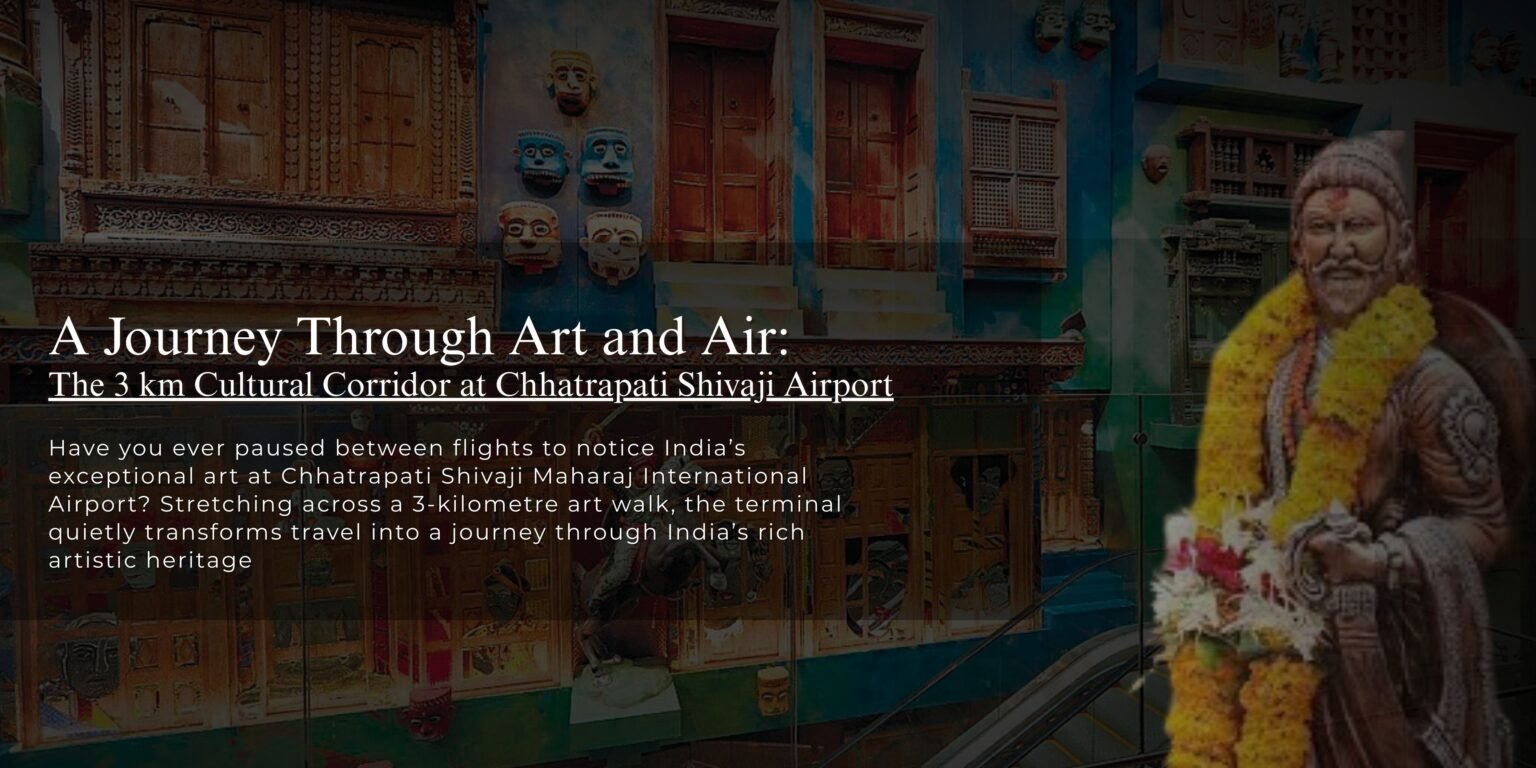

When one thinks of air travel, the default imagery often conjures queues, queues, and more queues, metal detectors, hastened boarding calls, and perhaps that perennial waiting lounge coffee. But at Chhatrapati Shivaji Maharaj International Airport (CSMIA) in Mumbai, a radically different experience awaits: an odyssey through India’s artistic heritage that stretches across more than 3 kilometres of terminal space, transforming transit into contemplative engagement.
An Artistic Paradigm Shift in Airport Spaces
Globally, terminals have traditionally valued efficiency over aesthetics, but CSMIA’s Terminal 2 subverts this logic. With its ArtBeat of New India Museum, one of the world’s largest public art programmes embedded within an airport, the terminal becomes far more than a utilitarian node. Here, art is not an afterthought but an integral part of spatial design and cultural transmission.
Stretching approximately 3.2 kilometres and enveloping over 200,000 square feet, the art installation programme presents more than 5,500 artefacts and over 100 curated installations that span ancient, vernacular, and contemporary practices across India. This expansive scale situates the corridor among the most ambitious public art initiatives globally, not merely in quantitative magnitude but in conceptual integration with an everyday environment.
From Utility to Immersion: Art as Experience
At its core, the Airport Art Walk rejects the dichotomy of “airport art” as decorative filler and situates artworks as active participants in the travel narrative. The art is interwoven with passenger movement: you encounter installations as you check in, progress toward security, drift between gates, or glide along travelators. This spatial choreography ensures that art is not static display but a lived, kinetic experience.
A singular sculpture or painting is but a point on a continuum; the corridor itself is the canvas. It evokes what Harper’s Bazaar aptly describes as a terminal transformed into “a living gallery,” one where paintings converse with sculpture and craft traditions meet contemporary installation.
Narratives Embedded in Materials and Memory


The artworks at CSMIA are purposefully curated into thematic zones, each narrating facets of India’s cultural identity, geography, and memory. Travellers might encounter a tribute to hand-painted theatre screens from Maharashtra, capturing a fading artisanal tradition once ubiquitous in local drama arenas. Elsewhere, a Mumbai-inspired recycled material installation provocatively reconfigures detritus into forms that speak to sustainability and urban imagination.
Other installations invoke regional idioms with poetic clarity, from Kerala’s mural traditions rendered in celestial patterns to Nagaland’s carved symbolic entrances that evoke tribal legacies. A Kashmir-inflected cultural narrative underscores unity through shared cultural motifs, while an homage to Pondicherry’s temple gopurams brings religious architecture into modern spatial dialogue.
This thematic layering fosters what might be called temporal multi-vocality, viewers traverse histories as they traverse space, encountering a palimpsest where ancient craft dialogues with urban modernity.
Contextualizing the ArtWalk in India’s Cultural Ecosystem
The airport’s art programme does more than beautify; it acts as a cultural ambassador. For international visitors, the installations offer immediate exposure to India’s artistic plurality before a single official tour begins. For domestic travellers, the museum’s layered narratives can engender pride and reflection, reminding us that public art, when integrated with civic infrastructure, can be both accessible and profound.
The initiative also reflects an institutional commitment to supporting living traditions. The ArtBeat of New India programme is anchored in the ethos of Atithi Devo Bhava- “The guest is god”, emphasizing hospitality and respect not just in service, but in cultural presentation.
Technological and Curatorial Innovation
Beyond static installations, CSMIA has embraced technology to deepen engagement. Audio-guide applications provide contextual narratives, enabling audiences to unlock stories behind the art during their passage. Meanwhile, virtual museum features extend accessibility beyond physical travellers to global digital audiences.
This blend of analog and digital interpretative layers points to a curatorial vision that is both inclusive and forward-looking, one that recognizes the shifting modalities through which contemporary audiences engage with cultural heritage.
Reframing Public Space Through Art
The artistic programme at CSMIA challenges deeply held assumptions about where art belongs and who it serves. Airports are thresholds, between cities, cultures, and states of being, and this art corridor amplifies that liminality. In doing so, it reframes a busy international terminal as a site of cultural mediation rather than simply logistical transition.
From a critical perspective, this repositioning is significant: it asserts that art need not be sequestered within conventional institutions like galleries or museums. Instead, art can animate the quotidian corridors of public life, democratizing access and enriching the human experience in spaces once considered sterile.
Art in Motion, Motion as Art
The 3 km Art Walk at Chhatrapati Shivaji Maharaj International Airport stands as a testament to the transformative potential of public art when concertedly curated and generously scaled. It invites travellers to slow their pace, reflect on cultural legacies, and find resonance in objects and motifs that span India’s vast artistic spectrum.
As contemporary institutions increasingly recognize the power of art in public space, CSMIA offers a compelling model: one where travel and culture coalesce, where waiting becomes discovery, and where the corridor between gates becomes a corridor through history.