





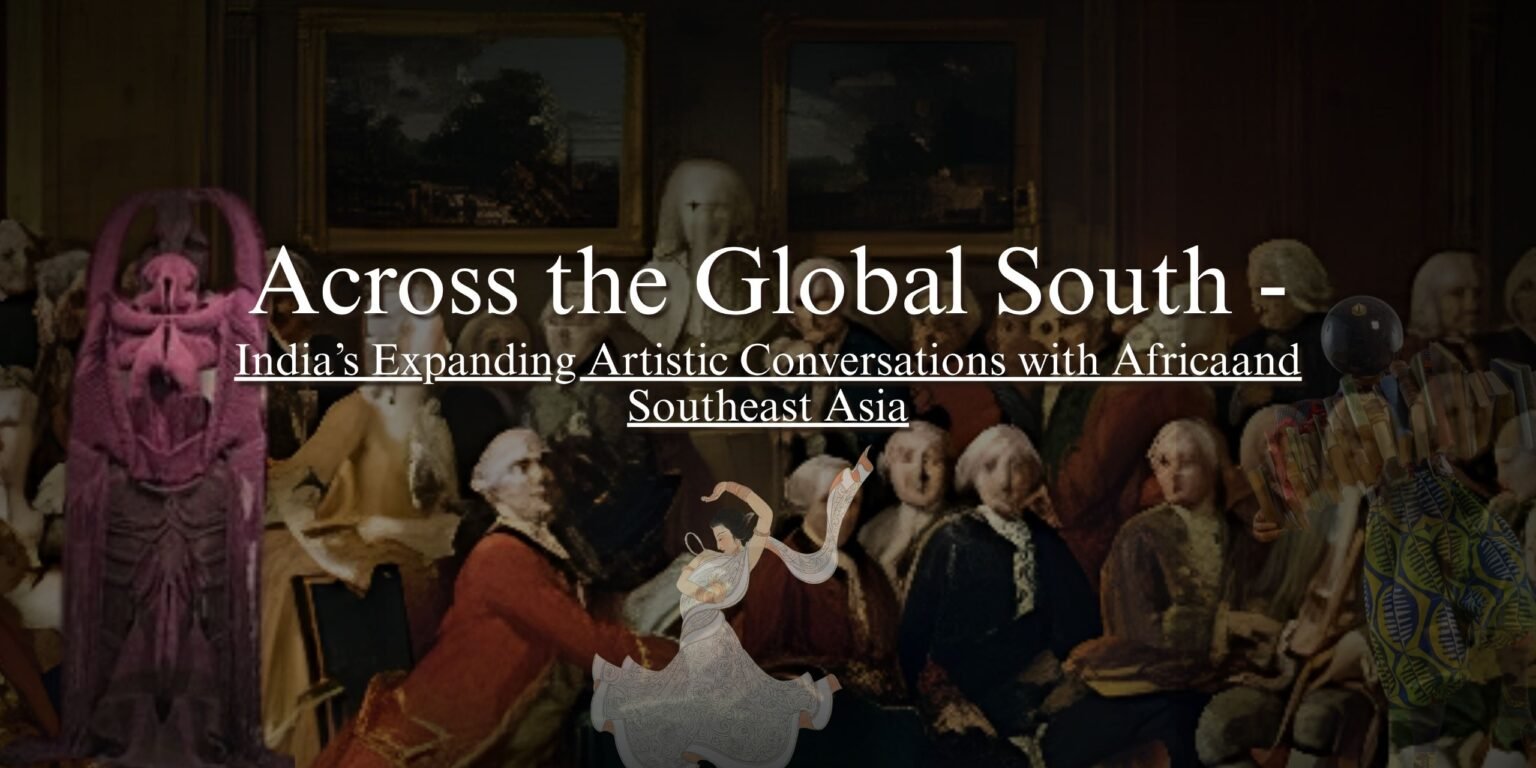

In the early decades of the twenty-first century, artistic exchange in the Global South is undergoing a profound transformation. Increasingly, creative practices rooted in India are engaging in sustained dialogue with contemporaneous artistic currents in Africa and Southeast Asia, forging new networks of exchange that challenge entrenched Euro-North models of cultural representation and art historical canonization. This emergent constellation of artistic relationships is neither accidental nor merely coincidental- it reflects a deliberate reimagining of cultural connectivity, one that emphasizes shared histories of colonialism, migration, trade, and political struggle while foregrounding distinct local perspectives, methodologies, and aesthetic grammars.
Decentering the Global North
Contemporary art discourse has long been dominated by Western institutions, market logics, and pedagogical frameworks. Yet artists, curators, and cultural practitioners from the Global South are actively reconfiguring this imbalance, asserting autonomous value systems and collaborative structures that speak from within their own geopolitical realities. In India, landmark institutional initiatives such as the India Art Fair have created platforms for robust exchange and critical engagement. The fair’s programming increasingly includes voices from the broader Global South, emphasizing the need to frame artistic practice beyond Western-centric evaluation and to celebrate plurality in cultural production. Recent talks at the Fair, for example, highlighted how the Global Majority, comprising more than 80% of the world’s population with roots in Indigenous, African, Asian, and Latin American cultures, is reshaping the global arts ecosystem with inclusive narratives that insist on shared agency rather than peripheral participation.
Similarly, artist-led collectives and cross-border residencies have played an instrumental role in establishing transregional connections. India’s Khoj International Artists’ Association has been historic in facilitating artistic encounters across South Asia, Africa, Latin America, and beyond through workshops, residencies, and collaborative projects since the late 1990s. Its early model brought together creative practitioners from Kenya, South Africa, and Cuba alongside Indian and Asian counterparts, creating a space where dialogue could flourish outside of institutional hierarchies.
Shared Histories, Material Dialogues
The artistic exchanges between India, Africa, and Southeast Asia are not abstract intellectual exercises; they are grounded in tangible histories of trade, diaspora, and cultural intermingling. Exhibitions like Interwoven Dialogues- Contemporary Art from Africa and South Asia stage visual conversations that trace these interconnections through media as varied as textile, installation, and mixed-media sculptural work. Featuring artists from Nigeria, Senegal, Ghana, Pakistan, and India, the exhibition underscores the tactile materiality of fabric and pattern as a metaphor for cultural interrelation, an embodied testament to the shared aesthetics and conceptual foundations that traverse these regions.
These exhibitions do more than juxtapose artworks; they create spaces for viewers to reconsider how artistic traditions intersect, diverge, and inform one another. Indian artists participating in such dialogues often find resonance with African artists who similarly navigate layered histories of colonialism and postcolonial identity. The material specificity of textiles, for instance, becomes a site where histories of labor, craft, heritage, and modernity are simultaneously contested and celebrated.
Curatorial and Diplomatic Synergies
Beyond exhibitions, cultural diplomacy and curated projects also facilitate intersectional artistic exchange. Initiatives such as Spotlight Singapore, a cultural diplomacy platform aimed at fostering understanding and collaboration between Singaporean and global artistic communities, highlight how Southeast Asian art ecosystems strategically engage with counterparts in South Asia and beyond. While originally conceived to showcase local artistic talent, platforms like Spotlight have evolved into bridges linking artistic communities with shared interests in breaking traditional hierarchies.
Singapore Art Week, for example, recently curated exhibitions that interrogate parallels between Southeast Asian, Latin American, and African modernisms, addressing shared colonial legacies and aesthetic strategies that subvert reductive narratives of identity and place. The exhibitions Tropical and Translations- Afro-Asian Poetics reflect a renewed curatorial focus on cross-continental dialogues within the Global South, expanding the scope of engagement with Indian and African artistic frameworks through thematic explorations of identity, migration, and diaspora.
Institutional Platforms and Biennales
Biennales and regional art summits also contribute significantly to this discourse of inter-regional art exchange. Events such as the Kochi-Muziris Biennale in India and the Dhaka Art Summit in Bangladesh have evolved into pivotal forums for artists and thinkers from diverse regions, including Africa and Southeast Asia, to engage with one another’s work. The Kochi-Muziris Biennale, as India’s largest contemporary art exhibition, routinely includes international artists whose practices reflect global contemporary concerns while rooted in specific cultural contexts.

The Dhaka Art Summit functions as a research-oriented, non-commercial platform that places priority on dialogue, scholarly exchange, and new commissions, welcoming participation from creators across the Global South and positioning South Asian art within a wider transnational conversation.
Reimagining Artistic Futures
What makes these evolving dialogues particularly compelling is their insistence on equality in cultural exchange rather than unidirectional flows of influence. Indian artists and institutions are increasingly seen as partners rather than recipients within global networks, contributing to a larger redefinition of how art traditions are written, taught, and circulated. In doing so, the very idea of a singular art centre is dismantled in favor of a polycentric model, where multiple nodes of significance coexist and inform one another.
In this light, the artistic conversations between India, Africa, and Southeast Asia represent more than cross-regional curiosity; they articulate a shared imperative to address histories of marginalization, to create new aesthetic vocabularies, and to affirm cultural sovereignty in a connected world. These engagements are not merely exhibitions or events; they are ongoing reconfigurations of art’s meaning in the twenty-first century, a Global South articulation of visual thought that refuses to be contained