




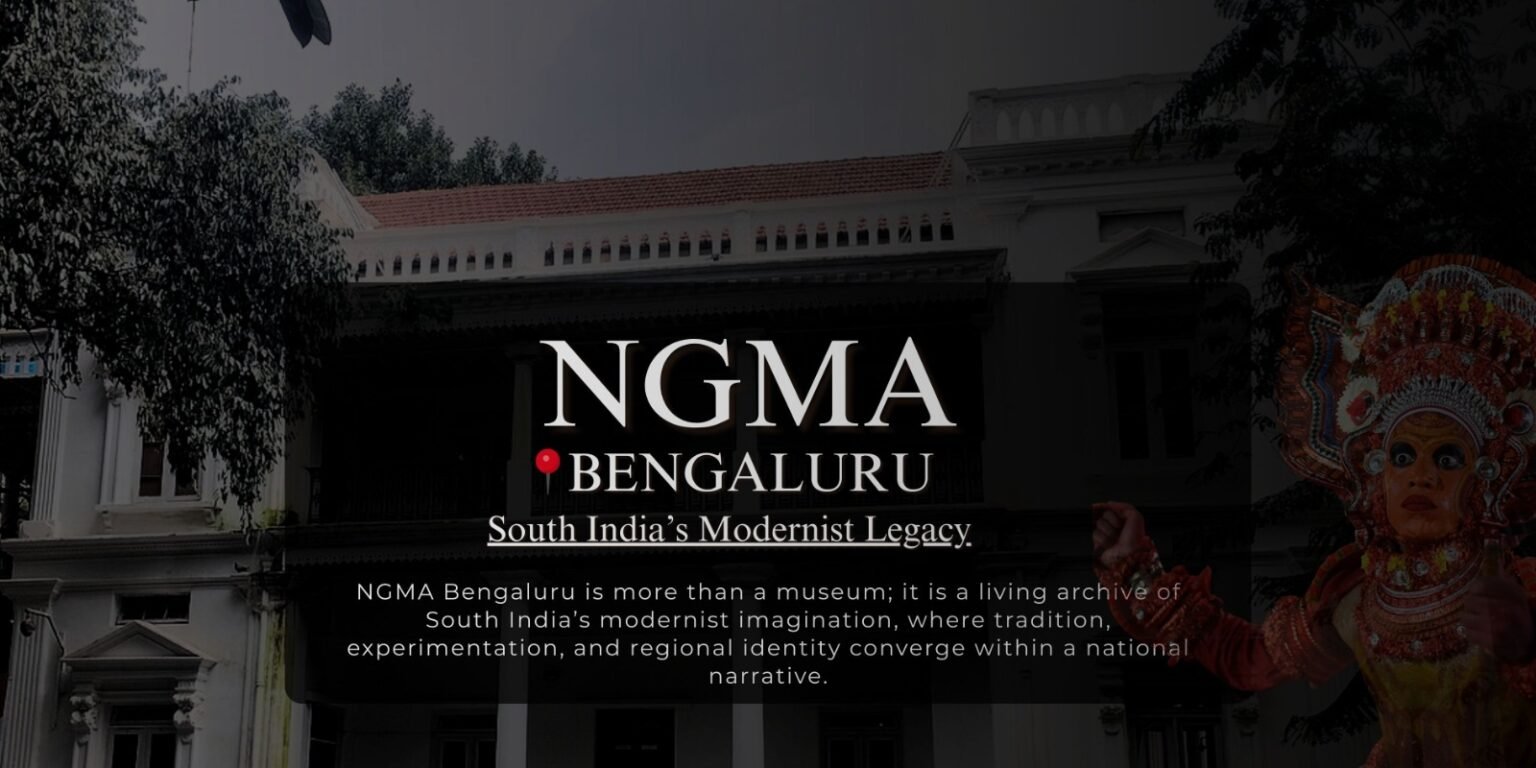

The National Gallery of Modern Art, Bengaluru, stands today as a site of intellectual reflection and cultural resonance, a testament not merely to the artefacts it houses, but to the dynamic aesthetic histories those artefacts embody. Housed in the gracious heritage structure of Manikyavelu Mansion, which was transformed from royal residence into a museum space upon its public inauguration on 18 February 2009, NGMA Bengaluru articulates a deeply considered dialogue between tradition and modernity within the visual arts of India.
As a subordinate office of India’s Ministry of Culture, NGMA Bengaluru is one among three national galleries (alongside its counterparts in New Delhi and Mumbai) charged with preserving and presenting the evolution of modern and contemporary Indian art. Its collections and exhibitions traverse a historical arc from the late colonial period through the post-Independence years to the present moment, thereby mapping the broader contours of artistic experimentation and nation-building in visual form.
NGMA Bengaluru’s mission, embedded within its serene campus dotted with fountains, expansive lawns, and an open garden that houses sculptural works, is rooted in both pedagogical engagement and aesthetic immersion. Beyond its galleries, comprising paintings, graphic prints, sculptures, and photography that chart modern India’s artistic developments, the institution regularly hosts talks, workshops, guided tours, and interdisciplinary programs designed to connect audiences of all ages with the conceptual underpinnings of artistic practice.
Positioning South Modernisms
The tale of modern art in South India cannot be told without acknowledging the region’s singular negotiation of indigenous traditions with global art movements. Unlike the early Western modernist project, which often valorized rupture, many South Indian modernists articulated a creative syncretism, where local visual idioms, folk motifs, and mythic narratives were woven into the fabric of a broader modernist discourse.
In this light, the typical NGMA Bengaluru visitor encounters work that moves beyond the representational to the conceptual, evoking hybrid languages of colour, form, and symbolism. While the gallery’s public documentation foregrounds the wide historical sweep of its holdings, encompassing Indian miniatures and Bengal School painters to post-Independence figures, the enthusiasm for surveys of regional modernism quietly underscores the necessity of situating South Indian artists firmly within India’s modernist canon.
Modernist Voices in a Southern Context
The following artists, some well-known, others emerging within critical scholarship, reflect the pluralistic energies that define South Asian modern art.

K. H. Ara (1914–1985)
Krishnaji Howlaji Ara, widely recognized as among the first in India to deliberate on the figurative nude in a modernist idiom, exemplifies the spirit of early post-colonial artistic inquiry. A founding member of the Progressive Artists’ Group in Bombay, Ara’s canvases foreground a rigorous engagement with form and corporeality, setting a precedent for later figurative explorations in Indian painting.
K. G. Subramanyan (1924–2016)
Born in Kerala and later a pivotal figure at institutions such as Santiniketan and Baroda, Subramanyan’s work resists facile categorization. His practice encompassed folk–modern experiments that interrogated the boundaries between popular and high art. Subramanyan’s assemblage of works, spanning murals, prints, books, and paintings, illuminates a conscionable rethinking of Indian visual culture in the post-Independence period. His retrospective exhibitions in South India have drawn attention to the continued relevance of his interventions across generations of artists, emphasising his commitments to pedagogy and cross-cultural aesthetics.
Laxma Goud (b. 1940)
Emerging from Andhra Pradesh with formal training from Hyderabad and Baroda, Laxma Goud’s etchings and prints evoke the rhythms of rural life and regional identities with a lyrical blend of folk motifs and modernist sensibility. His mastery of line and form, particularly in graphic media, positions him among India’s most incisive commentators on labour, community, and cultural memory.
A. Ramachandran (b. 1935)
Rooted in the iconographies of tribal cultures and mythological narratives, Ramachandran bridges a historical consciousness with contemporary concerns. His layered works challenge viewers to reimagine myth as a living archive, one that reverberates within contemporary cultural anxieties and aesthetic possibilities alike.
B. Prabha (1933–2001)
Prabha stands as a singular voice within South Asian modernism. Trained at the Sir J. J. School of Art in Mumbai, she is best known for her graceful, elongated figures of rural women, painted with a striking economy of line and colour that emphasised resilience, dignity, and quiet fortitude. Her oeuvre, often dominated by monochrome palettes that foreground emotional resonance over formal complexity, foregrounds the lived experience of women marginalised in both art historical narratives and societal structures. Her works, now part of major collections including NGMA and corporate holdings, testify to the intricate interplay of gender, labour, and visual rhetoric in modern Indian art.
S. G. Vasudev (b. 1941)
As a founding member of the Cholamandal Artists’ Village, a crucible for the Madras Art Movement, Vasudev’s oeuvre reveals a sustained meditation on line, colour, and the semiotic potentials of form. Through media ranging from oil to collage, Vasudev’s art negotiates a complex network of personal and collective memory, and his retrospectives at institutions including NGMA serve as cultural touchstones for the South Indian art community.
T. V. Santhosh (b. 1968)
A later generation practitioner, Santhosh’s conceptual engagements bridge figuration with global discourse, particularly underpinning themes of conflict, memory, and media representation. His installation and sculptural works articulate a contemporary sensibility that dialogues both with India’s artistic legacy and a global post-modern milieu.
G. R. Santosh (1929–1997)
Though more closely associated with Tantric aesthetics and poetic abstractions, Santosh’s inclusion in discussions of modern Indian art signals a broader embrace of metaphysical and philosophical dimensions within Indian modernism, dimensions that impart a spiritual depth to formal innovation.
Institutional Significance and Future Trajectories
As the cultural landscape of Bengaluru evolves, NGMA’s role is more vital than ever. Its programming, spanning historical surveys, thematic exhibitions, and interdisciplinary discussions, suggests models for curatorial practices deeply attuned to historical complexity and contemporary relevance.
For practitioners, scholars, and collectors alike, the gallery represents both archive and provocation: archive in the vast legacies it houses, and provocation in the questions it invites about artistic agency, national narrative, and regional specificity. In curating dialogues that foreground South India’s contribution to modernism, NGMA Bengaluru re-situates the canonical story of Indian modern art within broader, more inclusive frames.