





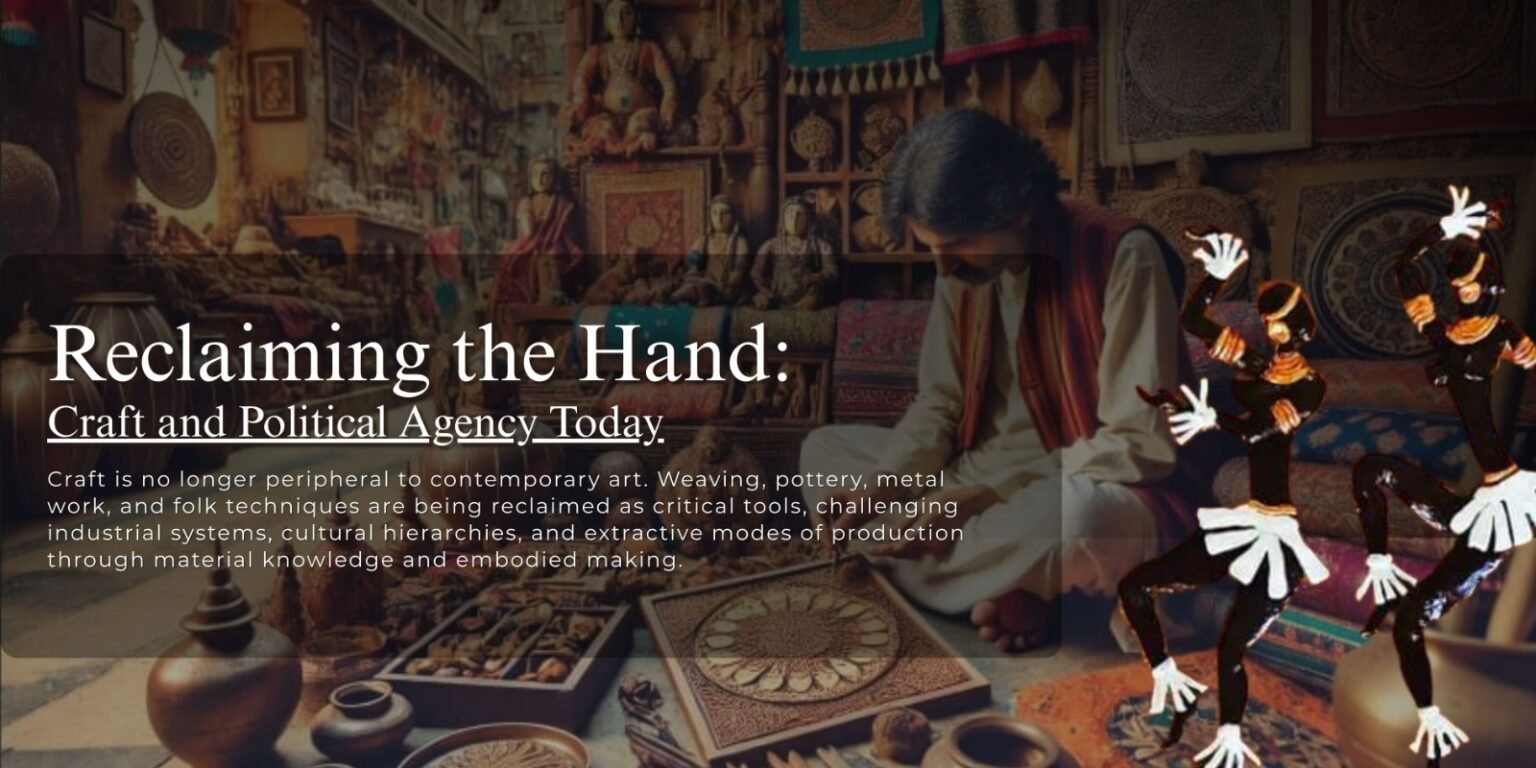

Contemporary art in the 21st century is witnessing a significant revaluation of traditional craft practices. Far from being relegated to the domain of decorative or nostalgic production, craft, whether weaving, pottery, metalwork, or folk technique, is increasingly deployed as a mode of political, ecological, and anti-industrial resistance. Across geographies, artists are reclaiming the handmade not as an anachronism but as a potent language of critical engagement that challenges dominant paradigms of industrial capitalism, cultural hierarchy, and globalized consumption. This resurgence questions entrenched art histories and restores craft to a central role in debates about labor, sustainability, identity, and materiality.
Craft Beyond Decoration: Political and Epistemic Stakes
The contemporary resurgence of craft has less to do with aesthetic nostalgia and more to do with the urgent political and ecological crises of our time. Scholars and practitioners argue that craft cannot be understood merely as a category of artifact; it is a set of embodied practices that carry historic knowledge, community memory, and resistance to extractive economies. In contemporary discourse, craft becomes a language of resistance known as craftivism, a portmanteau denoting craft blended with activism, where the act of making, the materials chosen, and the social relationships around making all carry political urgency. Exhibitions focusing on craftivist practices demonstrate how stitched, woven, or sculpted works can embody dissent, community engagement, and critiques of power structures, moving beyond ornament to object as a political agent.
Historical Marginalization and Reclamation
Historically, craft has often been marginalized within Western art histories, positioned as subordinate to “fine art” due to its association with labour, gendered practices, and non-Western cultural contexts. This distinction, rooted in colonial, patriarchal, and capitalist hierarchies, dismissed centuries-old traditions of handmaking as “functional” or “ethnological” rather than intellectual or conceptual. Contemporary scholarship, however, is actively dismantling this binary. By foregrounding the intersections of craft with gender, colonialism, and ecological conscience, researchers and artists are uncovering how crafts were, and remain, forms of resistance and knowledge production. Craft practices, especially those historically associated with women and Indigenous communities, become sites of epistemological contestation that challenge hegemonic definitions of artistic value and creativity.
Weaving, Textiles, and Embodied Memory
In India and beyond, textile arts such as weaving and dyeing have been reconceptualized by contemporary artists to articulate political, ecological, and personal narratives. Materials like thread and loom are deployed not as remnants of domestic labour but as tools of material inquiry. Textile-based practices have gained visibility at major art institutions and biennales, signaling a tectonic shift in how craft is contextualized within contemporary art. These works often grapple with histories of gendered labour, regional identity, and ecological change, blending handweaving or embroidery with conceptual strategies to explore displacement, memory, and social fragmentation. Within these practices, the slow, embodied gestures of stitching and weaving challenge the tempo of mass production and consumer culture
Pottery and Clay: Material Resilience and Ecological Engagement
Simultaneously, ceramics and pottery, which have deep historical roots in communities around the world, are being reactivated in contemporary practice as forms of ecological engagement and social resilience. Artists and artisan networks collaborate on projects that foreground clay’s material specificity, ecological cycles, and community knowledge, reframing handmade ceramics as mediators of long-term thinking in contrast to ephemeral industrial products. In India, traditional pottery clusters have been central to initiatives that highlight the craft’s capacity for innovation and adaptation in the face of environmental disruption. These examples underscore a broader trend: clay is not only a medium of form but a site for interrogating relationships between land, labour, ritual, and sustainability.
Metal Work: Tradition, Innovation, and Spatial Politics
Metal crafts, ranging from historic techniques like lost-wax casting to intricate inlay traditions such as Bidriware or Koftgiri, have similarly migrated into contemporary art discourses, where they embody both historic memory and conceptual reimagination. Artists and designers now reinterpret these metalworking traditions, combining meticulous hand skills with contemporary aesthetics to generate works that resonate with modern audiences. The integration of recycled materials and sustainable practices further amplifies metalwork’s resonance as a craft of resistance, particularly in contexts where industrial waste and environmental degradation loom large. Such projects demonstrate how age-old techniques can engage meaningfully with urgent concerns about sustainability and material reuse.
Ecological Repair and Material Practice
Across these diverse fields, contemporary craft is increasingly framed within ecological discourses. Scholars argue that craft’s emphasis on low-carbon materials, embodied labour, and relational modes of making represents a critical stance against the extractive logics of consumer capitalism. By privileging care, repair, and sustainability, rather than novelty, speed, and disposability, craft practices articulate an ecological ethos that links material experience with structural critique. This has led to a deeper philosophical reflection on what it means to make in the present moment, highlighting values of interdependence, community, and ecological stewardship.
Craft in Global Contemporary Art
Importantly, the resurgence of craft as resistance is not confined to any single geography. Contemporary craft practices globally engage with social justice issues, climate crisis narratives, and cultural sovereignty. Exhibitions that foreground craft often do so not as a nostalgic celebration but as a critical intervention, dismantling simplistic hierarchies between art and craft, questioning the commodification of handmade objects, and envisioning alternative economies of aesthetic value. Whether through weaving memorial threads, firing clay with local materials, or forging metal into narrative forms, craft emerges as a living, evolving practice that blends tradition, innovation, and political intent.

Craft as Critical Practice
The return of craft in contemporary art is not a simple revival of tradition but a deliberate and deeply political reengagement with material, labour, and memory. As artists and thinkers critique the social and environmental consequences of industrial and digital production, craft stands as a reminder that making with the hand is simultaneously a form of resistance, reflection, and resilience. Embodied knowledge, community networks, and ecological awareness all converge within craft practices, underscoring their continued relevance. In this context, craft is not an artifact of the past but a vital instrument of contemporary resistance, challenging us to rethink what it means to make, labour, and belong in an increasingly fragmented world.