





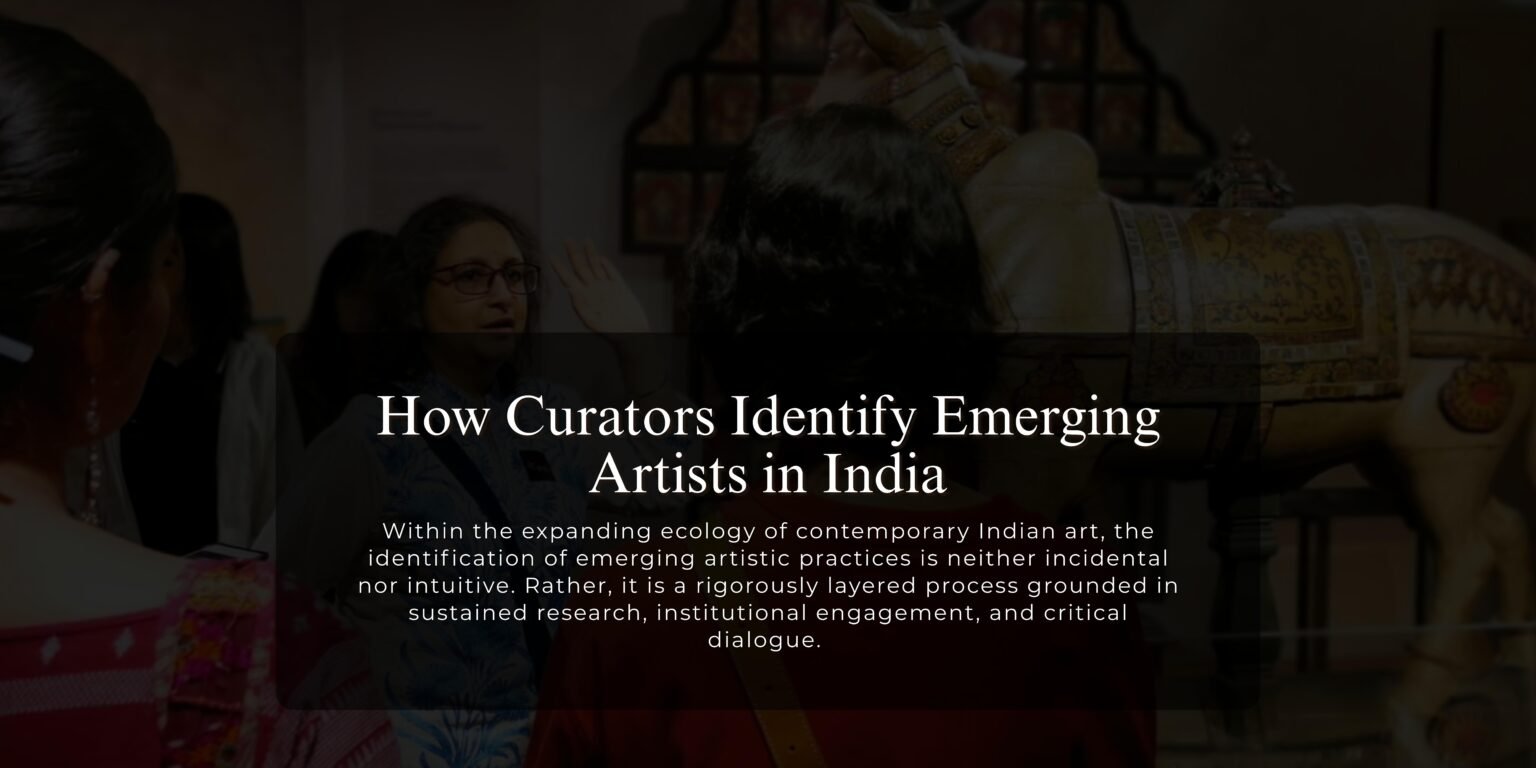

Within the expanding ecology of contemporary Indian art, the identification of emerging artistic practices is neither incidental nor intuitive. Rather, it is a rigorously layered process grounded in sustained research, institutional engagement, and critical dialogue. For curators operating within India’s complex cultural landscape, the act of “discovery” is less about immediacy and more about longitudinal observation, tracking the evolution of practices across sites, contexts, and discursive frameworks.
At the foundation of this process lies the continued relevance of institutional pedagogy. Degree exhibitions at leading art schools such as the Faculty of Fine Arts Baroda and Kala Bhavana remain critical entry points for curatorial inquiry. These spaces function not merely as academic endpoints but as incubators of nascent visual languages. Curators often approach these exhibitions as research fields, attentive to early articulations of form, material sensitivity, and conceptual ambition. What is particularly significant is not technical resolution, but the presence of a thinking practice, one that signals the potential for sustained inquiry.
Beyond institutional frameworks, residency programmes have emerged as pivotal sites for extended curatorial engagement. Organisations such as the Khoj International Artists’ Association exemplify this shift. Residencies offer a temporal dimension often absent in gallery exhibitions; they allow curators to encounter artists within the process of making, rather than at the point of completion. This exposure to iterative development enables a deeper understanding of an artist’s methodology, their responsiveness to context, and their capacity to engage critically with material and concept. In this sense, residencies function as laboratories of practice, where the trajectory of an artist can be more meaningfully assessed.
Parallel to these structured environments is the growing importance of independent and non-commercial exhibition spaces across urban centres such as Mumbai, Delhi, and Bengaluru. These spaces, often experimental and less constrained by market imperatives, provide visibility to practices that have yet to be absorbed into the commercial gallery system. For curators, they represent sites of risk and possibility, where unconventional approaches and marginal narratives can surface. The absence of overt market mediation allows for a more direct engagement with artistic intent, often revealing practices that challenge dominant aesthetic or institutional frameworks.
In recent years, digital platforms have further complicated and expanded curatorial research methodologies. Applications such as Instagram now operate as supplementary archives of artistic production. While not substitutes for physical engagement, they enable curators to track the continuity of practice over time, observing shifts in material exploration, thematic concerns, and visual coherence. Importantly, digital presence is not evaluated in terms of visibility alone, but in relation to consistency and critical depth. A sustained and self-reflexive practice often reveals itself through patterns of making, even within the fragmented temporality of online platforms.
Crucially, the selection of emerging artists is rarely predicated on formal qualities alone. Within the Indian context, curators increasingly prioritise practices that demonstrate a sustained engagement with context, whether socio-political, spatial, ecological, or material. The question is not simply what the work looks like, but what it does: how it situates itself within contemporary discourse, and how it negotiates the complexities of lived experience in India. This emphasis reflects a broader shift in curatorial thinking, where relevance is measured through critical positioning rather than aesthetic novelty.
Despite the proliferation of digital and institutional tools, the studio visit remains central to curatorial methodology. It is within the studio that the most nuanced insights emerge, through conversation, observation, and proximity to the processes of making. Studio visits allow curators to assess not only the coherence of an artist’s body of work, but also the intellectual and conceptual frameworks that underpin it. They reveal the rhythms of practice, the unresolved questions, and the internal logic that may not be immediately visible within exhibited works. In many cases, it is this encounter that determines whether a practice holds the potential for sustained relevance.
Large-scale platforms such as the India Art Fair serve a different, yet equally important function within this ecosystem. Rather than sites of discovery, they operate as points of consolidation, where practices that have been observed and tracked over time are presented within broader institutional and market networks. Visibility at such platforms signals a certain level of validation, positioning emerging artists within a larger discourse that includes collectors, galleries, and global institutions.
Ultimately, the identification of emerging artists in India is best understood as a durational process. It resists the immediacy of trend-driven visibility and instead privileges sustained engagement, critical reflection, and contextual awareness. For art advisory and consultancy practices, this approach is particularly significant. It underscores the importance of informed mediation, guiding collectors and institutions not towards what is merely visible, but towards what is intellectually and culturally consequential.
In an increasingly accelerated art world, where visibility can often be mistaken for value, the curatorial process offers a necessary counterpoint. It insists on time, rigour, and discernment. And in doing so, it ensures that the practices which emerge are not only relevant to the present, but capable of shaping the future of contemporary art discourse in India.