





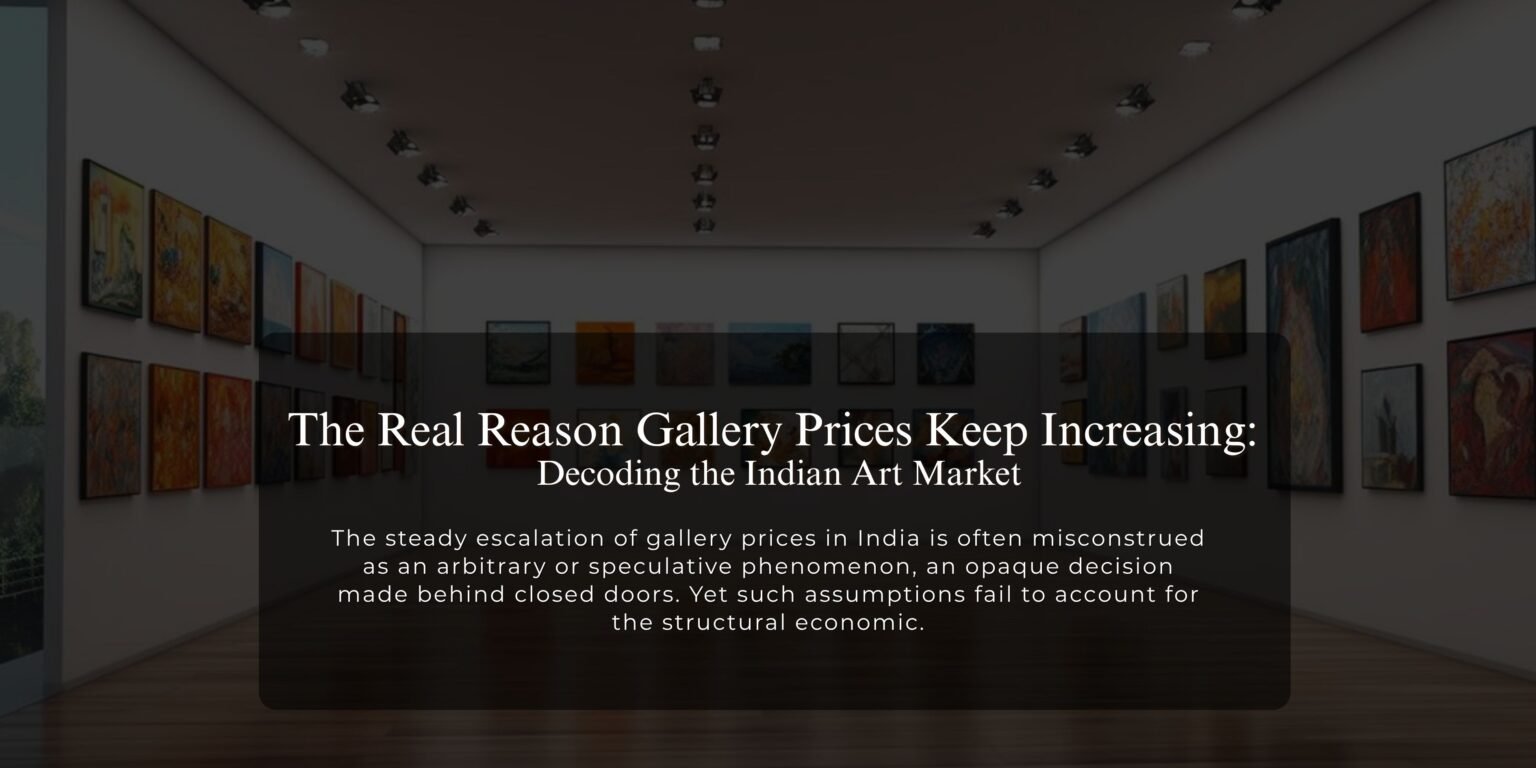

The steady escalation of gallery prices in India is often misconstrued as an arbitrary or speculative phenomenon, an opaque decision made behind closed doors. Yet such assumptions fail to account for the structural, economic, and cultural mechanisms that govern pricing within the Indian art ecosystem. Far from being impulsive, price increases are typically the outcome of a calibrated response to artistic trajectory, institutional validation, and market equilibrium. To understand this dynamic is not merely to decode pricing, but to grasp how value itself is constructed within contemporary Indian art.
At the centre of this process lies the principle of momentum. In the primary market, where galleries represent artists and place their works with collectors, pricing is closely tied to demonstrable demand. When an artist’s exhibition achieves a sell-out status, or when their works begin to enter significant private and institutional collections, galleries interpret this as a signal of growing market confidence. This momentum is not anecdotal; it is measured through sales velocity, waiting lists, and repeat acquisitions by serious collectors. Price adjustments, in this context, function as a rational response to increased demand rather than an anticipatory gamble.
Institutional visibility further amplifies this effect. Inclusion in exhibitions at major public institutions such as National Gallery of Modern Art or participation in curated biennales and museum-led projects often repositions an artist within a more rigorous art historical framework. Such validation extends beyond market appeal; it signals curatorial endorsement and scholarly relevance. Consequently, galleries recalibrate pricing to reflect not only demand but also the enhanced cultural capital associated with institutional recognition. For art advisory practices, this intersection of market and institutional validation serves as a critical indicator of long-term value.
Equally significant is the role of career progression. The transition from emerging to mid-career status represents a substantive shift in both artistic practice and market perception. Emerging artists are often priced accessibly to encourage entry-level collecting and to build a foundational collector base. However, as an artist’s practice matures—evidenced by increased scale, conceptual ambition, and critical engagement—their market positioning evolves. Mid-career artists are expected to produce more resolved bodies of work, often supported by a history of exhibitions, publications, and institutional engagement. Pricing, therefore, becomes a reflection of accumulated labour, intellectual depth, and professional development.
This progression is not merely qualitative; it is also strategic. Galleries operate within a long-term framework, cultivating artists’ careers over extended periods. Incremental price increases are part of this strategy, ensuring that early collectors are rewarded for their foresight while simultaneously signalling growth to new entrants. A stagnant price point, by contrast, can raise concerns regarding an artist’s trajectory, suggesting either a lack of demand or an absence of critical development. In this sense, pricing operates as both an economic and semiotic tool, communicating value, stability, and progression within the market.
The relationship between primary and secondary markets introduces another layer of complexity. Auction houses such as Sotheby’s and Christie’s play a pivotal role in establishing public benchmarks for value. When works by an artist achieve higher-than-expected results at auction, this information circulates rapidly within the market, influencing both perception and pricing. Galleries, in response, may adjust their primary market prices to align with these secondary market indicators, thereby maintaining credibility and coherence. Failure to do so can create disparities that undermine confidence among collectors and investors.
However, this alignment is not without its risks. Auction results can be volatile, influenced by factors such as provenance, rarity, and competitive bidding. Responsible galleries therefore exercise caution, ensuring that price increases remain consistent with the artist’s broader trajectory rather than reacting to isolated spikes. This measured approach underscores the importance of market balance, a concept that is often overlooked in discussions of pricing. Balance involves maintaining equilibrium between supply and demand, ensuring that works are neither overproduced nor undervalued.
Scarcity, in this regard, is a critical factor. Artists who produce selectively, prioritising quality over quantity, often experience more sustainable price growth. Limited availability enhances desirability, particularly among collectors seeking long-term value. Conversely, excessive production can dilute market interest, leading to stagnation or even depreciation. Galleries, therefore, play an active role in regulating output, working closely with artists to align production with demand without compromising artistic integrity.


The Indian context introduces additional nuances. Unlike more mature Western markets, where pricing structures are often standardised and transparent, the Indian art market operates within a hybrid framework, combining formal institutional practices with informal networks of collectors, advisors, and intermediaries. Relationships, reputation, and trust play a significant role in shaping transactions. As a result, pricing is not solely determined by quantitative metrics but also by qualitative factors such as gallery credibility, curatorial vision, and collector confidence.
Moreover, the increasing participation of Indian artists in global platforms has introduced new benchmarks for valuation. International exposure, through art fairs, residencies, and cross-border exhibitions, expands an artist’s collector base, often leading to upward price revisions. This global-local interplay has redefined the parameters of value, situating Indian artists within a broader transnational market while retaining the specificity of local context.
For art advisory and consultancy practices, these dynamics necessitate a nuanced approach to valuation. Pricing must be understood not as a static figure but as an evolving indicator of artistic and market development. Advisors are required to assess not only current prices but also the underlying factors that inform them: exhibition history, institutional engagement, collector base, and production patterns. Such an approach enables more informed acquisition strategies, balancing immediate considerations with long-term potential.
Ultimately, the escalation of gallery prices in India reflects a process of recognition rather than speculation. It is the market’s way of acknowledging an artist’s trajectory, an accumulation of labour, visibility, and validation over time. To interpret price increases as arbitrary is to overlook the intricate ecosystem that sustains artistic production and circulation.
In this light, pricing becomes more than an economic mechanism; it becomes a narrative device, charting the evolution of an artist’s career. For collectors, galleries, and advisors alike, the task is not merely to respond to these shifts but to understand the conditions that produce them. Only then can one engage meaningfully with the market, not as a space of opacity, but as a field of informed and deliberate exchange.