






Museums are often imagined as temples of memory, spaces where cultural heritage is displayed in gleaming galleries, telling us stories about art, history, and humanity. Yet, behind this public face lies a profound and often misunderstood reality: the vast majority of objects museums own are not on view. Instead, they reside in storage, meticulously cared for but hidden from public gaze. Understanding why this happens is essential not only for appreciating how museums function, but for grasping what it means to steward culture responsibly in the twenty-first century.
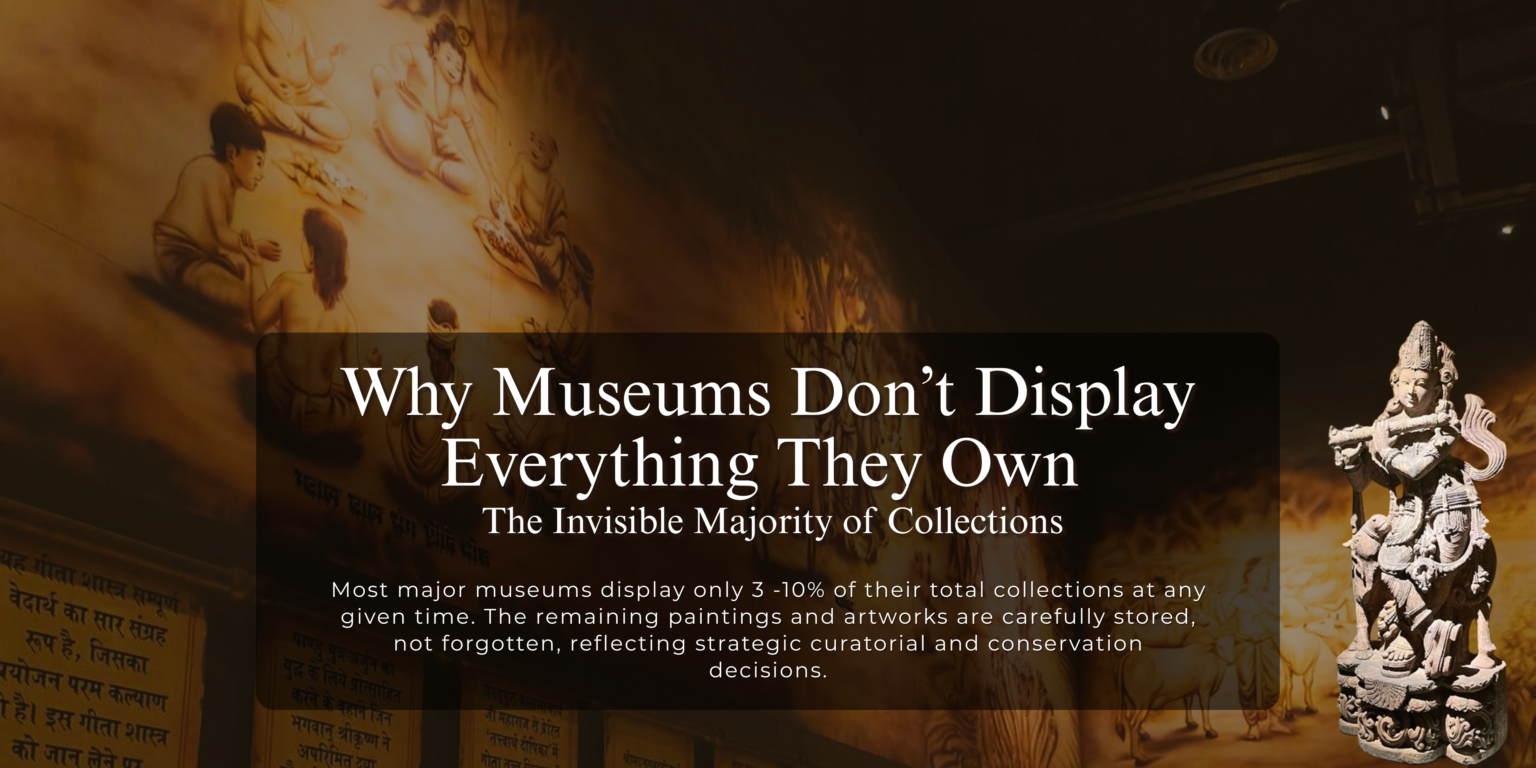
At many of the world’s leading institutions, only a remarkably small percentage, often between 3% and 10%, of a museum’s holdings is displayed at any one time. This statistic, echoed across museum practice literature, is not a symptom of negligence nor an attempt to “hide” objects from the public; rather, it is the outcome of a complex interplay between space, conservation science, curatorial narrative, and ethical stewardship.
1. Physical Space: A Finite Resource
The most immediate and tangible constraint is space. Museums accumulate collections over decades or centuries, and even as galleries expand, their capacity pales in comparison with the number of objects in their care. Artworks, archaeological finds, ethnographic materials, and natural history specimens can number in the tens of thousands to millions, far outstripping gallery footprints.
This disparity between collection size and display area is not unique to the largest institutions, it is a structural reality of the field. Curators must prioritize which objects serve the educational mission most effectively at a given moment. Lining every wall with every object would create visual overload, undermining the experience of contemplation and interpretation that museums strive to foster.
2. Conservation Imperatives: Protecting the Future
Beyond space, there is the imperative of conservation. Museums are custodians of cultural heritage, charged not only with display but with preservation for future generations. Many objects are intrinsically fragile; light, humidity, and temperature fluctuations can cause irreversible damage. Works on paper, textiles, and organic materials, for example, suffer accelerated deterioration when exposed to light for even moderate periods.
To mitigate these risks, artworks are rotated or kept in controlled storage environments where conditions are managed with scientific precision. Some materials can only be displayed for limited durations; others may undergo restoration before they are fit for exhibition. These conservation protocols ensure the longevity of collections, balancing access today with preservation tomorrow.
3. Curatorial Strategy: Narrative and Meaning



Museums are not static repositories; they are narrative spaces. Every exhibition is a curated argument, a deliberate arrangement of works that invites interpretation. Curators select objects not simply because they exist, but because they contribute meaningfully to a theme, dialogue, or research question. Displaying everything at once would dilute these narratives and compromise the educational intentions of the museum.
Thus, curatorial decisions are shaped by scholarly inquiry and institutional mission. For instance, a museum may prioritize works that illuminate under-told histories or strengthen representation of marginalized voices. Others rotate holdings within permanent displays or build special exhibitions around less commonly seen works to refresh public engagement and expand interpretive horizons.
4. The Hidden Majority: Storage as Care and Opportunity
Museum storage is often misconstrued as a dusty backroom where forgotten objects languish. In reality, storage is central to the museum’s mission. These facilities are engineered to provide optimal conditions for preservation, with rigorous climate control, archival materials, and expert handling. Items in storage are regularly reviewed, studied by scholars, and considered for future exhibitions.
Moreover, collections managers and registrars treat storage as a dynamic space. Open or “visible” storage, a practice whereby collections are shown in densely packed cases or specialized spaces, has emerged as an innovative way to increase access without compromising conservation or narrative coherence. Institutions from the Metropolitan Museum of Art to the Victoria & Albert Museum have adopted versions of this approach to bring more objects into public view.
Yet even visible storage is not a panacea; it often sacrifices interpretive context for breadth, and requires additional staff and infrastructure that many museums lack.
5. Ethical Considerations: Stewardship and Trust
Finally, museums hold collections in public trust. They are not private galleries that can casually divest themselves of holdings; they are stewards accountable to communities, donors, and future generations. Deaccessioning, the formal process of removing an object from a collection, is tightly governed and often controversial. Works are only deaccessioned when they no longer align with mission, are redundant, or cannot be responsibly cared for. These decisions are made with ethical rigor, not expediency.
In this light, the unseen majority of museum collections embodies a long-term commitment to cultural heritage. These are not forgotten objects but safeguards, resources for scholarship, education, and eventually, thoughtful presentation.
The Visible and the Invisible as Museum Practice
To look at a museum’s galleries without understanding what lies beyond them is to see only half the story. The objects in storage are not casualties of neglect but are part of a careful, deliberate, and ethically grounded practice that balances public access with preservation, scholarship with experience, and space with narrative intent.
Museums do not display everything they own because they are not warehouses of accumulation; they are institutions of meaning. The decision to house a work in storage is not a denial of its value, but a testament to the challenges of stewardship. In a world where cultural heritage is both fragile and indispensable, this balance, between what is seen and what is safeguarded, remains central to the museum’s role in society.