





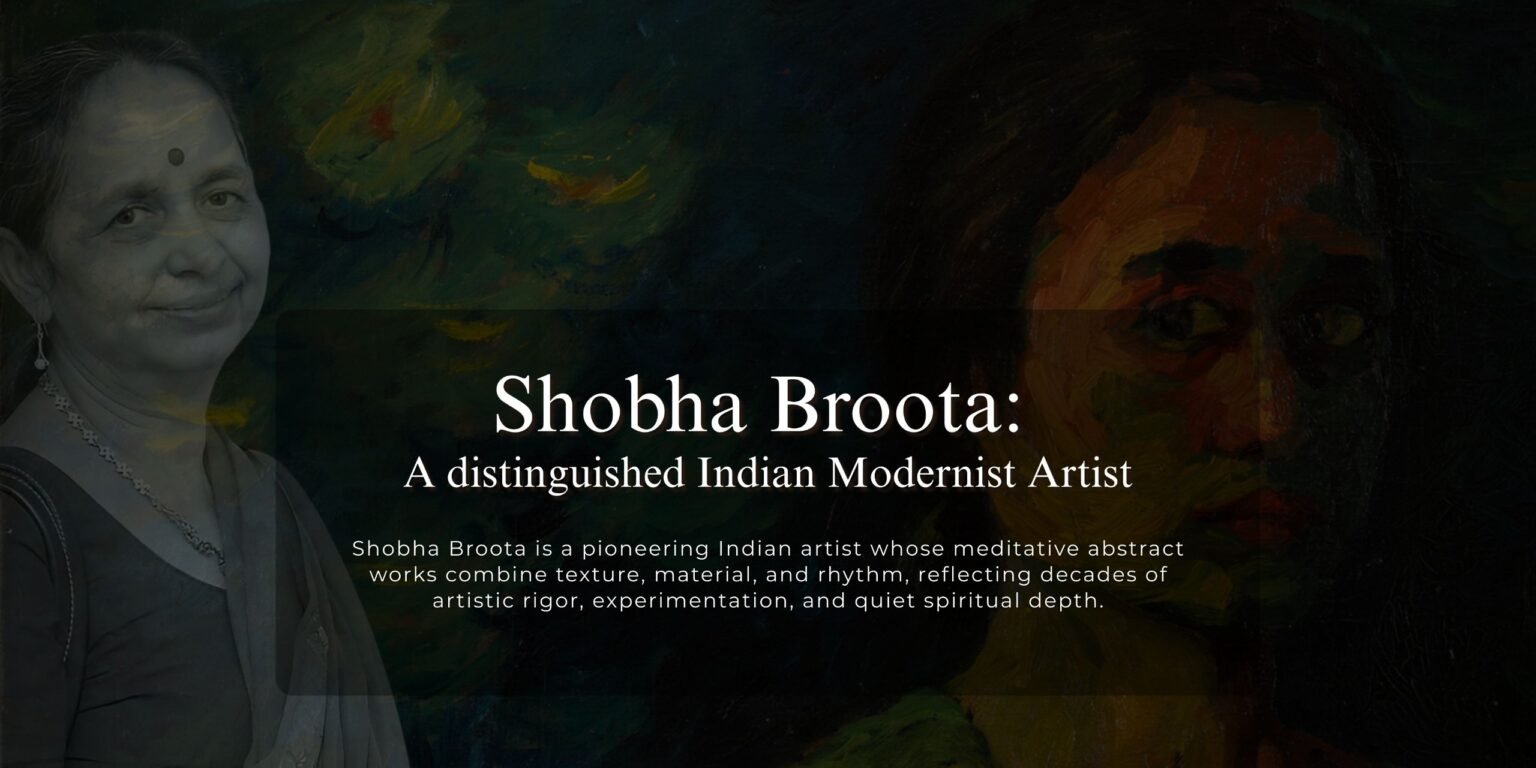

Shobha Broota (b. 22 January 1943, Delhi) stands as one of the most enduring and contemplative figures in Indian modern and contemporary art. Her practice encompasses a uniquely meditative abstraction that embodies rhythm, materiality, and spiritual depth, situating her work at the nexus of sensory perception and subtle philosophical enquiry. Over a career spanning nearly six decades, Broota has negotiated an artistic trajectory from figuration and figurative portraiture to minimalist and textile-infused abstraction, continually expanding the expressive capacities of her medium.
Early Life and Musical Foundations
Born into an artistically vibrant family in post-colonial Delhi, Shobha Broota’s formative years were steeped in both visual and musical culture. At the age of five, she commenced rigorous training in Indian classical music, eventually earning a Sangeet Visharad degree in Hindustani classical vocals at nineteen. In addition to her vocal discipline, she trained as a sitarist, and this early immersion in music profoundly shaped her artistic sensibility. Broota often speaks of music not merely as a parallel craft, but as an undergirding principle in her visual practice, endowing her paintings with rhythm, resonance, and silent cadence.
This confluence of sonic and visual worlds marks a distinctive feature of her art: the canvas becomes a space where rhythm is translated into visual pattern, and texture acquires a cadence reminiscent of musical composition. In the meditative stillness of her abstraction, one discerns a painterly equivalent of raga, where form opens into the atmosphere, and colour resonates like an inward vibration.
Academic Training and Early Career
Broota’s formal entry into the visual arts took place at the prestigious College of Art, Delhi, where she completed a Diploma in Fine Arts in 1964. This period of academic training provided her with disciplined command over draftsmanship and fine art traditions, forming a technical foundation that she would later transcend through experimentation. Immediately after graduation, she began teaching art, a vocation that she maintained alongside her own artistic production. Her early roles included appointments at the College of Art, Delhi, and later at Triveni Kala Sangam, where she influenced generations of young artists.
Artistic Evolution: From Figuration to Abstraction
Broota’s early works, beginning with her first solo exhibition in Delhi in 1965, were grounded in figurative portraiture and representational practice. These early canvases reveal an astute sensibility toward form, presence, and psychological nuance. However, through the 1970s and 1980s, her visual language underwent a significant transformation. She explored woodcuts and etchings, gradually distancing herself from overtly representational motifs and moving toward structured geometric forms and minimal abstraction.
By the late 1980s and early 1990s, her work had shifted decisively into the terrain of abstraction. In this phase, Broota began to distil visual expression into elemental forms, grids, dots, and fields of colour, that evoked universal principles of space, time, and being. Such shifts underscore a central aesthetic in her practice: the quest for a visual idiom that speaks less through depiction than through evocation.
Signature Styles and Material Experimentation
While Broota’s early abstract canvases rely on oil and acrylic media, her later practice embraced a compelling material ingenuity. She began incorporating hand-woven fabrics, threads, wool, silk and other textiles into her works, using them as tactile surfaces that extend abstraction into the realm of object and relief. These woven compositions, often described as woven paintings, are marked by rhythmic grids and intricate patterns that suggest both structure and suspension.
This textile approach not only enriches the sensory depth of her paintings but also gestures toward a poetics of labour and time. The repeated patterns and woven threads become a visual analogue of sustained focus, a meditation on continuity rather than narrative. In these works, colour and texture are not descriptive devices but resonate as metaphors for inner stillness and existential vibration.
Exhibitions and International Presence
Shobha Broota’s exhibition history is distinguished by both longevity and global reach. She has presented over two dozen solo exhibitions worldwide, including major shows such as Resonance at Aicon Gallery, New York (2018), Silent Murmurs in Los Angeles (2020), SNO Gallery in Sydney (2015), and Looking Within at the Museum of Sacred Art in Belgium (2014). These exhibitions consistently foreground her commitment to abstract forms that operate as sites of reflection and contemplation.
In India, her work has been showcased in landmark exhibitions such as Sutra at Gallery Espace in New Delhi (2021), which surveyed her mixed-media canvases fashioned over two decades, highlighting her distinctive idiom of line and resonance. More recently, Painting Infinity (2025) at Delhi Art Gallery offered a comprehensive retrospective, charting her evolution from portraiture and printmaking to metaphysical abstraction, organised into thematic sections that reflect her sustained intellectual inquiry.
Awards, Recognition, and Legacy
Throughout her career, Broota has received numerous honours, including awards from the All India Fine Arts & Crafts Society (AIFACS), Sahitya Kala Parishad, and the New Delhi Municipal Council (NDMC). She also received fellowships and scholarships from the Government of India’s Ministry of Culture, affirming her contribution to both artistic practice and pedagogy.
Her book Vesture of Being, co-authored with the eminent critic Keshav Malik in 2013, stands as a compelling reflection on her oeuvre, articulating the philosophical underpinnings that unite her canvases across decades.
A Quiet Force in Indian Abstraction
Shobha Broota’s art resists the spectacle of immediacy and instead invites a sustained, contemplative encounter. Whether through fields of colour, rhythmic patterning, or woven surface, her works resonate with a profound inner rhythm that dialogues with silence, spirituality, and the infinite. As a teacher, artist, and thinker, she occupies an indispensable place in the narrative of Indian modernism, one that continues to inspire rigorous introspection and cultural discourse.