




At the National Gallery of Modern Art (NGMA), New Delhi, visitors are invited to traverse an extraordinary artistic trajectory that maps not only the evolution of a visionary artist but also the tumultuous and transformative contours of modern India itself.
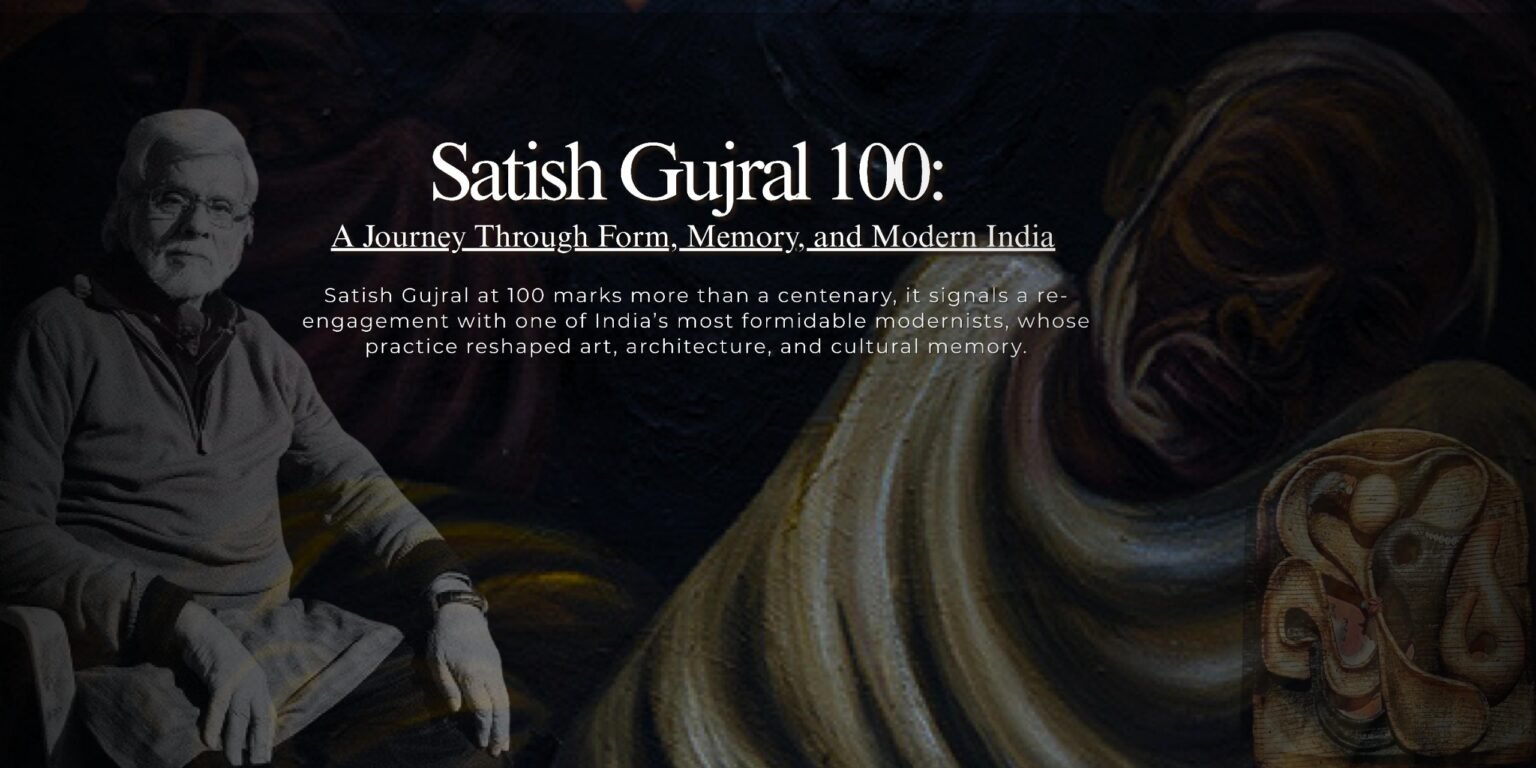
Satish Gujral 100: A Centenary Exhibition, opened on January 16, 2026, stands as a landmark commemoration of Satish Gujral’s seven-decade practice that bridged mediums, borders, and historical experience. It is an exhibition that unsettles the boundaries between the personal and the political, the material and the metaphysical, the witness and the maker.
Born in 1925 in Jhelum (now in Pakistan), Gujral’s life and oeuvre are inseparable from the subcontinent’s mid-twentieth century upheavals. Well before he became an architectural trailblazer and a celebrated modernist painter and sculptor, Gujral encountered the violence and dislocation of Partition, an event that haunted his earliest canvases. Works such as Mourners (1947- 48) and Snare of Memory (1954) articulate a visceral response to uprooted lives, reflecting a generation’s anguish with an expressive intensity that resonates well beyond their historical moment.
Curated by Kishore Singh in partnership with the Gujral Foundation and the Ministry of Culture, this centenary retrospective assembles 165 works spanning painting, sculpture, ceramics, architecture, and archival material. It affirms Gujral’s stature not simply as a multi-disciplinary artist but as a thinker whose practice interrogated the very conditions of modernity in India.
Memory, Materiality, and the Politics of Making
The exhibition’s core thematic thrust is memory, of history, silence, loss, and resilience. As visitors enter the Partition series section, they confront images laden with grief and stoicism, an aesthetic born of witnessing. These works do not merely depict suffering; they transform it into a poetic visual language, situating Gujral among the modernist artists who bent Western idioms to local histories and affective experience.
Parallel to his painting was Gujral’s sculptural experimentation, particularly his so-called “Burning wood” series. These reliefs, charred fragments of wood assembled into tactile, layered surfaces, are not only formally striking but conceptually dense: each piece embodies narratives of rupture and reconstruction, memory and decay. Kishore Singh has underscored that these works transcend material surface to evoke the suspended time of trauma and remembrance.
In rendering raw materials into monumental expression, Gujral’s work bespeaks an understanding of art as both embodied experience and civic intervention. His oeuvre insists that form is never divorced from content, nor aesthetics from ethics.
Beyond the Canvas: Architecture as Living Sculpture

If Gujral’s early paintings and sculptures testified to personal and national histories, his later architectural practice extended these concerns into public space. Untrained formally as an architect, he nonetheless conceived buildings, as his son Mohit Gujral observed, as “living sculpture”: environments that resonate with spatial narrative and sensory engagement.
The Belgian Embassy in New Delhi is emblematic of this philosophy, acknowledged internationally among the 1,000 Outstanding Buildings of the Twentieth Century. Its interplay of mass, void, and light reflects an artist’s sensibility transposed into inhabitable structure. Throughout India, his architectural projects, from university campuses to cultural institutions, retain a sculptural spirit that harmonises function and poetic form.
This synergy of art and architecture was further underscored in associated celebrations during the centenary year, including exhibitions focused on his architectural drawings and installations at India Art Fair and beyond, signalling how his influence persists across disciplines.
Accessibility, Inclusivity, and Curatorial Innovation
What distinguishes Satish Gujral 100 as a contemporary exhibition is its commitment to accessibility. Alongside monumental works, the NGMA showcase includes miniature pieces with Braille textures, enabling visually impaired audiences to engage with Gujral’s sculptural forms through touch. This curatorial choice embodies a profound democratic ethos, one that aligns with Gujral’s own belief in art as a vehicle for shared human experience.
Moreover, the inclusion of personal objects, architectural drawings, and studio archives invites the viewer into the artist’s creative interiority, rendering the exhibition at once archival and experiential.
A Legacy Interwoven with Modern India
Satish Gujral’s accolades, the Padma Vibhushan, Belgium’s Order of the Crown, and Mexico’s Da Vinci Award for Lifetime Achievement, attest to an international recognition rooted in deep cultural engagement. Yet, his most enduring contribution lies in the way his work recasts adversity as artistic agency, his practice as a lens through which India’s modern journey can be apprehended.
Even today, four years after his death in 2020, Gujral’s work remains a testament to art’s capacity to reflect collective memory and to articulate a shared humanity, a legacy eloquently captured in this centenary exhibition.
An Invitation to Re-Engage
Satish Gujral 100: A Centenary Exhibition, is not merely a retrospective in the conventional sense; it is an invitation to re-engage art as a living discourse. In mapping Gujral’s journey from the trauma of Partition to the formal audacities of architectural spaces, the exhibition encourages reflection on how creative resilience can shape not only artistic form but historical understanding.
In a moment where cultural institutions increasingly seek relevance and resonance, Gujral’s work reminds us that the most powerful art is that which insists on empathy, depth, and sustained inquiry into the human condition.