




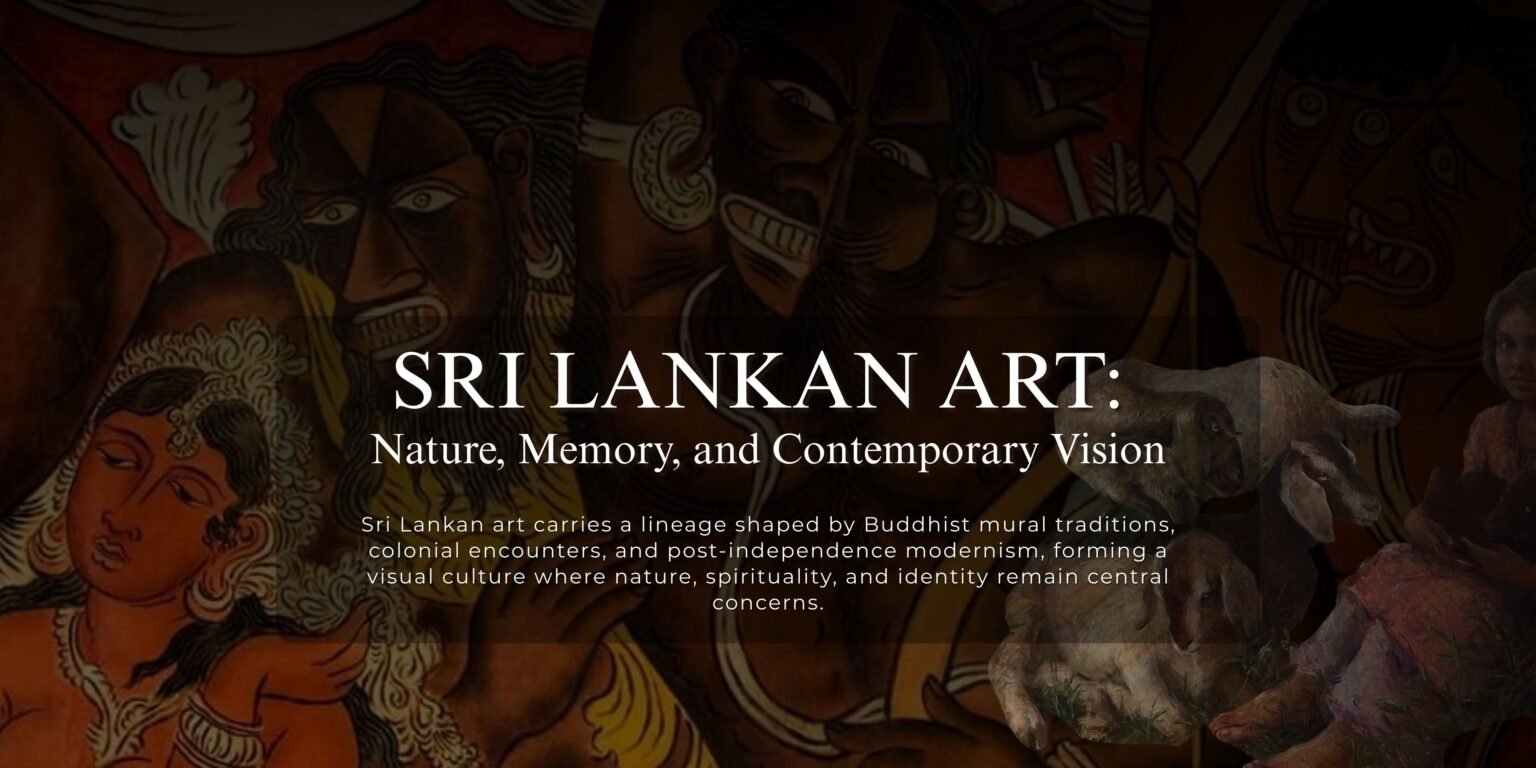

A Continuum of Tradition, Identity, and Creative Transformation
Sri Lanka’s artistic lineage is a rich testament to the island’s unique cultural synthesis, an evolving continuum where ancient spirituality, colonial encounters, and post-independence modernism interweave to shape a distinctive visual vocabulary. From early Buddhist murals depicting Jātaka tales of the Buddha to the modernist ruptures of the mid-20th century, Sri Lankan art continuously negotiates the interstitial spaces between local identity and global discourse. This essay traverses the historical foundations of Sri Lankan art and foregrounds several pivotal figures whose practices reflect the nation’s ecological, psychological, and socio-cultural complexities.
A Living Tradition Anchored in Buddhist Visual Culture
The origins of Sri Lankan visual culture are deeply rooted in the Buddhist artistic tradition. Since Buddhism’s introduction to the island in the third century BCE, narrative frescoes, iconographic sculpture, and temple murals have articulated spiritual ideals and cosmological allegory. These works, found at UNESCO World Heritage sites such as Sigiriya, Anuradhapura, Polonnaruwa, and Dambulla, often depict scenes from the life of the Buddha and Jātaka stories that communicated moral precepts to devotees across centuries. The enduring quality of these frescoes lies not only in their technical sophistication but also in their capacity to evoke spiritual contemplation and aesthetic resonance.
In subsequent eras, Kandyan period painting (1592–1815) further developed temple iconography by rendering Buddhist episodes across extensive mural surfaces, infusing local artistic idioms with symbolic flower motifs and traditional patterns. This lineage, which juxtaposes narrative depth with visual ornamentation, served as an important precursor to modern Sri Lankan art.
Modernism’s Emergence and the ’43 Group
The mid-20th century witnessed a pivotal shift as a cohort of Sri Lankan artists engaged with European modernist idioms while remaining rooted in local aesthetics. The Colombo ’43 Group, established in 1943, catalysed this transition by melding European influences with indigenous themes and forms. Founding members included George Keyt, Ivan Peries, Justin Daraniyagala, Richard Gabriel, and Lionel Wendt, among others. This collective rejected the colonial academic norms of their time, forging a modernist art language that was both globally aware and critically engaged with Sri Lankan cultural heritage.
George Keyt: Modernism and Mythic Narrative


Among Sri Lanka’s most influential artists, George Keyt (1901–1993) stands as a singular figure whose practice exemplifies the synthesis of local mythology and global modernism. Drawing upon Cubism, the decorative aesthetics of South Asian miniatures, and Buddhist and Hindu iconography, Keyt reconfigured the lexicon of modern art in Sri Lanka into a distinctive visual language. His canvases and frescoes often portray fluid, rhythmic forms inspired by the Jātaka tales and other mythic narratives, imbuing them with a modernist sensibility that resonates across South Asian art histories.
Keyt’s contributions extended beyond his paintings; he was a poet and intellectual whose essays articulated the artist’s philosophical commitments. His work remains foundational to understanding Sri Lankan modernism both within the island and in broader South Asian contexts.
Ivan Peries: Exile, Memory, and Psychological Poetics
Ivan Peries (1921–1988), another seminal member of the ’43 Group, articulated a deeply introspective mode of modernism. Peries’s work, often described as quietly contemplative and evocative, explored themes of displacement, memory, and the psychological imprint of post-colonial identity. His compositions convey a dreamlike yet grounded sense of place, weaving personal and collective narratives into representations of landscape and figure that are at once meditative and formally rigorous. Exhibitions such as Figures in a Landscape illustrate his capacity to evoke an emotional poetics that transcends literalism while maintaining connection to Sri Lankan sensibilities.
V. Senaka Senanayake: Environmental Vision as Contemporary Narrative
In the contemporary sphere, Senaka Senanayake emerges as a vital artistic voice whose work resonates with urgent ecological concerns. Celebrated for his vibrant and expansive depictions of rainforests, tropical flora, and fauna, Senanayake transposes the sensory richness of Sri Lanka’s natural landscapes into dynamic painterly expressions. Senanayake’s biography is remarkable: he first exhibited internationally at the age of ten and later refined his craft through studies in art and architecture at Yale University before returning to Sri Lanka.
What distinguishes his practice is its environmental intentionality. Rather than depicting ecological loss through denial or negation, Senanayake infuses his canvases with lush, saturated color, evoking both the beauty and fragility of endangered ecosystems. His work functions as visual advocacy, inviting viewers worldwide to contemplate conservation and cultural stewardship.
Shanaka Kulathunga: Figuration, Memory, and Psychological Interiorities
Against the backdrop of Sri Lanka’s evolving contemporary art scene, Dr. Shanaka Kulathunga occupies an intriguing interstice between figuration and introspection. A medical doctor by training and an artist by vocation, Kulathunga’s work delves into the complex terrains of human experience, memory, solitude, emotion, and lived identity. Educated at the Vibhavi Academy of Fine Arts under the mentorship of Chandraguptha Thenuwara, Kulathunga’s paintings reflect his dual engagement with scientific precision and expressive depth.
His portraiture and figurative compositions foreground moments of psychological intensity and lived experience, inviting viewers into quiet yet profound encounters with the human condition. Through subtle compositions and nuanced exploration of form, Kulathunga articulates a visual narrative that bridges observation and introspection.
Jagath Weerasinghe and Contemporary Criticality
In the realm of contemporary critique, Jagath Weerasinghe represents a significant conceptual voice. Known for his engagement with politics, history, and social discourse, especially in the wake of Sri Lanka’s protracted civil conflict, Weerasinghe’s practice challenges dominant narratives and expands the critical apparatus of Sri Lankan art. His work underscores how artists can act as cultural interlocutors, translating socio-historical tensions into compelling visual forms that interrogate power, memory, and identity.
Between Ecology, Memory, and Modern Expression
Sri Lankan art, from its ancient Buddhist roots to its contemporary articulations, navigates a persistent dialogue between tradition and transformation. Through figures such as George Keyt, Ivan Peries, Senaka Senanayake, Shanaka Kulathunga, and Jagath Weerasinghe, the island’s artistic practices encompass mythic resonance, environmental witness, psychological depth, and socio-political critique. Together, they define a cultural continuum that is globally engaged yet unmistakably grounded in the island’s ecological rhythms and storied past.
In an era where cultural narratives intersect with global discourses on identity, ecology, and memory, Sri Lankan art offers a compelling case study of how visual culture mediates between heritage and contemporary consciousness.