





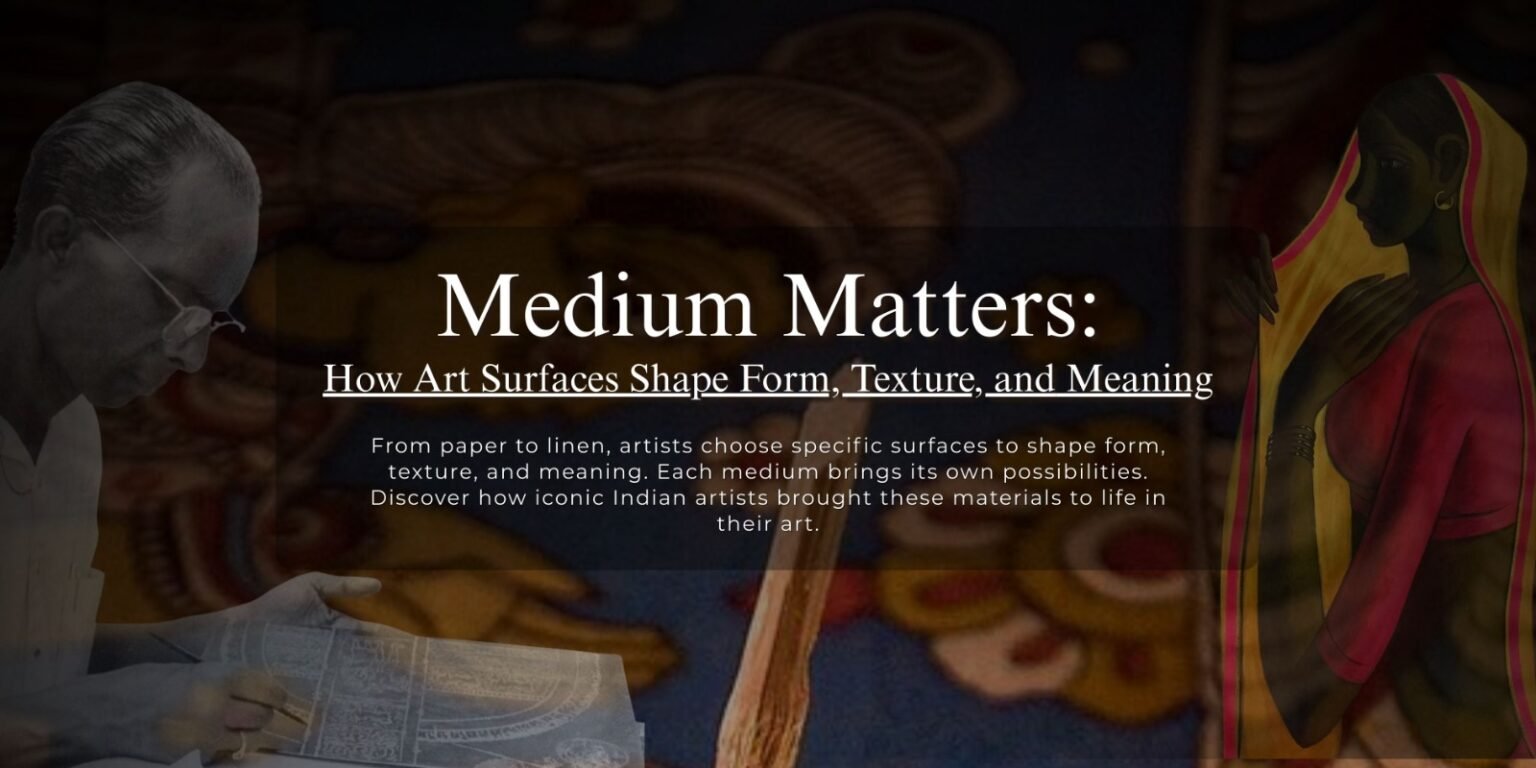

In visual art, the choice of surface is not merely technical; it is foundational to the work’s expressive potential. From the delicacy of paper to the solidity of linen and the transparency of glass, each substrate invites a distinct set of aesthetic concerns, constraints, and opportunities. Across the history of Indian modern and contemporary art, artists have harnessed these material characteristics not only to facilitate technique but also to deepen conceptual resonance. This article explores how specific surfaces like paper, masonite, canvas, wood, linen, cloth, glass, and acrylic interact with artistic intention, and how landmark Indian artists have exploited these dynamics to expand the visual language of South Asian art.
Paper: Foundation of Line, Print, and Experimentation
Paper has long served as a fundamental artistic ground, prized for its responsiveness to line, tone, and texture. It is the medium of choice for drawing, printmaking, watercolour, and mixed media because it accommodates a range of marks, from the lightest wash to the most incisive etched line. Modern Indian artists such as K. Laxma Goud exemplify the narrative and formal richness achievable on paper. Goud’s prints and drawings often deploy etching techniques that articulate contours and layered surfaces, fusing folk narrative with refined graphic expression.
Paper’s porous surfaces absorb and hold pigment in ways that emphasize gesture and immediacy, making it a preferred ground for artists who foreground process, memory, and observation. Its archival quality, coupled with its sensitivity to media, continues to make it an indispensable component in contemporary studios across India.
Masonite Board: Stability and Luminous Surfaces
Pressed wood boards like masonite offer a rigid, uniform surface that supports detailed paint application and layered effects. This was the preferred substrate for one of India’s most celebrated contemporary women artists, Anjolie Ela Menon, whose luminous paintings on masonite are iconic in Indian modern art. Menon’s use of oil on masonite allowed her to build translucent washes that achieve a jewel‑like glow and a subtle interplay of colour and light, lending her figurative compositions a distinct presence that differs from traditional canvas painting.
Masonite’s hardness and smoothness facilitate techniques such as glazing and scraping, enabling controlled alterations and a refined finish that resonates with Menon’s synthesis of European and Indian artistic influences.
Canvas: The Flexible Workhorse

Canvas remains the most widely recognized surface for oil and acrylic painting due to its combination of tensile strength, texture, and scalability. Its woven fibres create a surface that responds well to layered colour, impasto, and gestural mark‑making. Indian artists working in this tradition, such as B. Prabha, adopted oil on canvas to portray elongated figures and evocative colour harmonies that foreground emotional depth and sociocultural narratives. Prabha’s canvases resonate with a contemplative warmth and an articulation of form that exploits canvas’s subtle texture to amplify visual rhythm.
Canvas also allows for works of varying scale, from intimate studies to expansive compositions, enabling artists to tailor their visual vocabulary to the thematic requirements of their practice.
Wood: Solidity and Surface Presence
Wood has a long lineage as a support for painting and relief carving. Its solidity and grain introduce a tactile warmth that can enhance the physical presence of an artwork. In Indian art history, while wood has been used for traditional sculpture and icon panels, contemporary artists also engage with it for its natural texture and structural qualities. For instance, in sculptural practices, artists such as Ranjani Shettar integrate hand‑carved wood into large‑scale installations, preserving and accentuating the inherent surface of the material, thereby foregrounding its organic qualities as a structural and visual element.
This engagement underscores how wood’s materiality can influence sculptural and pictorial languages by anchoring the work in tangible, natural presence.
Linen: Refined yet Durable
Linen is esteemed by painters for its refined weave, durability, and archival performance. It provides a subtle, tactile surface that enhances the luminous effects of oil and acrylic pigments, often preferred for works intended to endure. Indian painter Laxman Aelay has explored the possibilities of linen within his mixed media approach, where the fine weave of the cloth permits nuanced layering, blurring the boundaries between drawing and painting.
Linen’s natural fibres and resilience under repeated handling make it particularly suitable for artists whose practice combines detailed mark-making with a commitment to longevity.
Cloth: Textile Surfaces and Narrative Expression
Cloth occupies a unique position between craft and fine art. Its flexibility, texture, and cultural associations have led artists to treat fabrics not merely as a support but as an active participant in meaning‑making. Across India, cloth has been integral to textile traditions, from batik to embroidered narrative panels, and many contemporary artists inherit and transform these legacies. Textiles invite exploration of dye, weave, and colour, and their historical functions, ritual, ceremonial, or utilitarian, inject layers of cultural reference into fine art. While specific contemporary examples vary widely, textile‑based approaches illustrate how material histories can shape artistic expression.
Glass: Transparency, Reflection, and Light
Glass as a surface introduces an interplay of transparency, reflection, and spatial depth that is unattainable on opaque supports. Artists such as M. F. Husain and A. A. Raiba ventured into glass painting and experimentation, exploiting the medium’s capacity to modify light and foreground colour as an active, luminous force.
In glass, paint and pigment interact with light differently than on canvas or board; reflections, refractions, and layered transparency become part of the work’s visual grammar. This makes glass a compelling choice for artists seeking to engage perception and presence in innovative ways.
Acrylic Sheets: Clarity and Depth in Contemporary Practice
In recent decades, rigid transparent supports such as acrylic sheets have opened new avenues for artists. These surfaces permit reverse painting, layering, and optical effects that foreground depth and spatial ambiguity. Contemporary Indian practitioners like Shyamal Mukherjee (among others) employ reverse painting on acrylic, producing vibrant, layered compositions that harness the medium’s clarity and physical depth to reconfigure narrative and figurative motifs in a modern idiom.
Acrylic sheets’ sleek surface and rigidity allow artists to work on both sides of the support, generating visual complexity while engaging with notions of transparency and layering that expand beyond the flat picture plane.
The relationship between medium and meaning in art is far from incidental. Surfaces such as paper, canvas, masonite, wood, cloth, glass, and acrylic each provide distinct affordances that shape artistic decision‑making. Indian artists, from the incisive printworks of K. Laxma Goud to the luminous masonite paintings of Anjolie Ela Menon and the expressive canvases of B. Prabha, demonstrates that the substrate is as integral to artistic expression as gesture and colour. Understanding these material choices enriches our appreciation of the work and illuminates the intricate ways in which surface and substance converge in the making of art.