





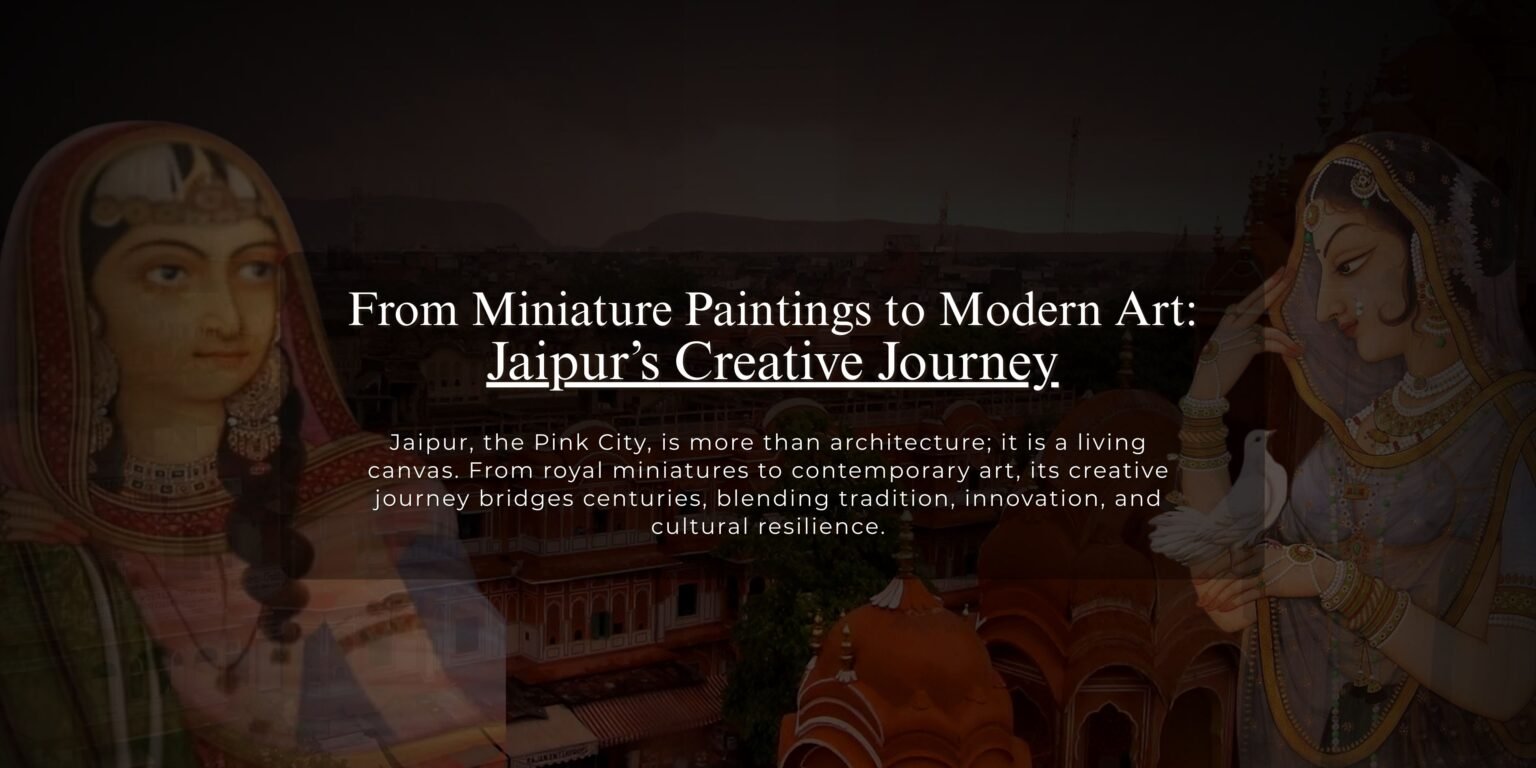

Jaipur, the celebrated Pink City of Rajasthan, is renowned not only for its architectural splendour but also for its extraordinary artistic traditions. Its creative trajectory encapsulates a distinctive dialectic between deep historic roots and contemporary expression. From the meticulous craft of miniature painting nurtured under royal patronage to a burgeoning ecosystem of modern and contemporary practices, Jaipur’s artistic evolution offers compelling insights into how tradition and innovation converge in complex cultural terrains.
A Courtly Canvas- The Origins of Miniature Painting
The tale of Jaipur’s art begins with Rajasthani miniature painting, an indigenous art form that attained remarkable refinement between the 17th and 19th centuries. Miniature painting in the region is characterised by its intricate brushwork, vivid palette, and intimate scale, often created on materials as varied as paper, cloth, and ivory with natural pigments of mineral and plant origin. Artists employed brushes crafted from squirrel hair to achieve astonishing levels of detail, rendering court scenes, mythological narratives, and episodes of nature with exquisite precision. These paintings were deeply embedded in the cultural ethos of Rajasthan, reflecting both secular and spiritual themes. Jaipur’s own school of miniatures, emerging from the erstwhile Amber State, developed a distinctive visual vocabulary that melded local aesthetics with Mughal influences, emphasising understated colour palettes and vibrantly energetic figures.
Central to preserving this tradition in modern times has been artists like Syed Shakir Ali, whose lifelong dedication to miniature painting has earned him national recognition. Born into a family with artistic lineage, and trained under eminent practitioners in the Mughal and Company styles, Shakir Ali has played a pivotal role in both sustaining and revitalising the Jaipur miniature idiom. His work, grounded in meticulous technique and deep cultural knowledge, underscores how these historic practices remain vital and dynamic. In 2013, he was honoured with the Padma Shri, one of India’s highest civilian distinctions, in recognition of his contributions to the field.
Living Traditions and Community Engagement
Today, Jaipur’s miniature painting is not confined to museums and private collections but thrives in classrooms, studios, and workshops across the city. Institutions such as art centres and private studios offer courses in traditional miniature techniques, enabling a new generation of artists and enthusiasts to engage directly with this heritage craft. Such initiatives play a critical role in sustaining artisanal knowledge systems and ensuring their relevance in contemporary cultural practice.
Moreover, festivals and exhibitions, such as those showcased at the Jaipur Centre for Art, provide platforms where historical practices intersect with contemporary sensibilities. Recent programming at the centre has included exhibitions that foreground miniature painting alongside contemporary voices, illustrating how the historical form continues to inspire innovation in visual expression.
Expanding Horizons: Folk and Popular Expressions


Beyond the formal traditions of courtly miniatures, Jaipur’s art scene is enriched by folk painting practices that express the cultural narratives of rural communities. Rajasthani folk arts such as Phad painting exemplify this vibrant lineage. Traditionally scroll‑like in format and rich in religious storytelling, Phad works are repositories of oral epic traditions, depicting deities and heroic figures in sustained visual narratives. While historically the domain of specific artistic communities, efforts to broaden access through formal instruction have helped expand the visibility and appreciation of these forms beyond their original contexts.
Modern and Contemporary Inflections
Parallel to the resilience of traditional art forms, Jaipur is witnessing a creative renaissance that actively engages with global artistic currents. Contemporary art festivals, workshops, and international collaborations have animated the city’s cultural landscape, inviting artists from India and abroad to explore Jaipur’s unique aesthetic heritage. Annual events such as the Cartist Automobile Art Festival merge cultural heritage with creative experimentation, fostering dialogue between established masters and emerging practitioners across disciplines.
International workshops, including watercolour symposiums that invite contributions from artists worldwide, further demonstrate how Jaipur’s artistic identity is expanding in scale and scope. These engagements foreground heritage sites, from Amer Fort to Jal Mahal, as living subjects of artistic inquiry, connecting historical architecture with contemporary artistic practice.
Jaipur as a Creative Hub
Recent cultural initiatives signal Jaipur’s emergence as a centre of creative synergy, where heritage and contemporary modes of expression coalesce. Projects spearheaded by cultural custodians and institutions, such as the Jaipur Centre for Art and collaborations with global curators, have expanded the city’s artistic horizons, drawing international attention while nurturing local talent. This renaissance reverberates across design, craft, and visual arts, positioning Jaipur as both guardian of tradition and incubator of contemporary creativity.
Jaipur’s evolution thus reflects a layered cultural narrative. Its miniature paintings, once sustained by royal patronage, now form part of a broader ecosystem that includes folk traditions, modern art practices, and global cultural exchanges. In each instance, the city’s creative journey highlights how historic forms do not reside in static preservation but are continually reinterpreted through new voices and visions.
Looking Forward: Sustaining Artistic Continuity
At the heart of Jaipur’s creative journey is the tension between preservation and transformation. The sustained cultivation of traditional practices like miniature painting, both through master‑apprentice lineages and formal programmes, ensures that historic forms remain vital. At the same time, contemporary artistic initiatives reframe these legacies within global dialogues, prompting fresh interpretations that resonate with diverse audiences.
For collectors, curators, and cultural practitioners, Jaipur offers a rare vantage point from which to study artistic continuity and change. Its artistic tapestry, woven from historic mastery and contemporary ingenuity, affirms that the city’s creative journey is not merely a chronicle of styles but a living testament to the resilience and adaptability of artistic cultures.