





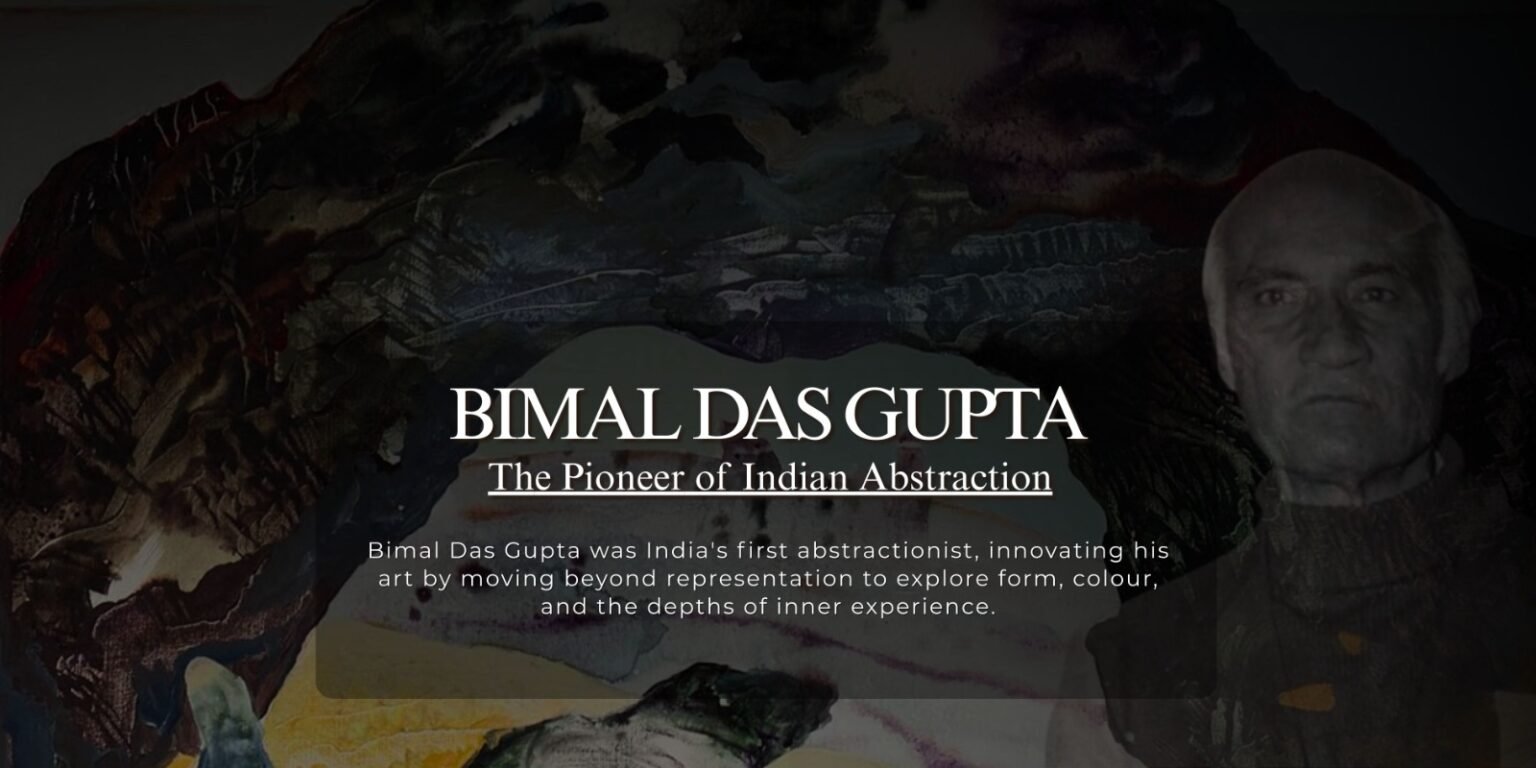

In the sprawling narrative of modern Indian art, few figures have charted a course as quietly radical and enduringly influential as Bimal Das Gupta (1917–1995). Long recognised by scholars, curators, and artists alike as one of the earliest proponents of abstraction in India, Das Gupta’s work reflects not only the country’s encounter with modernism but also a sustained interrogation of form, colour, and spiritual resonance.
Often overlooked in mainstream art histories for decades, Das Gupta’s art is now undergoing deserved reevaluation through exhibitions, publications, and renewed scholarly attention. This resurgence testifies to the depth of his artistic innovation and his unique position within the development of Indian abstraction.
Early Life and Artistic Formation
Born in Bengal in 1917, Bimal Das Gupta’s relationship with art began amidst familial ambivalence. Raised by his uncle, an employee in Delhi, he faced early resistance from relatives who deemed an artistic vocation impractical. Nevertheless, with the support of his father, he joined the Government College of Arts and Crafts in Calcutta in 1937, a pivotal moment that initiated his lifelong dialogue with visual form.
Das Gupta’s education was interrupted by the exigencies of the Second World War, during which he worked as a clerk in a war office and served as assistant art director for Victory magazine. This period, while seemingly tangential, expanded his visual sensibility and exposed him to applied arts and design, skills that would complement his later experiments.
After the war, Das Gupta worked with the renowned Dhoomimal Art Gallery in New Delhi and subsequently accepted a teaching position at the College of Art, New Delhi, where he taught for fourteen years. This dual practice of pedagogy and creation situated him at the centre of India’s evolving art scene, allowing him to influence and be influenced by a new generation of artists.
The Evolution of an Abstractionist
Das Gupta’s artistic trajectory defies simplistic categorisation. His early works retained a landscape idiom, often evoking the lyrical vistas and organic forms of his immediate environment. However, his scholarship in Europe in the early 1960s introduced him to a wider range of techniques and materials, including gouache, oils, watercolours, and eventually acrylics.
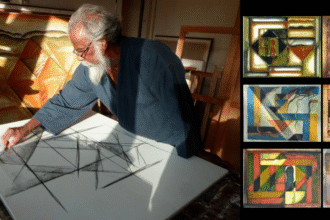
The influence of European modernism is evident in his tentative explorations of Cubism, but he did not adopt these methods uncritically. Instead, Das Gupta assimilated them into a distinctly personal language that remained deeply tied to India’s visual and philosophical traditions. His subsequent engagement with neo-tantrism, an aesthetic movement that blended spiritual concepts with abstract form, marked a decisive shift toward non-representational art.
By the 1940s, a time when most Indian artists were still navigating colonial legacies and figurative nationalism, Das Gupta was already probing the limits of abstraction, making him one of India’s first serious abstractionists.
Themes, Techniques, and Vision
At the heart of Das Gupta’s work lies an abiding fascination with nature, its rhythms, textures, and cosmic dimensions. Whether portraying oceanic depths, the interplay of light across a landscape, or meditative geometric forms, his paintings convey an embodied sensibility that bridges the external world and the artist’s inner vision.
Unlike some contemporaries who foregrounded the purely formal aspects of abstraction, Das Gupta’s canvases often evoke universality without forsaking intimacy. His mastery of watercolour, a notoriously challenging medium, and his later adoption of acrylics allowed him to explore translucency, layering, and chromatic subtlety with a rare finesse.
Critics and curators have noted the “spellbinding” quality of his colour harmonies, where earth tones, muted palettes, and bursts of light coexist in compositions that are at once serene and dynamic. These qualities helped define a uniquely Indian approach to abstraction, one that is meditative rather than merely expressive.
Recognition and Legacy
Das Gupta’s contributions were recognised during his lifetime. In 1972, he received an award from the Sahitya Kala Parishad in New Delhi, and in 1989, he was honoured as a Fellow of the Lalit Kala Akademi, one of the highest distinctions in Indian visual arts.
His works were exhibited widely, both in India and internationally, and he received commissions for significant projects, including murals for India pavilions at international fairs in Moscow and Tokyo.
Yet despite this recognition, Das Gupta’s oeuvre gradually receded from public view after his death in 1995, tragically resulting from a roadside accident that also claimed the lives of his immediate family.
Only now, in exhibitions such as “Bimal Das Gupta: Tutelage, An Ode to a Legend”, curated by institutions including Dhoomimal Gallery and Gallery Silver Scapes, is his legacy being reasserted within contemporary discourse. These exhibitions retrace his journey from early landscapes to mature abstraction across six decades, inviting renewed engagement with a visionary who helped shape Indian modernism.
A Distinct Place in Indian Art History
Bimal Das Gupta’s art occupies a singular space in India’s artistic evolution: an intersection of indigenous sensibility, global consciousness, and experimental audacity. At a time when prevailing tendencies leaned toward figurative realism, he pursued a path that was both introspective and outward-facing, anticipating many of the dialogues that define contemporary art today.
His legacy is not merely that of an abstract painter but of an artist who expanded the expressive possibilities of Indian art and challenged his peers and successors to consider abstraction not as an imported style, but as a mode of inquiry rooted in lived experience and philosophical engagement.