





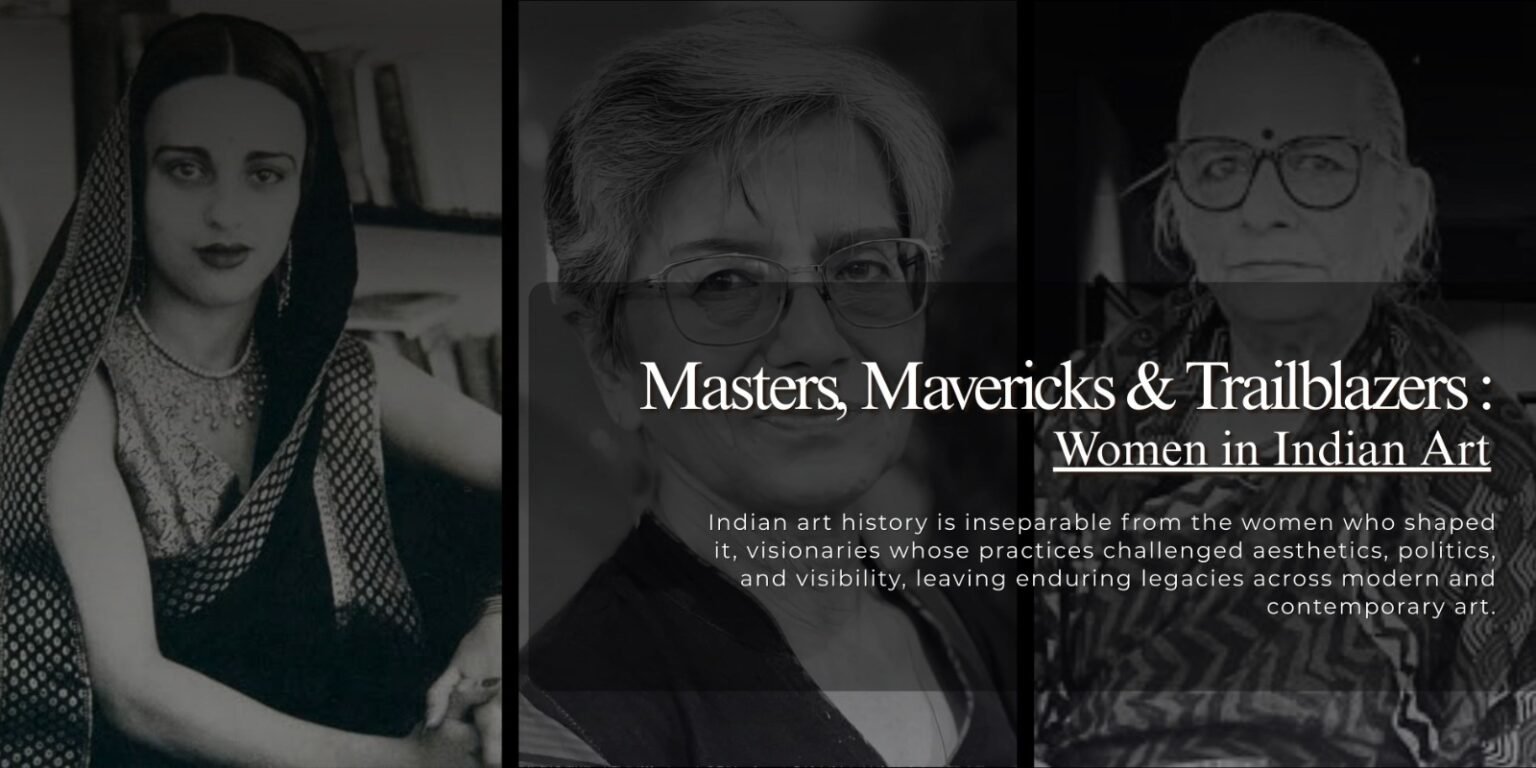

Throughout the arc of Indian art history, women creators have been both custodians of tradition and pioneers of avant-garde expression, even when the dominant narratives of art historiography sidelined their contributions. Masters, Mavericks & Trailblazers: Women in Indian Art is not merely a catchy title but a conceptual lens through which we can decipher the multiplicity of Indian women’s engagements with visual culture: as bearers of ancient artistic legacies, innovators within modernist vocabularies, and insurgent voices in contemporary practices.
Ancient and Folk Roots: The Unheralded Beginnings
The Indian subcontinent’s visual traditions have long depicted the feminine principle, from the sensuous yakshis of Mauryan and Shunga-era sculpture to the dynamic body rhythms of tribal folk traditions. While works such as the Dancing Girl of Mohenjodaro were created millennia ago, they articulate a visual grammar of movement, form, and identity that resonates with centuries of female representation. The book Women in Indian Art (Agam Kala Prakashan) elucidates how these early portrayals highlight social and cosmological understandings of female forms, even in the absence of named women artists in the corpus of early Indian art.
In the modern era, the Madhubani (Mithila) painting tradition has been significantly shaped by women practitioners whose motifs and stories encode local myths, ritual knowledge, and community histories. Contemporary masters like Bharti Dayal have elevated these vernacular vocabularies onto global platforms while maintaining ties to ancestral methodologies.
Modernist Pioneers: Re-Writing the Canon
The early 20th century was a period of intense artistic ferment in India, and women artists were fundamental to these developments, even if many art historical accounts have traditionally underplayed their role. Central among them stands Amrita Sher-Gil (1913–1941), whose expressive brushwork, rich chromatic palette, and profound empathy for Indian subjects helped define a critical Indian modernism. Sher-Gil’s paintings, such as Hill Women (1935), reveal a nuanced engagement with female subjectivity and rural life, establishing her as a canonical figure in India’s artistic imagination.
Contemporaneous artists such as Anjolie Ela Menon emerged in the post-Independence period, forging personal styles that negotiated Indian aesthetic sensibilities with international modernist influences. Menon’s canvases, often intimate portrayals of women in moments of introspection, articulate a psychological depth that resonates with broader socio-cultural concerns of identity and self-realisation.
Contemporary Voices: Expanding Narratives and Practices
In recent decades, the scope of women’s artistic practice in India has expanded exponentially, both in terms of media and thematic complexity. Artists such as Nilima Sheikh have undertaken geographically and historically expansive research into traditional practices, using drawing, scroll formats, and installation to reflect on displacement, memory, and cultural continuity. Her interventions underscore the critical role that rigorous research plays in contemporary artistic practice.
Likewise, the late Meera Mukherjee stands as a seminal figure in post-Independence Indian sculpture. Her monumental works, characterised by a synthesis of folk casting techniques with a modern formal economy, exemplify how women artists have reconfigured sculptural idioms in India. Exhibitions like Women Artists: from the collection of the National Gallery of Modern Art have foregrounded Mukherjee’s legacy alongside other significant women practitioners. Additionally, contemporary art fairs and exhibitions increasingly foreground women’s work in thematic presentations.
For instance, at Art Mumbai 2025 a dedicated sculpture park curated by Veerangana Solanki highlighted work by women sculptors interrogating themes such as migration, gendered labour, and collective memory, a testament to the evolving institutional recognition of women’s contributions.

Confronting Patriarchy and Reclaiming Space
Despite these accomplishments, it is important to acknowledge the structural challenges that women artists have historically encountered. Patriarchal biases within academy settings, galleries, and market systems have limited visibility and access. Yet, women creators have navigated these constraints, leveraging both collective and individual strategies to assert their presence in national and international art discourse. Academic analyses of gender and Indian art illustrate that women artists have persistently disrupted normative narratives, using their work to critique social hierarchies and represent marginalized voices.
Towards an Inclusive Historiography
Masters, Mavericks & Trailblazers: Women in Indian Art* thus encapsulates a lineage of extraordinary creativity, from ancient archetypes and folk traditions to modernist innovation and boundary-pushing contemporary practices. These women have not only enriched India’s artistic heritage but have redefined what it means to claim space within a cultural ecosystem long dominated by masculine paradigms.
For art advisors, curators, and practitioners, engaging with the work of women artists offers not only aesthetic enjoyment but profound insights into the socio-cultural textures of Indian history and identities. As museums, galleries, and fairs continue to foreground these voices, we behold a more complete and dynamic narrative of Indian art, one that honours both mastery and maverick defiance in equal measure.