






A Landmark Moment for Indian Museums
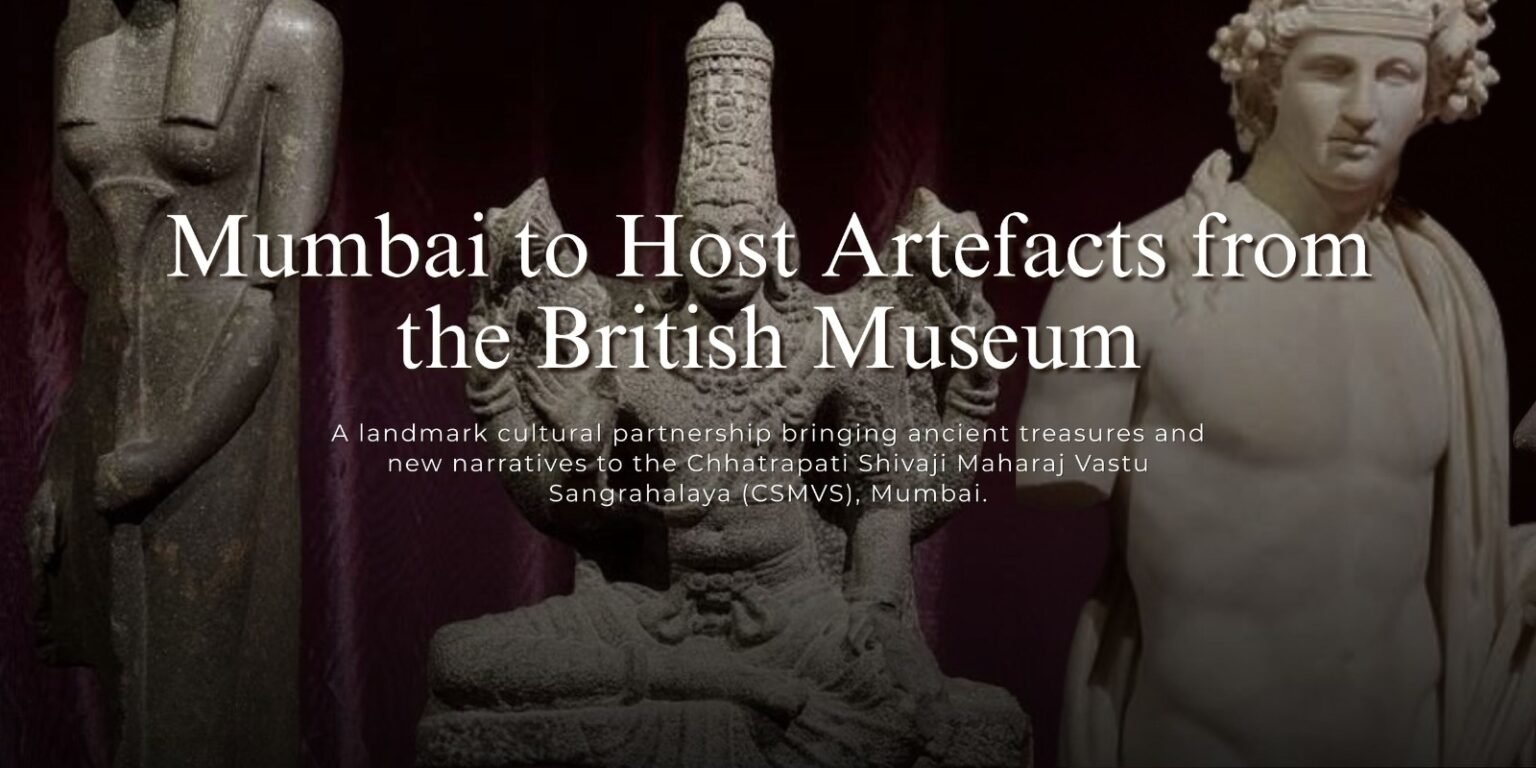
In December 2025, the Chhatrapati Shivaji Maharaj Vastu Sangrahalaya (CSMVS) in Mumbai opened an unprecedented exhibition featuring ancient artefacts on loan from the British Museum. Representing the largest cultural loan extended by the London institution to India, the exhibition brings together approximately eighty objects from ancient Egypt, Greece, and Mesopotamia. Beyond its scale, the initiative signals a shift in how global museums are beginning to renegotiate authority, access, and historical narrative in a post-colonial world.
Moving Beyond the Object – Why This Loan Matters
At first glance, the exhibition may appear to be a conventional museum exchange. Yet its significance lies not merely in what is displayed, but in ‘how’ and ‘why’ it is displayed. The British Museum has framed the loan as part of a broader commitment to widening public access and addressing the limitations of historically Eurocentric collecting practices. For Indian audiences, the arrival of these artefacts represents a recalibration of global cultural geography, placing Mumbai and most definitely India, firmly within international museum circuits traditionally dominated by Western capitals.
Shared Civilisations, Shared Histories
The artefacts on view span multiple ancient civilisations, including Egyptian sculptures, Greek statuary, and Sumerian relics. Their curatorial arrangement encourages comparative viewing rather than isolated appreciation. This approach subtly reinforces the idea that civilisations evolved through exchange rather than isolation, and that India’s own historical development has long been intertwined with broader transcontinental networks of trade, belief, and artistic influence.
Building on Established Institutional Partnerships
This collaboration is not an isolated gesture. CSMVS and the British Museum share a history of academic and curatorial exchange, most notably through earlier projects such as ‘India and the World: A History in Nine Stories’. That exhibition explored India’s global connections through objects drawn from international and Indian collections alike. The current loan builds upon this foundation, moving from temporary thematic collaborations to sustained institutional partnerships.
Global Co-Curation as a Curatorial Shift
One of the most important aspects of the Mumbai exhibition is its emphasis on co-curation. Rather than exporting a ready-made narrative from London, the exhibition has been shaped through dialogue between British and Indian curators. This reflects a growing international trend toward shared authority in museum practice, where knowledge production is collaborative and locally grounded. Such an approach challenges the long-standing assumption that Western institutions are the primary interpreters of global heritage
Decolonisation Without Repatriation?
The exhibition arrives amid renewed calls for the decolonisation of museum collections. While many critics argue that loans fall short of permanent restitution, the British Museum has positioned this initiative as a pragmatic response within existing legal frameworks, particularly the British Museum Act of 1963, which restricts deaccessioning. By enabling long-term loans, the institution seeks to foster dialogue, shared stewardship, and public engagement, even as debates around ownership continue unresolved
Cultural Diplomacy in Practice
Beyond the museum walls, the loan functions as an act of cultural diplomacy. It reflects deepening cultural cooperation between India and the United Kingdom, extending into academic exchange, conservation research, and public programming. For Indian scholars and students, the exhibition offers rare opportunities for direct engagement with globally significant artefacts, reinforcing museums as spaces of education rather than passive display.
Re-centering the Viewer
Perhaps the most profound shift lies in the repositioning of the viewer. Artefacts historically encountered by Indian audiences only through textbooks or foreign travel are now accessible within a local institutional context. This relocation alters not only who gets to see these objects, but how they are interpreted. It allows Indian audiences to approach global antiquity from their own intellectual and cultural vantage points, rather than as distant observers of Western narratives


Looking Ahead: A Model
The British Museum – CSMVS collaboration does not resolve the ethical complexities surrounding colonial collections. However, it does offer a meaningful model for future engagement, one rooted in collaboration, transparency, and shared responsibility. As museums worldwide grapple with questions of legitimacy and relevance, such partnerships suggest that the future of global heritage may lie not in possession but in participation.