



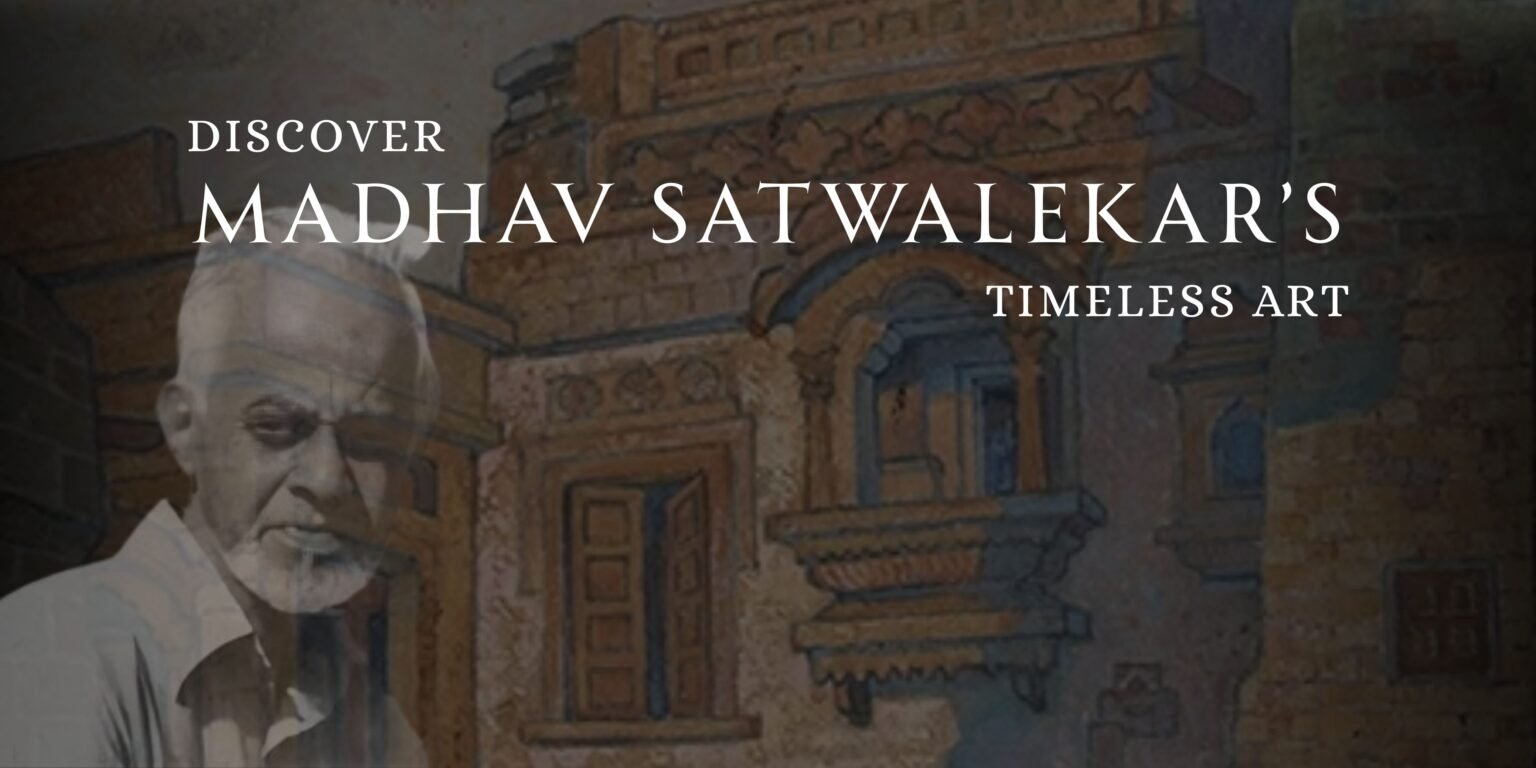

In the broader narrative of modern Indian art, Madhav Satwalekar occupies a position of understated significance. At a time when artistic practice increasingly gravitated toward bold experimentation and ideological assertion, Satwalekar remained committed to clarity, discipline, and emotional restraint. His paintings do not seek to dazzle or provoke; instead, they offer a contemplative space where observation, empathy, and technical mastery converge. In an age marked by visual excess, Satwalekar’s art continues to resonate through its stillness.
Born on August 13, 1915, in Lahore, then part of British India, Satwalekar emerged from an environment deeply shaped by intellectual and artistic inquiry. His upbringing instilled in him a belief that art must balance craftsmanship with meaning, a conviction that would quietly guide his lifelong practice.
Foundations of an Artistic Sensibility
Satwalekar’s early exposure to art and scholarship came through his father, Shripad Damodar Satwalekar, a painter and eminent Vedic scholar. This dual inheritance fostered in him an understanding of art as both a disciplined craft and a mode of contemplation. Rather than treating painting as mere representation, he approached it as a way of seeing, measured, reflective, and attentive to nuance.
His formal training at the Sir J. J. School of Art in Mumbai refined this sensibility. In 1935, he was awarded the Mayo Medal, the institution’s highest honor, recognizing not only his technical skill but also his compositional maturity. This early recognition affirmed his potential while encouraging him to seek further refinement beyond national boundaries.
European Training and Technical Discipline
Between 1937 and 1940, Satwalekar pursued advanced studies in Europe, training at the Florence Academy of Fine Arts, the Slade School of Fine Art in London, and the Académie de la Grande Chaumière in Paris. These years exposed him to classical European realism, rigorous draftsmanship, and disciplined compositional structures. Yet, rather than absorbing these influences uncritically, Satwalekar engaged them with discernment.
Upon returning to India, he translated European academic rigor into a visual language rooted firmly in Indian experience. His work demonstrates a careful synthesis: technical precision without rigidity, realism without excess, and emotion without sentimentality.
Aesthetic Restraint and Emotional Resonance
Satwalekar’s paintings occupy a quiet space between realism and introspection. Working primarily in oils and watercolours, he depicted village scenes, interiors, landscapes, and contemplative figures drawn from everyday life. His compositions are marked by balance and restraint, his palette subdued and earthy, his gestures economical.
Rather than dramatizing his subjects, Satwalekar allowed emotion to emerge gradually. Light, shadow, and spatial arrangement play a central role in creating atmosphere. Even the most ordinary scenes, a courtyard, a pathway, a figure at rest, carry a sense of stillness that invites prolonged engagement. Meaning unfolds slowly, through tone and structure rather than overt narrative.
Exhibitions and Artistic Recognition
Satwalekar’s first solo exhibition was held in 1945 at the Taj Hotel in Mumbai, marking the beginning of a steady and sustained exhibition career. Over the following decades, he presented more than thirty solo exhibitions in India and abroad, including in Europe, the Middle East, and East Africa. These exhibitions positioned him as a quietly influential figure within Indian modernism, respected for his technical assurance and emotional clarity.
His work found appreciation among collectors and institutions that recognized the enduring relevance of his visual language, one that resisted trends while remaining deeply engaged with lived reality.
Institutional Contributions and Pedagogical Commitment
Beyond his studio practice, Satwalekar contributed significantly to India’s artistic infrastructure. He co-founded the Indian Art Institute in the 1950s, aiming to expand public engagement with the visual arts. Later, as Director of Art for the Government of Maharashtra from 1969 to 1975, he played a key role in shaping policy, education, and institutional support for artists.
Teaching and mentorship were central to his philosophy. Satwalekar believed that art should not remain confined to elite circles but should function as a shared cultural language grounded in discipline and observation.
Art as Quiet Continuity
What ultimately distinguishes Madhav Satwalekar’s practice is its refusal to surrender to excess. His paintings affirm that emotional depth can coexist with restraint, and that modernity need not abandon clarity or craftsmanship. In a contemporary landscape often defined by speed and spectacle, his work offers an alternative mode of engagement, one rooted in patience, attentiveness, and quiet intelligence.
To revisit Satwalekar today is to rediscover the value of measured seeing. His art does not impose itself upon the viewer; it waits. And in that waiting, it reveals a timeless understanding of human presence, dignity, and the subtle rhythms of everyday life.