






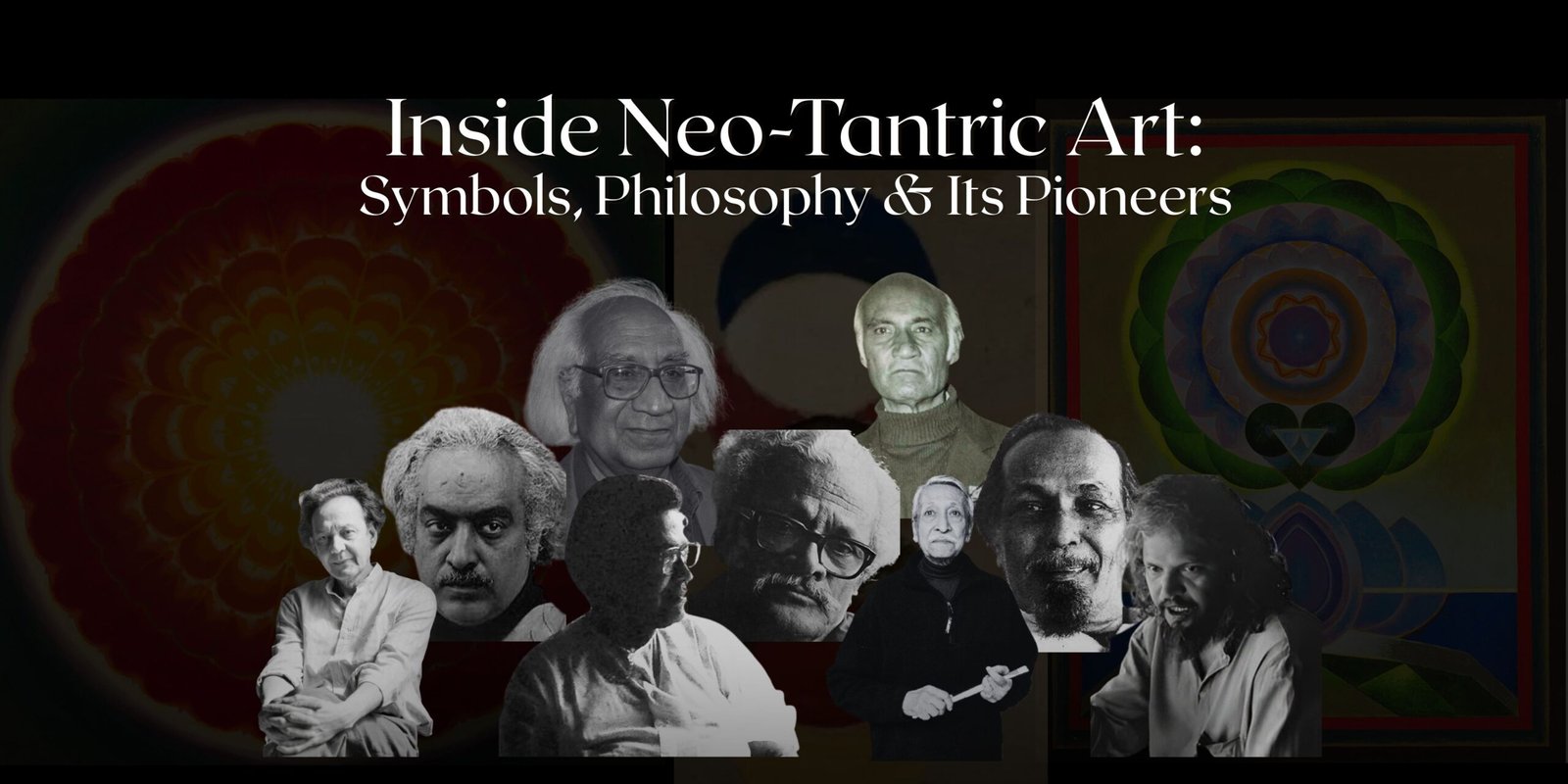
Neo-Tantric art stands as one of the most fascinating and spiritually resonant movements in modern Indian art. Rooted in the ancient traditions of Buddhist and Hindu Tantra, this movement transforms sacred symbols, metaphysics, and geometry into a contemporary visual language that speaks to both the spiritual seeker and the modern art connoisseur. From the 1960s onwards, Neo-Tantric art carved a unique niche by blending ritualistic symbolism with abstract modernism, creating works that are meditative, vibrant, and philosophically profound.
Origins of Neo-Tantric Art
The Neo-Tantric movement emerged in India during the 1960s and 1970s, a period marked by a revival of interest in Tantra studies. This resurgence was fuelled by new translations of key Tantric texts, rigorous scholarship, and renewed cultural interest in ritual, symbolism, and spiritual philosophy. As Indian artists sought to reconcile traditional spirituality with modern aesthetics, Tantra offered a rich visual and conceptual vocabulary.
Neo-Tantric art was not just a stylistic experiment—it represented a conscious effort to bridge the sacred and the secular, the ancient and the modern. Through symbols, mandalas, geometric forms, and vibrant colours, artists sought to visually articulate concepts of cosmic unity, energy, and metaphysical harmony.
Bimal Das Gupta: A Pioneer of Neo-Tantric Abstraction
Among the earliest and most influential figures of the Neo-Tantric movement was Bimal Das Gupta. His works masterfully blend Tantric symbols, geometric precision, meditative colour harmonies, and spiritual philosophy. Das Gupta played a key role in developing the movement’s abstract spiritual vocabulary, translating the metaphysical concepts of Tantra into forms accessible to modern audiences.
Through his meditative compositions, Das Gupta bridged the gap between ancient Indian philosophy and contemporary art, leaving a lasting impact on generations of Indian artists exploring abstraction and spirituality.
A Cohesive Artistic Movement
Neo-Tantric art is often regarded as a unified artistic movement, despite its diversity of practitioners and styles. Art historians like LP Sihare have emphasized that the movement’s cohesion lies in its shared inspiration from Tantric philosophy, metaphysics, and visual language. The artists were not merely using Tantric motifs decoratively; they were creating a symbolic system that communicated profound spiritual ideas.
KCS Paniker: The Early Precursor
A significant precursor to the movement was KCS Paniker. His seminal work, Words and Symbols (1965/66), introduced abstractions of ritual diagrams, mandalas, astrological charts, and archetypal figures. Paniker’s experimentation with symbolic forms laid the groundwork for the Neo-Tantric vocabulary, inspiring artists to explore the deeper spiritual resonance of visual geometry.
Biren De & GR Santosh: Exploring Cosmic Principles
Artists Biren De and GR Santosh focused on the male and female principles central to Tantric thought. Through geometric forms, radiant colours, and intricate patterns, their works conveyed the interplay of energy, balance, and cosmic union. These symbolic representations of duality and harmony became recurring motifs in the Neo-Tantric movement, demonstrating how spiritual philosophy could be distilled into pure visual abstraction.


PT Reddy: Reinterpreting Tantra
PT Reddy took Neo-Tantric abstraction a step further by reinterpreting traditional Tantric concepts through geometric yantras, mantras, sonic syllables, and the primordial bindu. His compositions often merged spiritual symbolism with contemporary socio-political themes, reflecting a vision of art that was simultaneously introspective and socially conscious. Reddy’s works illustrate how Tantra’s philosophical depth could be adapted to comment on the modern world without losing its sacred essence.
SH Raza & Acharya Vyakul: Icons of Symbolic Abstraction
Two towering figures in Neo-Tantric art, SH Raza and Acharya Vyakul, exemplify different yet complementary approaches.
- SH Raza is internationally renowned for his Bindu series, where the singular dot becomes a potent symbol of creation, cosmic energy, and spiritual focus. His vibrant compositions distill complex metaphysical ideas into simple, yet profoundly evocative forms.
- Acharya Vyakul, on the other hand, infused Tantric imagery with elements of folk and popular art, celebrating ritual and tradition. His work bridges high philosophy with everyday cultural expressions, emphasizing the lived, tangible aspects of spiritual practice.
Mahirwan Mamtani & KV Haridasan: Mandalas and Nature
Other notable contributors include Mahirwan Mamtani and KV Haridasan.
- Mamtani drew inspiration from mandalas, translating their meditative symmetry into abstractions that blend form, colour, and geometry. His works encourage viewers to contemplate patterns and cosmic relationships visually.
- Haridasan engaged deeply with texts like the Brahmasutra and the concept of panchabhutas (five cosmic elements), using them to reinterpret Tantric symbolism as metaphors for the natural world. His approach merges philosophy with ecological consciousness, highlighting Tantra’s universal relevance.
Symbols, Philosophy, and Legacy
At its core, Neo-Tantric art is more than just an aesthetic style; it is a formal exploration of spirituality through visual language. Artists drew upon motifs such as mandalas, yantras, bindu, and dualities of male-female energy to convey metaphysical ideas. Geometric precision, vibrant colour palettes, and symbolic abstraction became tools for translating philosophy into a visual medium.
The movement also represents a crucial dialogue between tradition and modernity. By grounding modern abstract art in centuries-old spiritual systems, Neo-Tantric artists created works that are meditative, intellectually stimulating, and visually striking. This fusion of the sacred and the contemporary continues to inspire contemporary Indian artists and collectors worldwide.
Conclusion: The Enduring Appeal of Neo-Tantric Art
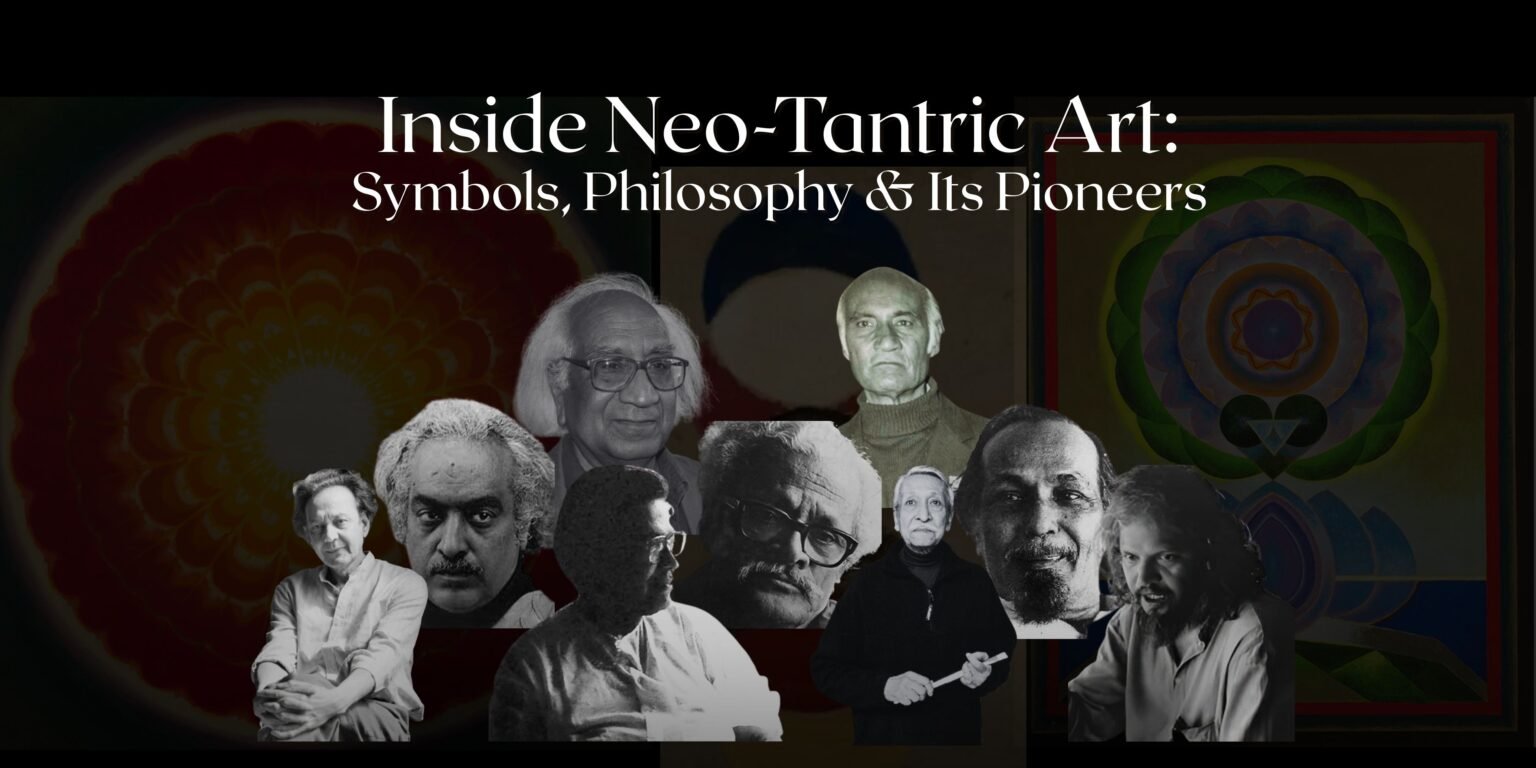
Neo-Tantric art remains a vital chapter in Indian modernism. From Bimal Das Gupta to KCS Paniker, Biren De, GR Santosh, PT Reddy, SH Raza, Acharya Vyakul, Mahirwan Mamtani, and KV Haridasan, the movement showcases the extraordinary potential of art to translate spiritual philosophy into visual experience.
Its enduring appeal lies in its ability to balance abstraction with meaning, geometry with emotion, and colour with consciousness. For collectors, art enthusiasts, and spiritual seekers alike, Neo-Tantric art is more than a movement—it is a journey into the symbolic heart of India’s cultural and philosophical heritage.
Explore Neo-Tantric art and witness how ancient Tantric wisdom finds new life in vibrant colours, geometric forms, and meditative patterns that transcend time.