





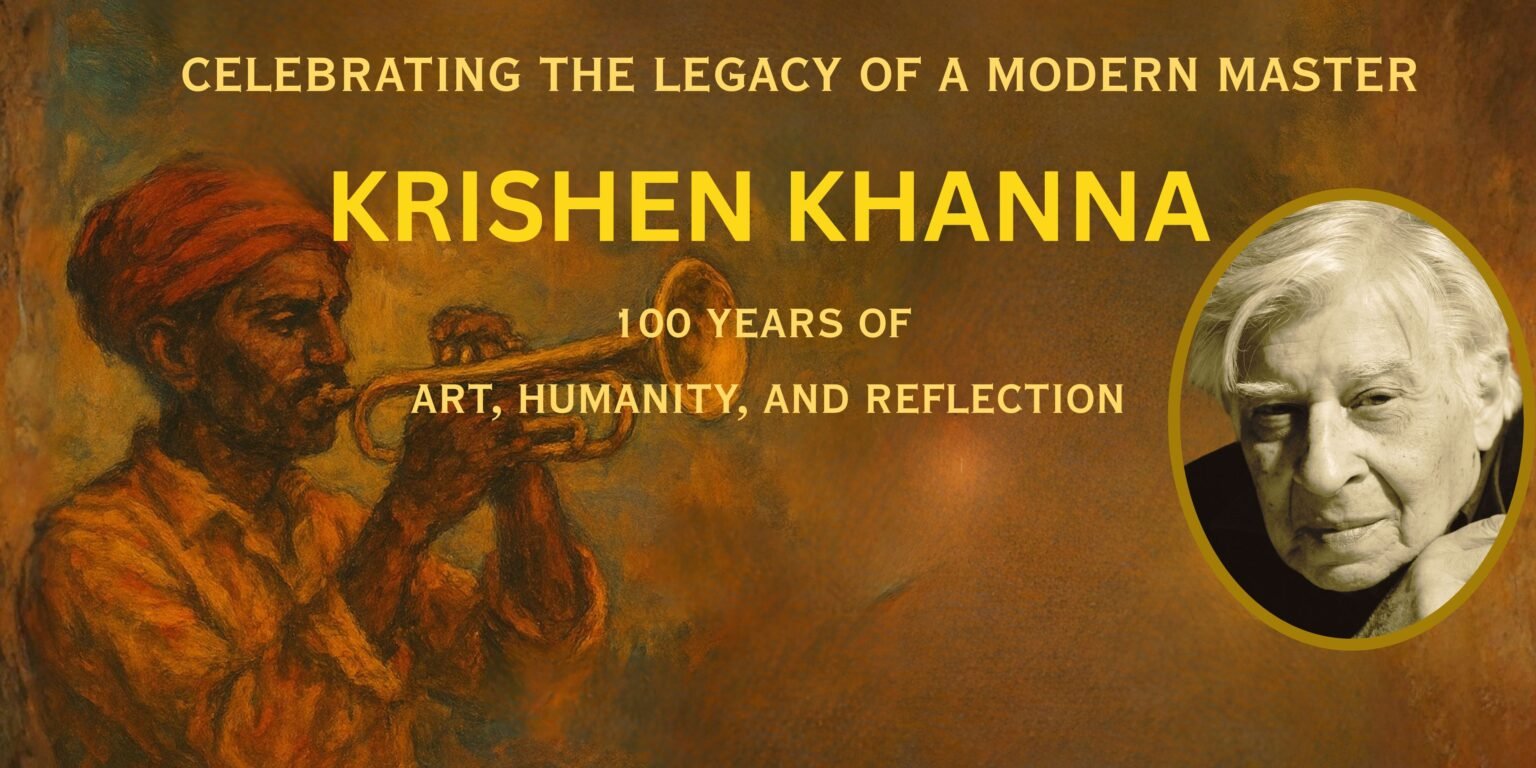

In the vast landscape of Indian modern art, few names shine as brightly as Krishen Khanna. Born in Lyallpur (now Faisalabad, Pakistan) in 1925, Khanna’s journey spans a century—a century of creation, observation, and deep empathy. In his 100th year, we take a moment to reflect on the life, art, and legacy of a true modern master whose work continues to resonate across generations.
A Life in Art: Krishen Khanna
Krishen Khanna’s story is as layered and textured as his paintings. Growing up during the pre-independence era in India, he absorbed the nuances of a changing society. His education and early career in banking offered him a lens into everyday life, yet his passion for art was unstoppable. Khanna’s oeuvre draws from a rich tapestry of influences: classical Indian art, European modernism, poetry, music, and the rhythms of urban life.
More than just a painter, Khanna is a storyteller. His studio, often captured in archival photographs, is a sanctuary where sketches, canvases, and fragments of daily life converge into a singular vision. Every line, colour, and brushstroke carries a narrative—a narrative about humanity, movement, and memory.
The Human Theatre
Khanna’s work is often described as a “human theatre”. His canvases teem with life—street musicians, labourers, families, and wanderers populate his compositions. Unlike artists who focus on the monumental or mythological, Khanna celebrates the ordinary.
His brushwork, sometimes gestural and loose, sometimes precise and detailed, gives each figure a sense of dignity and empathy. Take, for instance, The News of Gandhiji’s Death (1948)—a haunting work capturing the collective grief and quiet resilience of a nation. Khanna does not merely paint people; he conveys their emotions, their struggles, and their enduring spirit.
The Bandwallas – A Lifelong Motif
One of Khanna’s most enduring motifs is the bandwalla, or brass-band musician. Over decades, these figures have become synonymous with his artistic identity. They are not just subjects but symbols of rhythm, colour, and melancholy—representing the heartbeat of modern India.Through the bandwallas, Khanna explores themes of endurance, music, and communal identity.
Each composition tells a story—whether of a quiet morning parade, a festive procession, or the solitude of practice. His ability to turn everyday street musicians into poetic icons is unmatched. Khanna’s bandwallas remind us that art can elevate the mundane into the extraordinary.
Experimenting with Mediums
While Khanna is best known for his paintings, his experimentation with mediums reflects his restless creativity. From canvas to print, sculpture to digital forms, he constantly reinvents his visual language.


In works across mediums, we see the same empathy and storytelling that define his paintings. Prints often emphasize texture and line, while sculptures capture the physicality and movement of his subjects. Even his digital experiments echo the rhythms and patterns of life in motion. Khanna’s versatility underscores a crucial truth: true artistry is not bound by medium, but by vision.
The Artist Speaks
Khanna’s reflections on his career reveal the philosophy behind his work. He once said:
“When painters have lived through that length of time, they have a lot to look back to and reflect upon. A retrospective is not about the high peaks of your career, it is about the lock, stock and barrel of it all. It’s about the journey of time and tide as it were.”
This humility and introspection are evident in his art. Khanna does not chase fame or trends; he documents life with honesty, empathy, and a quiet intensity that continues to inspire emerging artists.
Early Milestones in a Modernist Journey
Khanna’s career is marked by significant milestones that reflect both national and international recognition. In 1955, he showcased his work at USIS, Chennai, and two years later at the All India Fine Arts and Crafts Society (AIFACS), New Delhi, as well as the Tokyo Biennale.
By the late 1950s and early 1960s, Khanna was exhibiting globally: Kumar Gallery, New Delhi; Leicester Gallery, London; Sao Paulo Biennale; Ashoka Gallery, Kolkata; Jehangir Art Gallery, Mumbai. Each exhibition not only cemented his reputation but also expanded the reach of Indian modern art.
His decision to leave a secure career in banking in 1961 to focus entirely on painting demonstrates his commitment to art as a lifelong vocation. This leap of faith paved the way for decades of creative exploration and influence.
A Global Acclaim: Awards and Fellowships
Recognition came both in India and abroad. Among his accolades:
- 1962-63: Artist-in-Residence, American University, Washington DC
- 1971: Fellowship at Rockefeller Council, New York
- 1986: President’s Award, Baghdad International Festival of Art
- 1989: Sahitya Kala Parishad Award, New Delhi; Gold Medal, First International Biennale of Art, Lahore, Pakistan
- 1990: Padma Shri, Government of India
- 2004: Lalit Kala Ratna ward
- 2011: Padma Bhushan, Government of India
These honours recognize not just technical mastery, but Khanna’s ability to engage with humanity through art—an accomplishment few artists achieve with such consistency and depth.
100 Years of Vision & Humanity
Krishen Khanna’s art is timeless because it captures the essence of human experience. His works are historical, personal, and philosophical simultaneously—each painting a reflection on society, culture, and empathy.
At 100, Khanna is not merely an elder statesman of Indian art; he is a living bridge between generations, traditions, and mediums. He reminds us that the purpose of art is not only to depict beauty but to explore humanity in all its complexity—its struggles, joys, and enduring spirit.
Khanna’s life and art exemplify the progressive ethos of Indian modernism: deeply rooted in history yet fearless in experimentation, socially aware yet profoundly personal. His legacy inspires artists and collectors alike, affirming that art is a lifelong conversation with the world around us.
Honouring the Master
As we celebrate Krishen Khanna’s centenary, it is worth revisiting his vast body of work, exploring his recurring motifs like the bandwallas, and acknowledging his role in shaping Indian modern art. His story reminds us that the value of art lies not just in galleries or accolades, but in its ability to connect, empathize, and endure.
For art enthusiasts, collectors, and historians, Khanna’s work offers endless inspiration—a century-long dialogue between canvas and life, between artist and humanity.