





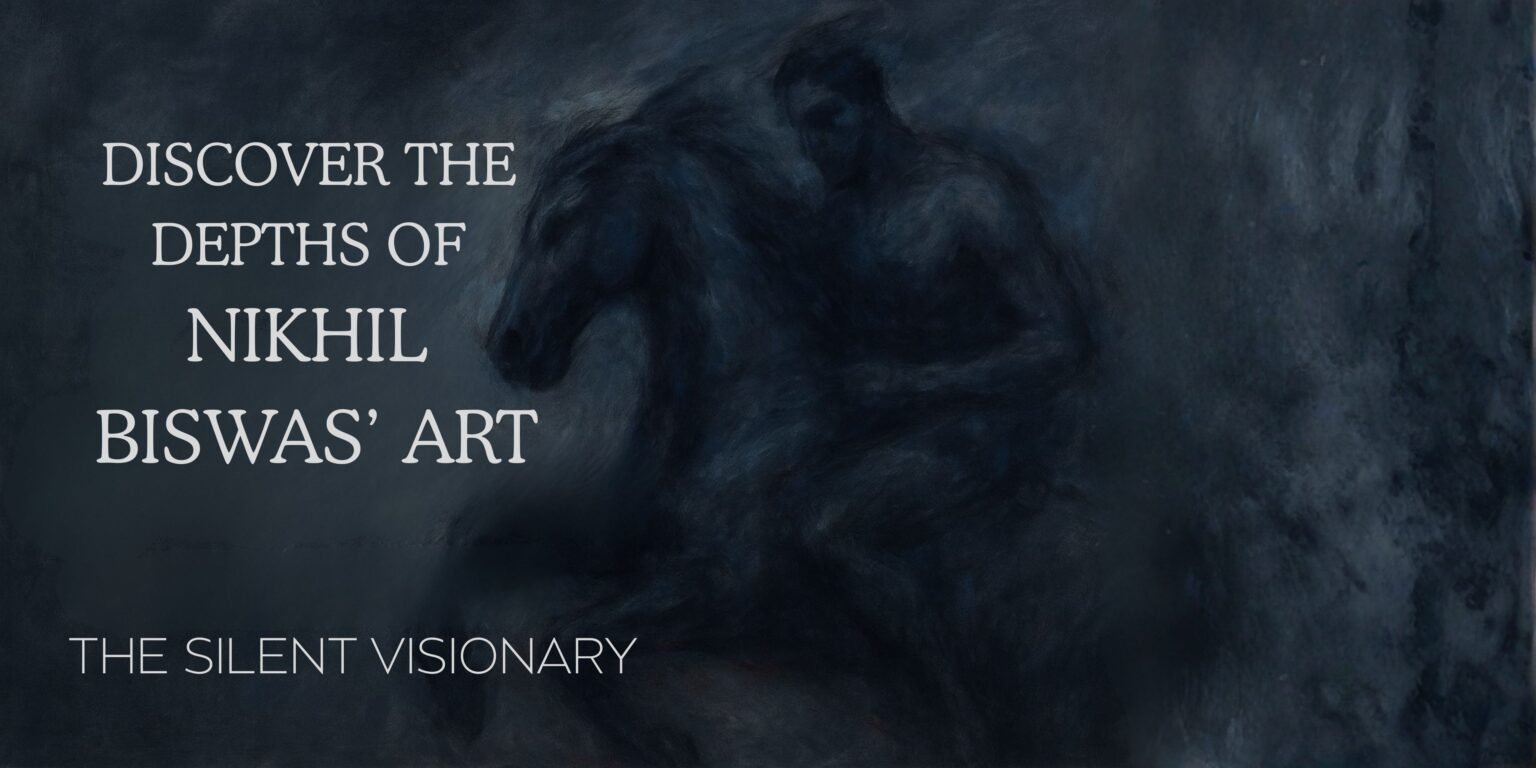

Among the pioneers of India’s post-independence modern art movement, Nikhil Biswas stands out as a deeply expressive and emotionally charged painter. His works are an intense exploration of the human condition — fragile yet fierce, deeply introspective yet universal in appeal.
Emerging from the vibrant Bengal art scene in the 1950s and early 1960s, Biswas brought a raw emotional force to Indian modernism. Trained in the classical techniques of drawing and painting, he eventually broke free from formalism to embrace expressionism — a language of art that prioritized feeling over form.
He worked with ink, watercolour and oil, often blending figurative and semi-abstract elements to express complex psychological and spiritual themes. His works are not just paintings but psychological landscapes, revealing the tension between man and his inner and outer worlds.
For Biswas, art was a form of confrontation — with society, with nature, and with the self. Each line he drew seemed to emerge from a place of struggle and empathy. His paintings, often haunting and layered, speak of loneliness, power, conflict, and redemption — themes that continue to resonate long after his time.
Man & The Beast: The Eternal Conflict
Smoky greys. Deep blues. Flickers of red.
A rare Nikhil Biswas painting where man and a horse merge in motion and emotion. In this artwork, one of Nikhil Biswas’ most striking works, we encounter the raw energy of instinct and emotion colliding on canvas.
A man and a horse-like beast are entangled in motion — bodies intertwined, limbs stretched in violent rhythm. There is no clear victor, no distinct boundary between the two forms. The composition pulls the viewer into the chaos — a whirl of movement and tension that feels both physical and metaphysical.
Here, Biswas delves into one of his recurring obsessions: the duality of civilization and savagery. The man symbolizes reason, order, and control; the beast embodies instinct, passion, and chaos. Yet, as the viewer stares longer, the boundaries blur — perhaps man and beast are not adversaries at all, but two halves of the same being.
The artist’s bold brushwork and dense textures heighten the emotional intensity. The swirling blues and greys evoke a stormy, psychological landscape — the battle within the human soul. This is not merely a depiction of man versus beast; it is, as Biswas himself implied through his oeuvre, man versus himself.

In this painting, as in much of his art, Biswas transcends the literal to touch the universal — exploring the primal urges, fears, and desires that shape human existence.
Horses: The Symbol of Spirit and Struggle
Horses gallop across Nikhil Biswas’ canvases like living metaphors. They represent strength, freedom, and vitality, yet also embody the raw, untamed energy of life itself.
To Biswas, horses were not just animals — they were mirrors of human struggle and endurance. Their restless motion, muscular forms, and dynamic energy became symbols of resistance and spirit.
In his compositions, the horse often appears intertwined with human figures, reinforcing his belief in the shared instinctual essence between man and beast.
The power of these works lies in their duality — the beauty of the creature set against the turmoil of existence, the strength that carries both grace and suffering.
The Human Condition
Much of Nikhil Biswas’ artistic philosophy revolved around the human condition — the loneliness, despair, and resilience that define our shared experience. His figures are often distorted, fragmented, or half-abstract, expressing psychological unrest rather than physical likeness.
Born in the wake of India’s independence, Biswas’ art reflects the unease of a new nation searching for identity. His brushwork became the language of trauma and transition. His palette — subdued, brooding, yet alive with sudden bursts of colour — mirrors a world oscillating between hope and despair.
In these works, Biswas became a visual poet of human emotion, painting not what he saw, but what he felt.
The Clown Series: Joy and Tragedy Entwined
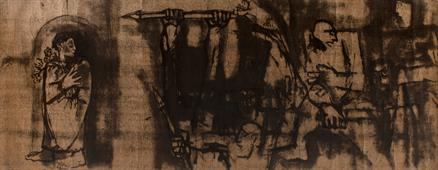
In the Clown Series, Biswas found the perfect symbol for life’s contradictions. The clown, with its painted smile and hidden tears, became his emblem of the human condition — both comic and tragic.
These works explore the fragile boundary between joy and sorrow, performance and reality. The clown in Biswas’ hands is not merely an entertainer; it is the face we all wear — a mask concealing our inner turmoil. Through these haunting portraits, the artist reflects on how humour becomes a form of survival, and tragedy an inevitable part of existence.
The emotional complexity of the series, coupled with Biswas’ expressive technique, reveals a deep empathy for the human soul — its vulnerability and courage in equal measure.
The Combat Series: Conflict and Survival
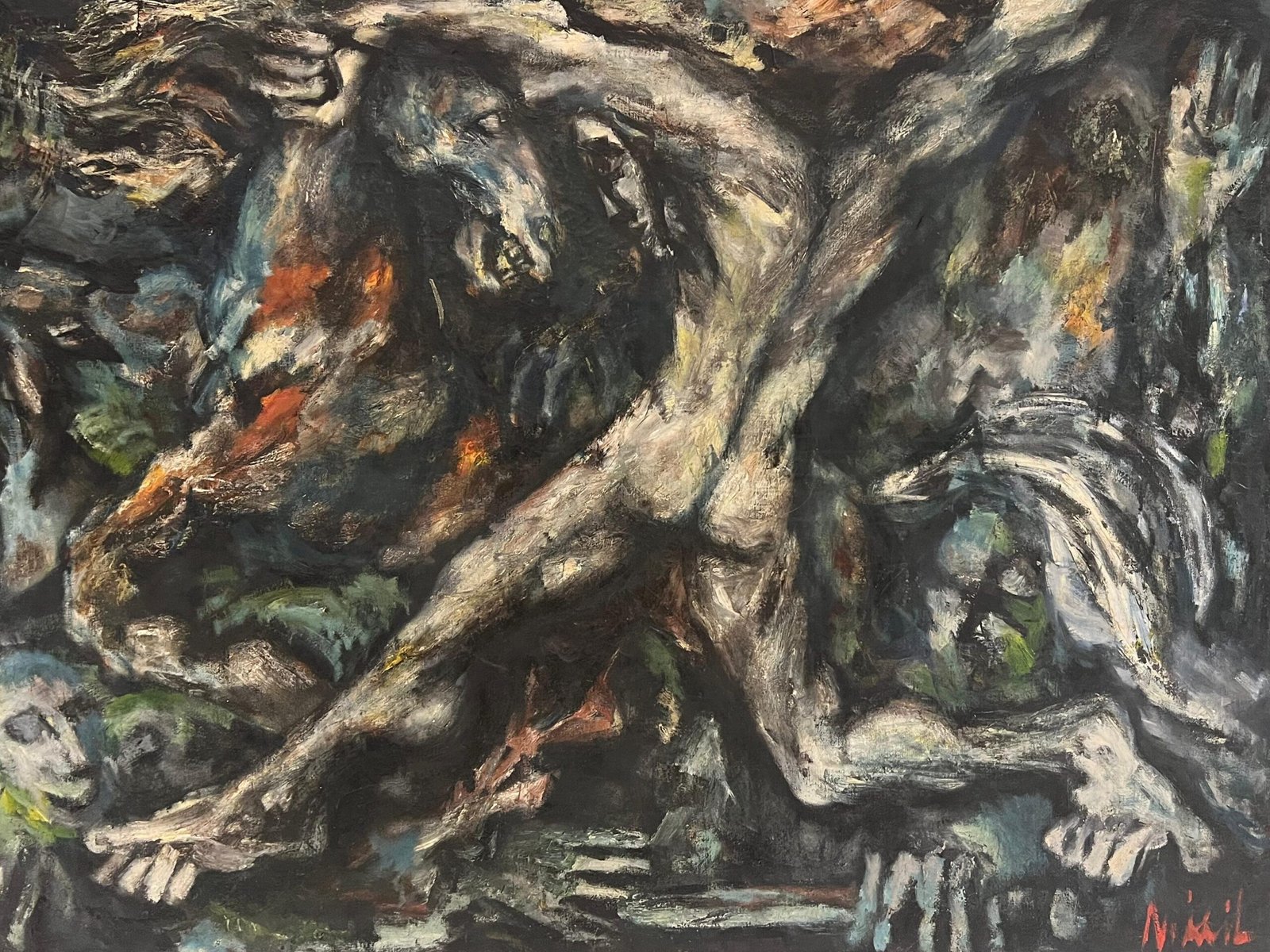
The Combat Series is among Nikhil Biswas’ most powerful bodies of work, capturing the intense struggle between man and beast.
Each canvas in this series brims with movement — limbs entangled, muscles straining, colours clashing. Through dynamic composition and charged lines, Biswas transforms these confrontations into metaphors for life’s battles — both internal and external.
The recurring theme of conflict in his work is not about dominance or defeat, but about coexistence — the realization that man and beast, reason and instinct, pain and beauty, are inseparable forces of nature.
The Christ Series: Suffering and Redemption
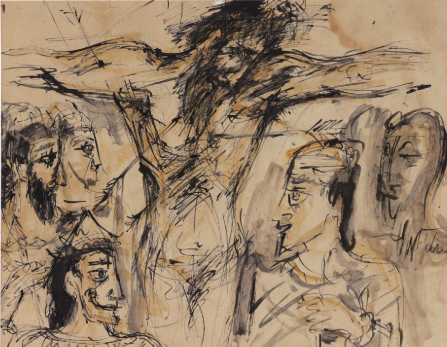
In the Christ Series, Biswas reimagines the universal image of suffering through his own cultural lens. The figure of Christ becomes a symbol not tied to religion but to human endurance and sacrifice.
Rendered with expressive strokes and dark, emotional hues, these works resonate with themes of redemption, agony, and transcendence. Biswas’ Christ is everyman — the bearer of collective pain, the witness to the world’s injustices, and a reminder of compassion amidst chaos.
Through these paintings, Biswas communicates a sense of spiritual universality — a belief that suffering can lead to understanding and that art, like faith, can offer salvation.
The Life of Nikhil Biswas: A Brief Flame
Often hailed as the “Vincent van Gogh of Kolkata,” Nikhil Biswas mirrored the Dutch master’s intensity — painting with raw emotion, inner turmoil, and unrelenting passion despite poverty, obscurity, and fragile health.
Born in the 1930s, Biswas’ journey as an artist was marked by both brilliance and struggle. A founding member of the Society of Contemporary Artists, he became a vital voice in redefining Indian art in the years following independence.
Yet, his life was heartbreakingly brief. On November 10, 1966, just a day before his much-anticipated exhibition in East Germany, Biswas succumbed to infectious hepatitis at the age of only 36.
His untimely death shocked the art world — a promising career silenced at its peak. But even in death, Biswas’ art found its audience. His works were exhibited posthumously in Germany and later became part of the permanent collection of the Halle Museum in Dresden.
In his short lifetime, he created an astonishing body of work that immortalized the struggle, resilience, and beauty of the human spirit.
A Legacy That Lives On
Nikhil Biswas’ art continues to move viewers today with its honesty and depth. His paintings — fierce, emotional, and hauntingly beautiful — remind us that art is not about perfection but truth.
Each canvas is a reflection of humanity’s eternal conflicts: between strength and fragility, instinct and intellect, life and death. Through his vision, Biswas transformed personal pain into universal expression — ensuring his voice echoes long after his time.