





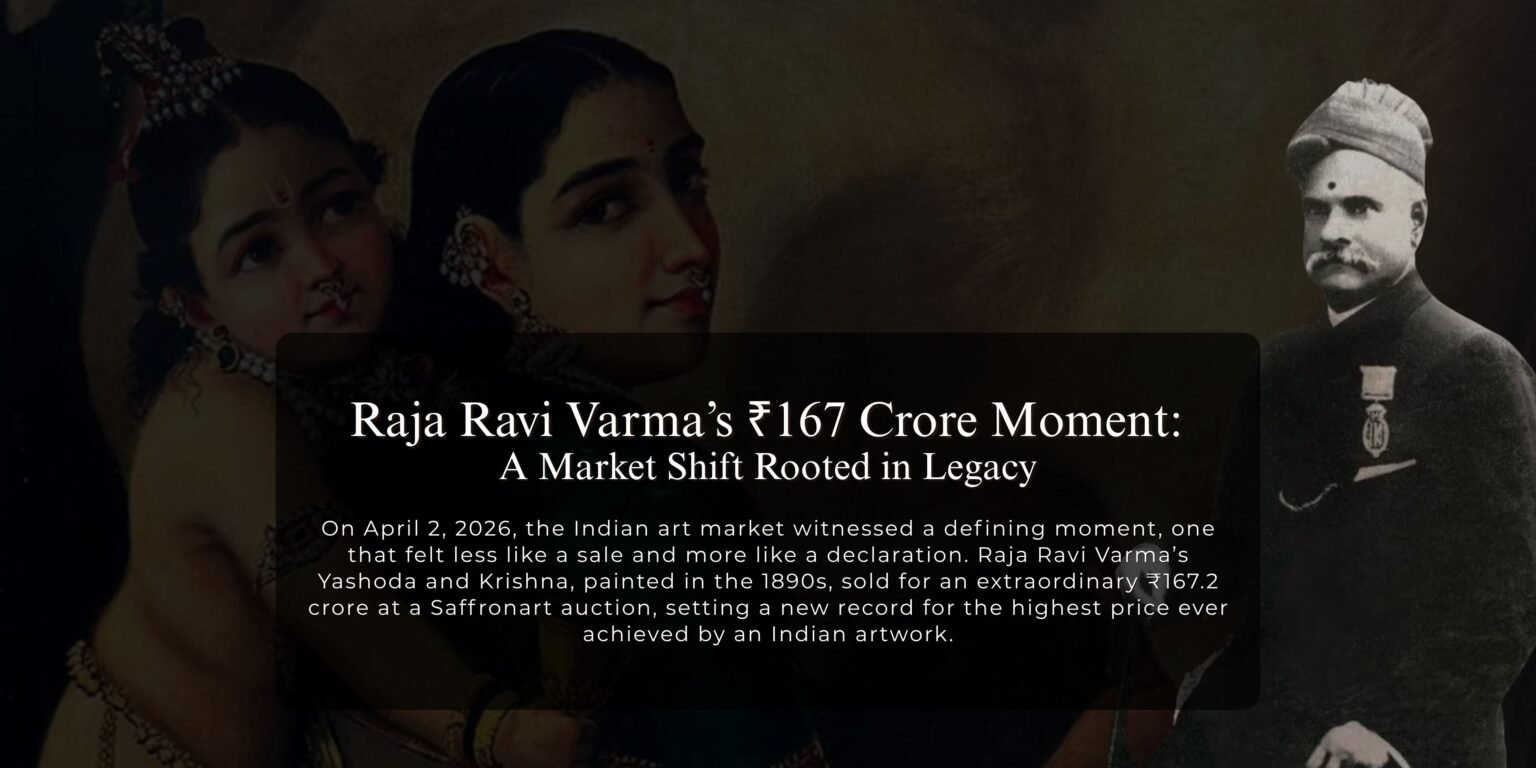

On April 2, 2026, the Indian art market witnessed a defining moment, one that felt less like a sale and more like a declaration. Raja Ravi Varma’s Yashoda and Krishna, painted in the 1890s, sold for an extraordinary ₹167.2 crore at a Saffronart auction, setting a new record for the highest price ever achieved by an Indian artwork.
This landmark result did more than surpass numbers; it fundamentally recalibrated how Indian art is valued, perceived, and positioned within both domestic and global markets.
A Record That Rewrites the Market
Until this moment, the benchmark for Indian art stood at ₹118 crore, set by M. F. Husain’s Untitled (Gram Yatra) in 2025.
The leap to ₹167 crore, an increase of nearly 41% in just a year, is not merely incremental; it is disruptive.
Such a sharp rise signals three crucial shifts:
- A deepening confidence in Indian art as a financial asset
- A growing pool of serious collectors willing to compete at the highest level
- A renewed recognition of historically significant works
The seven-minute bidding battle that led to the sale underscores not just demand, but conviction.
Why Yashoda and Krishna Matters
At the heart of this record lies not just rarity, but resonance. Yashoda and Krishna captures a deeply intimate, almost domestic moment between the divine child Krishna and his foster mother. Rooted in the Bhagavata Purana, the painting transforms mythology into lived emotion, something Varma mastered with exceptional clarity.
Executed in his signature realist style, the work employs chiaroscuro, light and shadow, to bring depth and immediacy to the scene.
But beyond technique, its power lies in familiarity. For over a century, such imagery has shaped India’s visual understanding of its own mythology.
This is precisely why Varma is often described as the artist who gave Indian gods a human face.

The Artist Who Bridged Worlds
Born in 1848 in Kilimanoor, Kerala, Raja Ravi Varma occupies a singular position in Indian art history.
He is widely regarded as one of the first artists to successfully merge European academic realism with Indian subjects, creating a visual language that was both technically refined and culturally rooted.
His works, from Shakuntala and Damayanti Talking to a Swan to Galaxy of Musicians, redefined narrative painting in India.
But perhaps his most radical contribution was accessibility.
Through his lithographic press established in the 1890s, Varma reproduced his paintings as affordable prints, bringing art into everyday homes.
In doing so, he democratized art in a way that few artists before him had attempted.
Auction Journey: From Undervalued to Iconic
For decades, Raja Ravi Varma’s works occupied a curious space in the market. While revered culturally, they were not always priced in alignment with their historical importance.
This began to change gradually in the early 2000s, as Indian art entered global conversations through auctions and international exhibitions. Yet, even then, modernists like Husain, Raza, and Souza often commanded higher prices.
The ₹167 crore sale marks a decisive shift.
It suggests that the market has finally aligned with art history, recognizing Varma not just as a cultural icon, but as a cornerstone of Indian modernity.
As one expert noted, such results demonstrate “depth of demand, scholarship, and confidence in works of true art-historical importance.”
Rarity and Provenance: The Real Drivers
One of the key reasons behind this record is scarcity.
Very few of Varma’s original oil paintings remain in private hands today.
Most are housed in institutions or royal collections, making any appearance at auction a rare event.
When rarity intersects with:
- Strong provenance
- Iconic subject matter
- Museum-level quality
…the result is not just a sale, but a market-defining moment.
A Broader Market Implication
This sale does not exist in isolation, it will ripple across the Indian art ecosystem.
- Revaluation of Classical Masters
Artists from the 19th and early 20th centuries may now see renewed attention and upward price correction. - Increased Institutional Interest
Museums and foundations may accelerate acquisitions to secure historically significant works. - Investor Confidence
Indian art is increasingly being seen not just as cultural capital, but as a serious financial asset. - Global Positioning
Such results place Indian art more firmly within the global auction narrative, alongside Western masters.
Beyond Price: A Cultural Assertion
While ₹167 crore is a staggering figure, the true significance of this sale lies beyond numbers.
It is a reaffirmation of:
- India’s artistic heritage
- The emotional power of its visual traditions
- The enduring relevance of artists like Ravi Varma
In many ways, Yashoda and Krishna represent more than a masterpiece; it is a mirror of collective memory.
A Turning Point, Not a Peak
The question now is not whether this record will be broken, but when, and by whom.
Will it be another Varma?
A modernist master?
Or a contemporary voice yet to fully emerge?
What is certain, however, is this:
The ₹167 crore sale has not just set a benchmark, it has expanded the horizon.
For collectors, it signals urgency.
For institutions, responsibility.
And for the art world at large, a reminder that true value, historical, emotional, and cultural, eventually finds its price.