



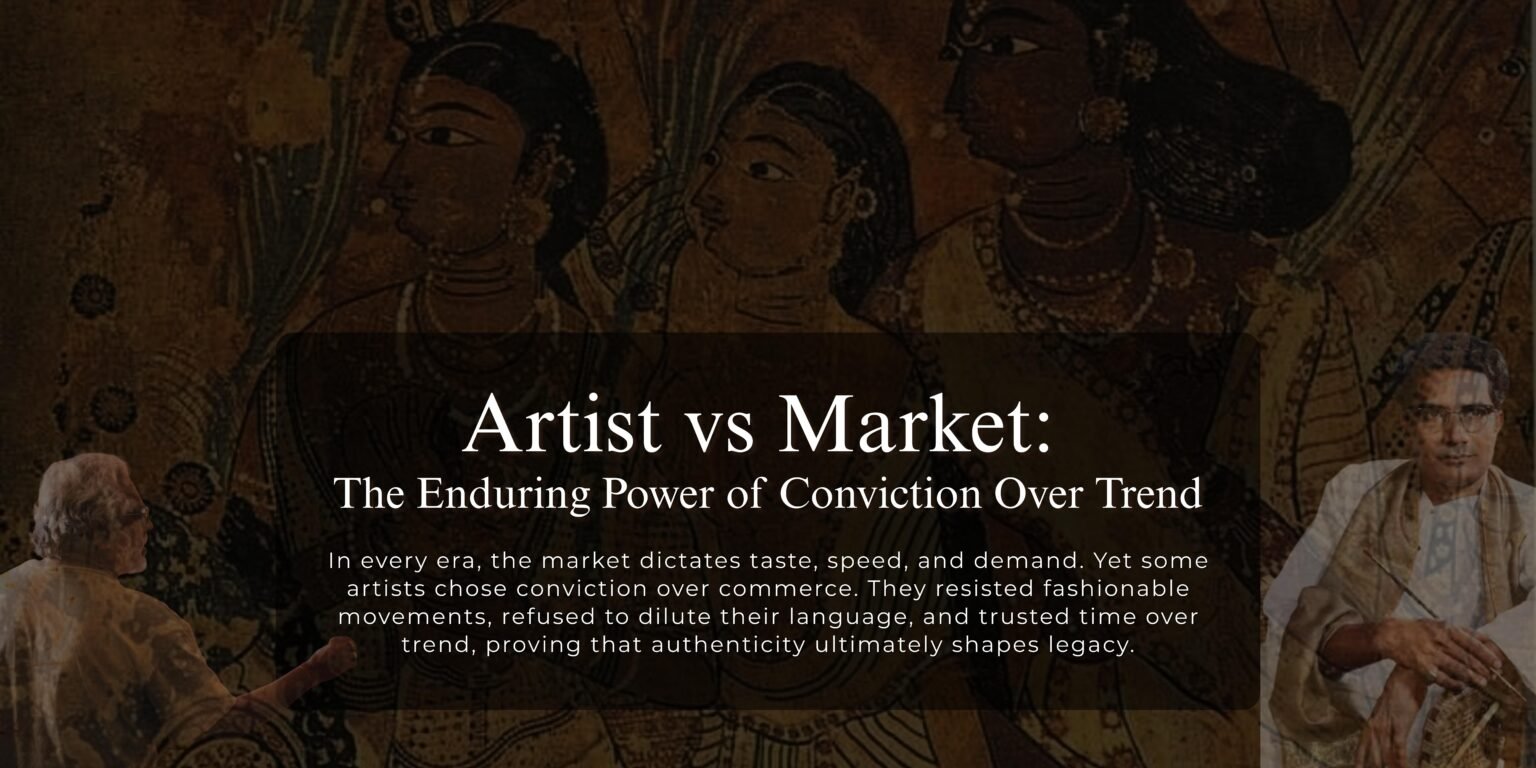

The relationship between artistic production and market forces has long been fraught with tension. In an increasingly globalised art economy, where biennales, auctions, and art fairs dictate visibility and valuation, the pressure on artists to align with prevailing trends is both immediate and pervasive. Yet, across histories and geographies, a distinct lineage of artists has resisted this gravitational pull. Their practices, defined not by compliance but by conviction, illuminate a crucial truth for collectors, advisors, and cultural institutions alike: the market may shape visibility, but it is authenticity that ultimately shapes legacy.
At its core, the distinction between art and fashion is neither rhetorical nor superficial; it is structural. Fashion thrives on ephemerality, on the rapid turnover of styles that sustain cycles of consumption. Art, in its most rigorous form, resists such temporality. For many serious practitioners, the studio is not a site of production calibrated to demand, but a space of sustained inquiry. The refusal to alter one’s visual language for immediate relevance is not an act of defiance for its own sake; rather, it reflects an adherence to a deeper methodological and philosophical commitment. This distinction is particularly relevant within advisory frameworks, where the temptation to privilege what is “current” can overshadow what is enduring.
The temporal dimension of artistic practice further underscores this divergence. Markets reward immediacy: works that are legible, repeatable, and easily assimilated into prevailing aesthetic trends often achieve rapid circulation. By contrast, artists committed to long-term vision cultivate practices that unfold over decades. Their oeuvres are not constructed in response to auction cycles or curatorial fashions but emerge through processes of research, revision, and reflection. For advisors and collectors, recognising this temporal depth is essential. It requires a shift from short-term speculation to long-term cultural investment, an understanding that significance often accrues slowly, sometimes imperceptibly, before becoming historically evident.
Technique, too, becomes a site of resistance in such contexts. In moments when conceptual immediacy or digital reproducibility dominate artistic discourse, a sustained commitment to material and technical rigour acquires renewed significance. The disciplined study of form, anatomy, surface, and medium, often perceived as anachronistic within fast-paced market environments, signals a refusal to relinquish the foundational aspects of artistic practice. This is not to privilege one mode over another, but to recognise that technical commitment, when pursued with seriousness, embodies a form of intellectual and aesthetic integrity that resists commodification.
Equally significant is the refusal to dilute identity. The art market frequently rewards recognisability: a signature style that can be easily identified, reproduced, and circulated. While such coherence can be artistically legitimate, it can also become a constraint when driven primarily by commercial incentives. Artists who resist trends often reject the pressure to replicate “successful” works. Instead, they embrace unpredictability, allowing their visual language to evolve, even at the risk of alienating existing markets. This willingness to forgo stability in favour of growth underscores a broader ethical stance: that artistic identity is not a brand to be managed, but a process to be continually redefined.
History offers ample evidence that such positions are seldom rewarded in their own time. Many artists who deviated from dominant aesthetics faced marginalisation, critical misunderstanding, or commercial neglect. Yet it is precisely this temporal disjunction, between production and recognition—that distinguishes enduring contributions from transient success. The delay in validation, while often challenging, becomes a measure of independence. For institutions engaged in artist representation and gallery programming, this raises important questions: how might one support practices that resist immediate legibility? How can curatorial frameworks accommodate work that unfolds outside dominant narratives?
The eventual convergence of market and conviction is, perhaps, the most instructive aspect of this dynamic. Markets, despite their apparent immediacy, are not immune to historical revision. Practices once deemed unfashionable are frequently reassessed, their depth and consistency gaining recognition over time. What was previously marginal can become central; what was overlooked can become canonical. This process is neither predictable nor uniform, but it underscores the limitations of trend-based valuation. Authentic practice does not expire, it matures, accruing significance through sustained engagement.

The career of Lucian Freud offers a compelling illustration. Working in post-war Europe, a period dominated by abstraction and minimalism, Freud remained resolutely committed to figurative painting. His portraits, marked by an unflinching psychological intensity and a rigorous engagement with the human form, stood apart from prevailing movements. For decades, his work occupied a position of relative marginality within dominant critical discourses. Yet, over time, this very refusal to conform positioned him as one of the most significant painters of the twentieth century.
A parallel narrative can be traced within the Indian context. Tyeb Mehta, associated with the Progressive Artists’ Group, was known for his deliberate pace and refusal to overproduce, even as demand for his work grew. His paintings, characterised by formal economy and existential intensity, reflect a practice governed by internal necessity rather than external pressure. Similarly, Ram Kumar developed a deeply introspective abstract language over decades, resisting both narrative excess and market sensationalism. His landscapes, often austere and meditative, exemplify a sustained engagement with form and emotion.
The case of Bhupen Khakhar further complicates this discourse. At a time when abstraction held critical dominance in India, Khakhar embraced narrative figuration, drawing on popular culture, vernacular imagery, and personal experience. His work, initially perceived as unconventional, has since been recognised for its conceptual depth and cultural significance. In each of these instances, the artist’s commitment to an individual vision, despite prevailing trends, has proven central to their enduring relevance.
For contemporary art advisory and consultancy practices, these histories offer more than retrospective insight; they provide a framework for engagement. To recognise and support artists who resist trends is not merely an ethical position but a strategic one. It requires attentiveness to processes rather than products, to trajectories rather than moments. It calls for a recalibration of value, one that privileges depth, consistency, and intellectual rigour over immediacy and repetition.
Ultimately, the tension between artist and market is neither resolvable nor inherently antagonistic. Markets are necessary; they facilitate circulation, visibility, and sustainability. Yet their logic must be approached with critical awareness. For it is often at the margins of market alignment, where artists work against the grain of prevailing taste, that the most significant contributions emerge. In an era defined by speed and spectacle, the quiet persistence of conviction remains, perhaps, the most radical gesture of all.