





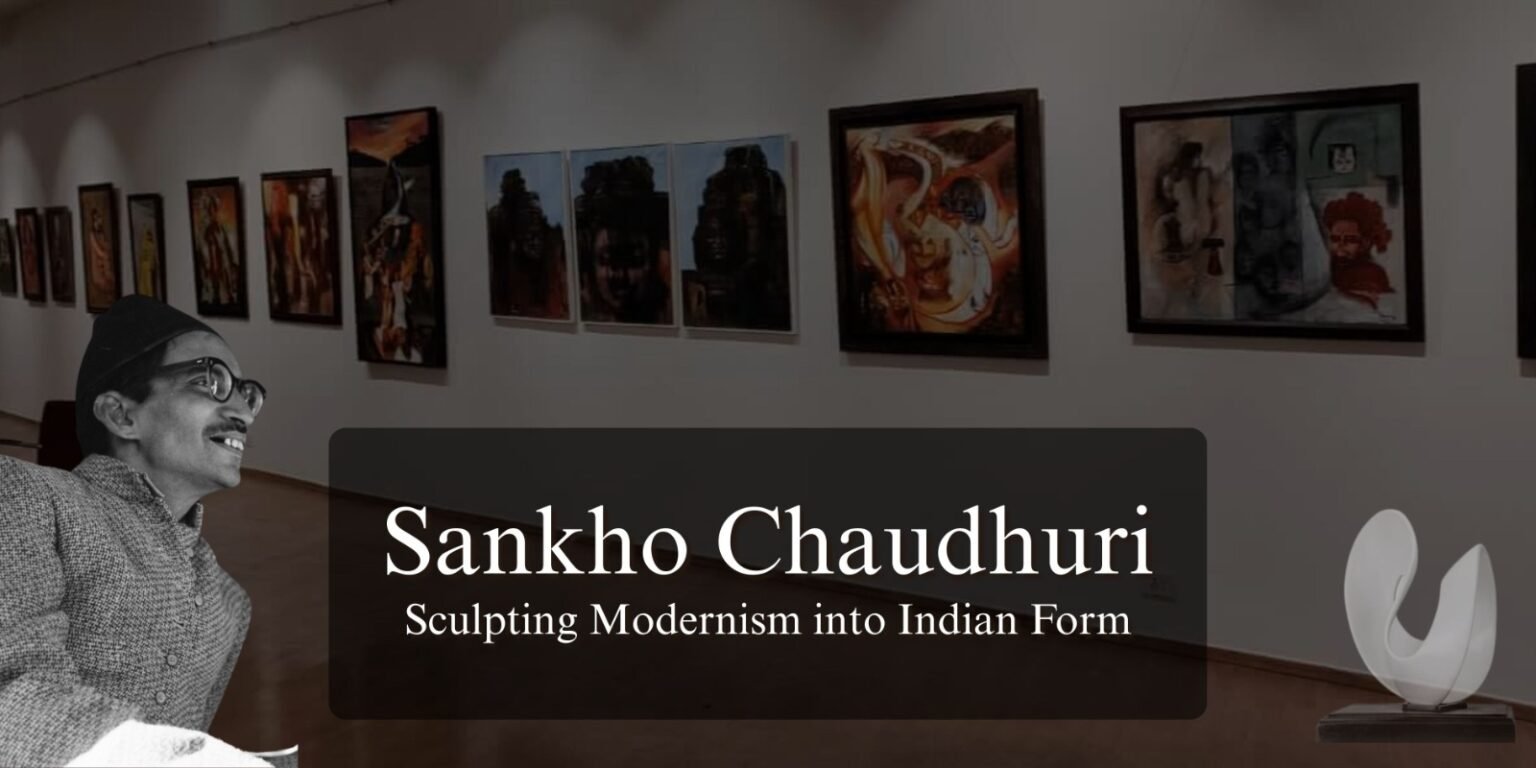

In the story of modern Indian art, few figures embody both the experimental zeal and institutional leadership of Sankho Chaudhuri (1916–2006). More than a sculptor, he was a formative force in shaping an Indian modernism that was at once rooted in local sensibilities and conversant with global idioms. His career, spanning six decades, not only advanced the formal language of three‑dimensional art but also reshaped the pedagogical and cultural infrastructures that sustain artistic practice in India.
From Naranarain to Sankho: Early Life and Education
Born Naranarain in the Santhal Parganas region of Bihar in 1916, he came to be universally known by his affectionate moniker, Sankho. He pursued his artistic education at Kala Bhavan, Santiniketan, the visionary art school founded by Rabindranath Tagore, where he studied under the tutelage of Ramkinkar Baij, a towering figure of Indian sculpture. Baij’s pedagogy emphasized freedom of expression, deep engagement with material, and a sensitivity to natural forms, principles that would profoundly shape Chaudhuri’s aesthetic trajectory. In 1939, he completed his Bachelor of Arts, and by 1945 he had earned a Diploma in Fine Art with Distinction in Sculpture from Santiniketan.
This formative period imbued Chaudhuri with a synthesis of Indian ethos and modernist inquiry. Unlike artists who merely reproduced Western models, Chaudhuri internalised modernism’s formal innovations while attuning them to indigenous philosophical and aesthetic frameworks, a hallmark of his mature practice.
Artistic Beginnings and the Paris Influence
Chaudhuri’s early work was marked by explorations into Cubism, an engagement that expanded during a pivotal study tour of Europe in 1949. In Paris and London, he encountered international avant‑gardes and met figures such as István Beöthy, whose abstract and constructivist vocabulary influenced Chaudhuri’s understanding of space, form, and volume.
Yet even as his forms became increasingly abstract, his work never abandoned a deep respect for the human scale and organic rhythm. Themes such as the female figure and wildlife recur throughout his oeuvre, not as literal depictions but as distilled expressions of life’s underlying energies.
Material Mastery and Formal Experimentation
A defining feature of Chaudhuri’s work is his fearless experimentation with materials. Across his career, he engaged with bronze, wood, concrete, stone, terracotta, fibreglass, and steel, mastering each medium with equal facility and curiosity.
From large‑scale public reliefs to mobiles and intimate studio pieces, his sculptures are animated by a sense of rhythm and movement. Forms are often elongated, intertwined, and flowing, suggesting flight, dance, or cosmic motion rather than static representation. His approach reflects a belief that sculpture is not merely an object to be seen but a force that engages the surrounding space and invites movement from the viewer.
This material diversity and formal fluency placed Chaudhuri at the forefront of Indian sculpture’s transition from academic naturalism, a legacy of colonial artistic training, to a vibrant abstraction rooted in intuition and experimentation.
Philosophy, Expression, and Style
Chaudhuri’s philosophy of sculpture was anchored in the conviction that artistic form should emanate from an inner rhythm rather than mimic external appearances. In his view, form and space function as complementary energies; sculpture unfolds not through mere mass but through the dynamic interplay of void and volume.
This spiritual and conceptual depth ensured that his work resonated beyond formal accomplishments. His pieces often possess a meditative quality, exploring themes of balance, continuity, and the metaphysical unity between human and natural forces.
Pedagogy and Institutional Leadership
Beyond his studio practice, Chaudhuri’s influence as an educator and leader was monumental. In 1949, he joined M.S. University, Baroda (now Vadodara) as a Reader and later served as Professor, Head of the Department of Sculpture, and Dean of the Faculty of Fine Arts. During his tenure, the campus became a crucible of modernist thought, educating generations of artists and fostering an environment of intellectual exchange and cross‑disciplinary creation.
His pedagogical legacy extended beyond India; he taught at the University of Dar es Salaam, Tanzania, and represented Indian art in forums such as UNESCO conferences in Paris and Venice, underlining his role as a cultural ambassador for Indian modernism.
Institutionally, Chaudhuri assumed pivotal roles. He served as Chairman of the Lalit Kala Akademi, a national academy of fine arts, and participated in numerous juries and advisory boards, shaping art policy and championing artist support mechanisms.
Exhibitions and Public Presence
Chaudhuri’s work was exhibited extensively, both nationally and internationally. His first solo show took place in Bombay in 1946, followed by major presentations in New Delhi, Calcutta, and Baroda. In 1997, the National Gallery of Modern Art (NGMA) in New Delhi mounted a retrospective celebrating his six decades of innovation.
Some of his most notable commissions include “Music” for All India Radio in 1957 and monumental bronze statues of Mahatma Gandhi installed in Rio de Janeiro (1964) and Copenhagen (1986), works that attest to his capacity to engage public space at an architectural scale.
Recognition and Enduring Legacy
Chaudhuri’s contributions were acknowledged with a constellation of honors. Among these were the Padma Shri (1971), the National Award of the Lalit Kala Akademi, fellowships, honorary doctorates, and distinguished titles such as Lalit Kala Ratna (2004).
Yet beyond accolades, his lasting legacy resides in the language of modern Indian sculpture itself, a language that harmonises abstraction with emotional resonance, experimentation with philosophical inquiry, and material prowess with conceptual depth.
Chaudhuri’s life and work demonstrate that modern Indian art was not a derivative of Western models but a laboratory of ideas that synthesised indigenous sensibilities with global modernism. In the pantheon of Indian sculptors, he remains pre‑eminent, not merely for what he made, but for how he expanded the field’s possibilities.