






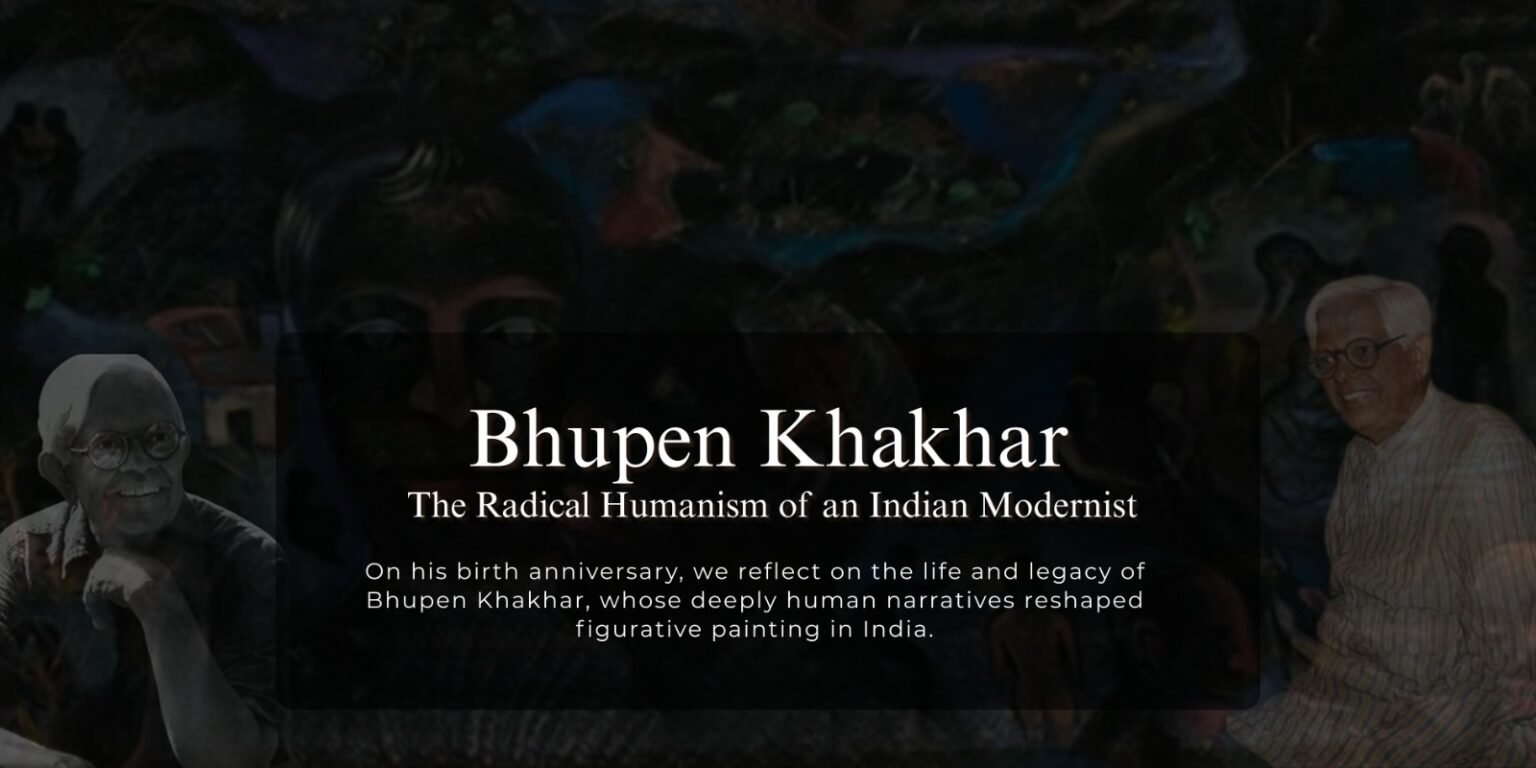

Every year on 10 March, the birth anniversary of Bhupen Khakhar invites renewed reflection on one of the most singular voices in Indian modern art. Born in 1934 in Bombay (now Mumbai), Khakhar’s career defied many conventions of artistic formation and subject matter. Neither formally trained in the traditional sense nor shaped by the dominant aesthetic ideologies of his time, Khakhar emerged as an artist whose work profoundly reconfigured the narrative possibilities of Indian modernism.
Khakhar’s early life did not initially point toward an artistic career. Educated at the University of Bombay, he completed degrees in economics and commerce before qualifying as a chartered accountant, a profession he continued to practice for many years in Baroda. Yet even while pursuing this career, Khakhar remained deeply engaged with literature, mythology, and visual culture. His encounter with the poet-painter Ghulam Mohammed Sheikh in the late 1950s proved transformative, encouraging him to engage with the vibrant intellectual environment of the Faculty of Fine Arts at the Maharaja Sayajirao University of Baroda.
Baroda in the 1960s and 1970s became one of the most fertile centres of modern art in India, and Khakhar soon became associated with the Baroda Group, which included figures such as Ghulam Mohammed Sheikh and Vivan Sundaram. Within this milieu, Khakhar’s practice developed a distinct visual language, one that combined narrative figuration, humour, autobiography, and social observation. While many Indian modernists were exploring abstraction, Khakhar turned resolutely toward the everyday lives of ordinary people, crafting paintings that depicted barbers, clerks, watchmakers, and small-town figures.
In doing so, Khakhar challenged the hierarchies that had historically shaped Indian modern art. Rather than portraying mythic heroes or monumental historical subjects, his canvases centred on the seemingly “insignificant” individual. The result was a visual world that was intimate, empathetic, and often gently ironic. Through vibrant colours and deliberately flattened perspectives, he constructed scenes that appeared deceptively simple yet carried layers of psychological and social meaning.
Art historians frequently identify Khakhar as India’s first Pop artist, though his engagement with Pop aesthetics differed significantly from its Western counterparts. Early works incorporated elements of popular visual culture, images clipped from calendars, posters, and commercial prints, combined with graffiti-like marks and painterly gestures. Yet unlike American Pop Art, which often celebrated consumer culture, Khakhar’s version remained deeply rooted in the lived realities of Indian urban life.
Among his most celebrated paintings is You Can’t Please All (1981), a work that exemplifies his autobiographical approach to narrative painting. The painting juxtaposes a naked figure, often interpreted as a self-portrait, with scenes unfolding in the surrounding landscape, referencing the well-known fable about a man, a boy, and a donkey. Through this composition, Khakhar meditates on social judgment, individuality, and the impossibility of conforming to societal expectations.
Perhaps the most radical aspect of Khakhar’s practice, however, lies in his frank exploration of sexuality and identity. At a time when homosexuality remained deeply taboo in Indian society, Khakhar openly addressed queer experience in works such as Two Men in Benares (1982). His paintings did not sensationalise intimacy; instead, they portrayed it with tenderness and emotional candour. In doing so, he became one of the first Indian artists to bring queer identity into the visual discourse of modern art.
Despite his unconventional path, beginning serious artistic practice relatively late and largely self-taught, Khakhar gained remarkable international recognition. His works entered major museum collections, including the British Museum, Tate, and Museum of Modern Art. In India, he received the Padma Shri in 1984, and internationally he was honoured with the Prince Claus Award in 2000, acknowledging the profound cultural significance of his work.
Khakhar passed away in 2003 in Baroda, leaving behind a body of work that continues to shape conversations around Indian modernism. His paintings remain strikingly relevant today precisely because they foreground the complexities of identity, vulnerability, and social belonging.
For contemporary art advisors, curators, and collectors, Khakhar’s legacy also offers an important reminder about the plurality of Indian modern art. The narrative of modernism in India is often dominated by a handful of canonical figures and movements. Yet Khakhar’s practice demonstrates that the most enduring artistic contributions sometimes arise from unexpected trajectories, those that move between professional worlds, challenge cultural taboos, and remain deeply attentive to the textures of everyday life.
As the art world continues to reassess the histories of modern and contemporary practice in South Asia, Khakhar’s work stands as a compelling testament to the power of narrative figuration. His paintings remind us that art history is not merely a story of stylistic evolution; it is equally a story of human experience, of ordinary lives, private desires, and the courage to render them visible.
On his birth anniversary, therefore, remembering Bhupen Khakhar is not simply an act of homage. It is an invitation to reconsider how Indian modernism can be written: not only through monumental gestures, but through the quiet, complex humanity of the everyday.