




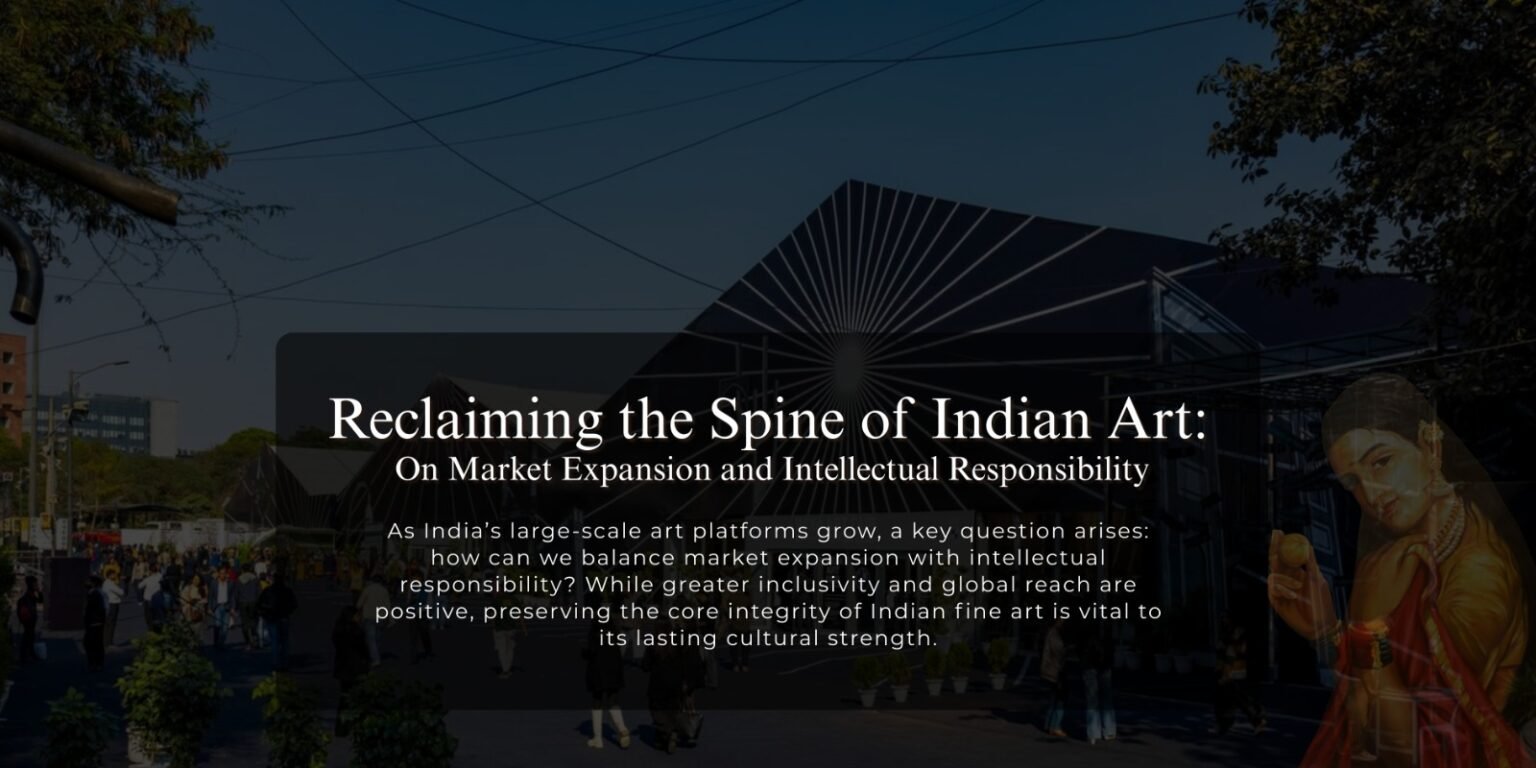

In recent years, India’s art ecosystem has experienced a depth and velocity of growth that would have been difficult to foresee even a decade ago. Major fairs such as the India Art Fair, now in its late teens, alongside global influencers like the Kochi‑Muziris Biennale, have propelled Indian work onto international platforms and invited a new generation of collectors, critics, and curators into active engagement with the country’s visual culture. Yet, this expansion brings into focus an urgent and ongoing question: As the market expands, how do we preserve the intellectual and historical foundations that give Indian art its unique cultural value?
At the heart of this discourse is a structural tension between market dynamics and cultural stewardship. On the one hand, developments in sales valuations, reflected in record‑breaking auction results for artists like M.F. Husain, Tyeb Mehta and V.S. Gaitonde, affirms that Indian art is commanding global attention and financial momentum unlike ever before. In 2025 alone, several works by modern Indian masters achieved exceptional prices, signaling unprecedented collector confidence. These achievements testify to a maturing appetite among private buyers and institutions alike, suggesting India’s place in the global art market is no longer peripheral.
But this growth also reveals a lopsidedness: while a narrow stratum of established modernist icons dominates market narratives, the broader historiography and plurality of Indian practice often occupy marginal positions. Even as iconic names ascend in value, many lesser‑shown figures from the mid‑20th century remain underexposed despite their crucial contributions to India’s artistic evolution.
This situation is complicated by the structure of contemporary art fairs themselves. Designed to operate at the intersection of commerce and culture, fairs necessarily function as businesses with booth pricing, sponsorship structures, and curated prestige aimed at drawing international collectors. In platforms such as the India Art Fair’s 2026 edition, programming explicitly includes dialogues around market value, identity, and access, demonstrating curators’ awareness of both commercial expectations and cultural questions. The inclusion of panels on access, accountability, and the role of the public in shaping art’s value reflects a growing self‑awareness within the fair circuit about its broader role in shaping Indian art discourse.
Yet, the de facto prioritisation of what is most “market‑ready” has implications for cultural depth. Galleries and booths that emphasise decorative design objects, furniture, and applied arts, while enriching the field in their own right, risk overshadowing the lineage of fine art that has defined India’s modern and post‑modern traditions. This trend can contribute to a diminishing visibility of historical trajectories, effectively severing contemporary audiences from the conceptual scaffolding that underpins the work they encounter today.
Importantly, this is not to discredit innovation or inclusivity; rather, it is to argue for balance. As India’s fairs become increasingly interdisciplinary and international in scope, they must ensure that the foundations of Indian art history, the philosophical impulses, political engagements, and aesthetic innovations of earlier generations, remain central to the narrative.
Indeed, one of the most enduring strengths of India’s cultural heritage has been its capacity to integrate diverse modalities of expression. Historical movements such as the Santiniketan school exemplified an approach to modernism that was neither purely Western nor strictly traditional, but deeply contextual, rooted in philosophical inquiry as much as visual practice. Such intellectual frameworks are not antiquarian relics; they are living legacies that enrich the interpretive experiences of artists and audiences alike.
The challenge, therefore, is not simply to promote Indian art, but to cultivate an ecosystem that supports both market expansion and intellectual rigor. A mature art world is one that does not confuse volume with depth, nor commercial success with scholarly relevance. This requires intentional strategies: active support for research institutions, enhanced archival access, integration of academic voices into curatorial programming, and investment in educational resources that contextualise artists beyond price tags.

Moreover, ethical and infrastructural concerns, such as provenance research, authentication protocols, and transparent transaction frameworks, must underpin the mechanisms of commerce as robustly as aesthetics inform scholarship. Without such rigor, long‑term credibility can be compromised, undermining both collectors’ trust and the cultural weight of Indian art.
In practice, this means embracing programming that foregrounds lineage alongside novelty, platforms that embed critical discussion into public engagement, and frameworks that valorise not just market capital but cultural capital. Fairs have begun to reflect this shift, but much remains to be done in bridging the divide between spectacle and substance.
The future vitality of Indian art will hinge on our collective capacity to harmonise global exposure with intellectual responsibility. Inclusivity and accessibility need not dilute historical depth; on the contrary, they can be instruments through which tradition and innovation converse. When curators, galleries, institutions, and collectors commit to a shared ethos of cultural stewardship, the art world becomes not just a marketplace of objects, but a repository of ideas, histories, and meanings.
In this light, the charge before us is not merely economic, but epistemological: to ensure that Indian art’s spine, its historical consciousness and conceptual integrity, remains resilient even as its global wingspan continues to expand.