





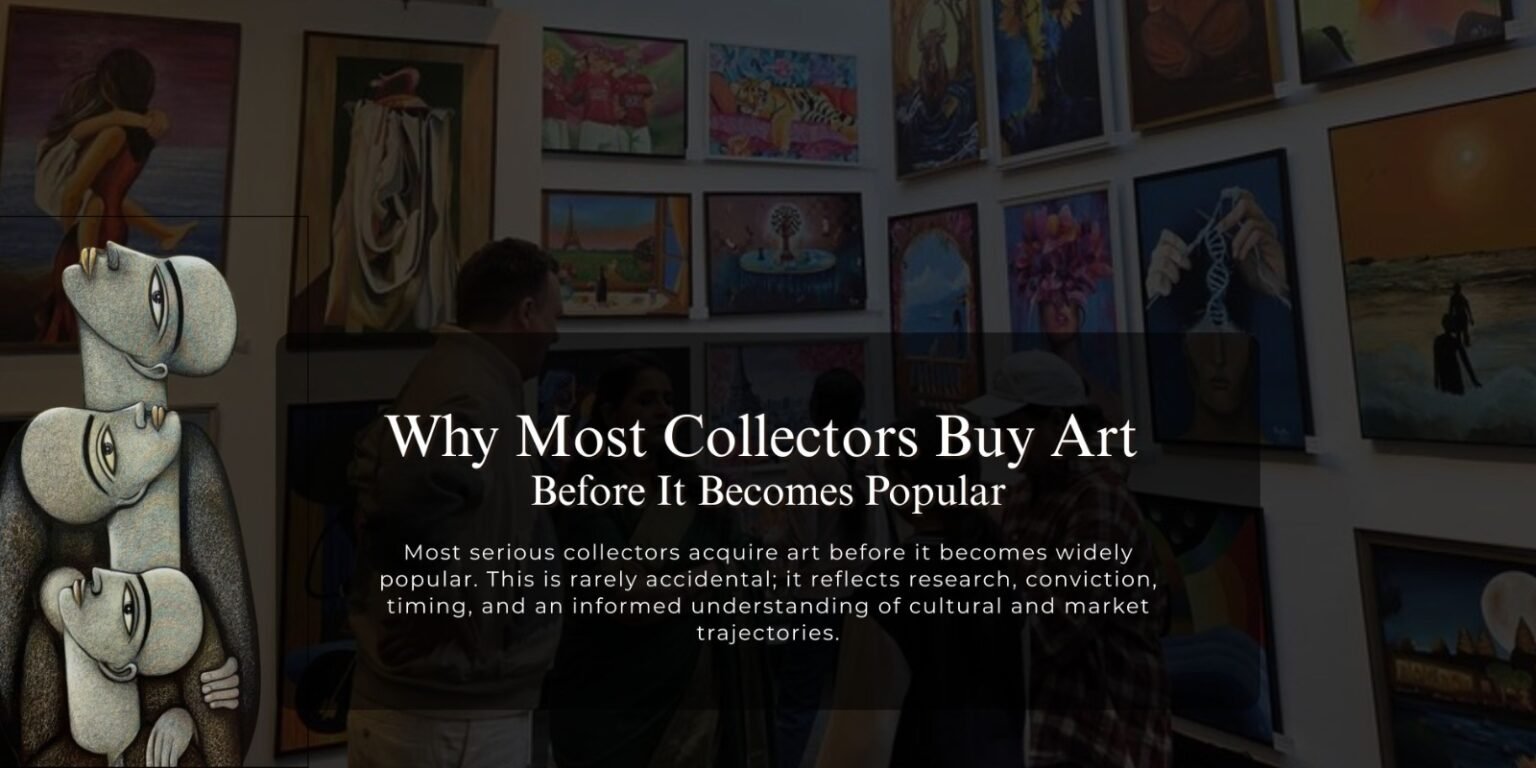

Understanding the motivations, strategies, and cultural imperatives behind early acquisition in the contemporary art world
In contemporary art markets, a distinctive phenomenon has emerged: collectors are increasingly inclined to acquire works by artists before they achieve widespread critical acclaim or commercial demand. This pattern, far from being a mere speculative gambit, is rooted in a confluence of cultural, economic, and psychological drivers that illuminate both the evolving nature of art patronage and the logic of art as an asset class.
1. The Intersection of Aesthetic Appreciation and Financial Strategy
At its core, early acquisition reflects a dual impulse: aesthetic engagement and strategic foresight. Collectors, especially those who work with advisory or scholarly frameworks, seek out works that resonate visually and conceptually, but also possess the potential for significant appreciation. Emerging artists typically offer lower entry prices than their established counterparts, making early purchases economically accessible while allowing collectors the opportunity to support artistic innovation at its nascent stage. This alignment of taste and opportunity underscores why collectors pursue under-the-radar talent: it maximizes both cultural value and future capital growth.
This approach dovetails with broader market observations: recent art market surveys show that a substantial majority of collectors (72%) are actively drawn to emerging artists, often because of the distinct price dynamics and perceived growth potential before broader recognition.
2. Affordability and Accessibility in a Stratified Market
One fundamental driver of early buying is straightforward economic logic. Artworks produced before an artist’s breakout are generally more affordable. For collectors informed by advisory practices or by institutional context, this provides a pragmatic entry point into collecting without the prohibitive costs that accompany blue-chip names. Economically, the law of supply and demand suggests that as an artist’s profile rises, scarcity and competitive demand drive prices upwards, a trajectory that early buyers are uniquely positioned to benefit from.
Additionally, for new and younger collectors in particular, the ability to access artists at early stages, through gallery representations, studio visits, or direct engagement, has fundamentally democratized participation. These forms of access flatten traditional barriers once imposed by private auction houses and elite circle gatekeepers, enabling a broader cohort to stake claims in promising artistic futures.



3. Support for Creative Evolution And Narrative Value
Collecting art before popularity also reflects a deeper commitment to nurturing artistic trajectories. Unlike commodities whose value is purely transactional, art works are embedded within narratives: the unfolding career of an artist, the cultural moments they reflect, and the dialogues their work invites. Collectors with serious aesthetic or academic intent derive intellectual and emotional satisfaction from witnessing and participating in that evolution.
In this sense, early acquisition is not merely speculative; it is relational. It positions the collector as an active participant in an artist’s professional arc, often enabling ongoing dialogue, patronage, and mutual growth. Early works, therefore, gain narrative and historical value as markers of an artist’s developmental journey, amplified through exhibitions, critical reviews, and institutional recognition over time.
4. Market Dynamics and Competitive Positioning
The modern art market is informed not only by taste but by networked knowledge and timing. Tech-mediated discovery, whether through online galleries, social media platforms, or digital art fairs, has accelerated awareness of new talent and encouraged collectors to act swiftly. Surveys of collector behavior indicate that an increasing share of acquisitions is made directly from artists, often influenced by online visibility rather than established institutional validation.
This immediacy breeds a competitive edge. Acquiring art before its “moment” is often an assertion of discernment, an expression that the collector possesses connoisseurship sharp enough to identify quality before widespread endorsement. In the context of art advisory and consultancy, this signal functions almost as intellectual capital: it demonstrates a capacity to navigate aesthetic terrains independently, and it reinforces the collector’s status both socially and within connoisseurial circles.
5. The Psychology of “Not Missing Out”
Parallel to economic and aesthetic motivations is a robust psychological component: the fear of missing out. In cultural markets as in financial ones, scarcity and anticipation drive demand. The desire to secure a piece before others recognize its value is an expression of both competitive instinct and cultural sensibility. A collector’s awareness that early works may later become rare, and therefore more valuable, can spur acquisitions that, while grounded in appreciation, also respond to a temporally sensitive logic of opportunity.
This is not inherently speculative in the opportunistic sense; rather, it reflects a sophisticated balancing of timing, taste, and valuation, elements central to informed art acquisition.
Beyond Speculation – Toward Cultural Stewardship
To characterize early acquisition solely as financial speculation would be to overlook the nuanced motivations at play. Collectors who intentionally acquire works before popularity do so at the intersection of passion, foresight, and cultural engagement. Their activity supports artistic ecosystems, fuels broader recognition of underrepresented voices, and enriches cultural archives with works that might otherwise be undervalued.
In the increasingly dynamic landscape of the global art market, these early bets are not just investments in value, but commitments to artistic futures. They reaffirm the enduring role of the collector, whether guided by advisors, galleries, or personal connoisseurship, as a steward of culture as much as a participant in commerce.