






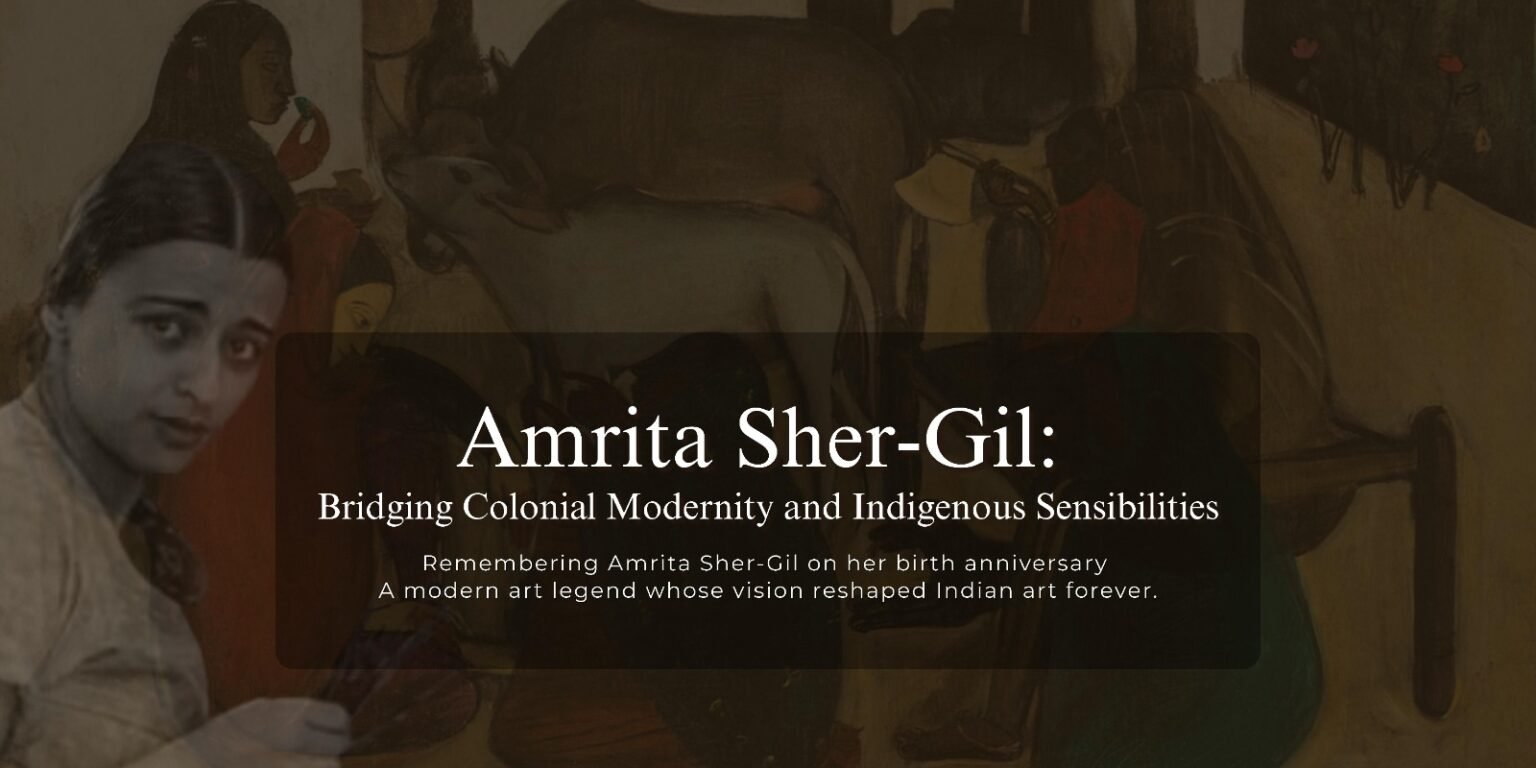

On 30 January 1913, amidst the cosmopolitan milieu of Budapest, a singular artistic force was born: Amrita Sher-Gil, a painter whose hybrid identity and creative ingenuity would ultimately redefine notions of modern art in India and beyond. Though her life was tragically short, ending at just 28 years of age, Sher-Gil’s oeuvre occupies a position of immeasurable significance in the canon of twentieth-century art. Her work remains a testament to the fertile intersections of European modernism and South Asian visual traditions, and her legacy continues to shape contemporary artistic practices.
A Bicultural Genesis and Early Artistic Promise
Sher-Gil’s formative years were marked by profound cultural fluidity. Born to a Hungarian opera singer mother and an Indian aristocratic father of Sikh descent, her early life spanned continents and aesthetic worlds. Her talent was evident from a young age, prompting familial support and early encouragement, notably from her uncle, the Indologist Ervin Baktay.
At sixteen, she secured admission to the École des Beaux-Arts in Paris, where she trained rigorously in life drawing and embraced the teachings of Post-Impressionist masters. During this period, Sher-Gil absorbed influences from Paul Cézanne, Amedeo Modigliani, and Paul Gauguin, yet her work always bore an unmistakable individuality. It was here that she painted Young Girls (1932), a work that won her associate membership at the prestigious Grand Salon in Paris, making her the youngest and first Asian artist to receive this distinction.
Return to India: Artistic Reorientation
Despite her success in Europe, Sher-Gil experienced a profound artistic and existential pull toward India. In 1934, she returned with her family, determined to cultivate an art that spoke authentically to the Indian context. The Indian subcontinent did not merely provide new subject matter; it reconfigured her aesthetic purpose. Sher-Gil consciously shed aspects of her European artistic identity, even adopting Indian saris as her everyday dress to embody her evolving sense of self and visual engagement with her subjects.
This period marked a radical transformation. The luminous hues, earthy reds, browns, and warm tones that characterize her Indian work contrast starkly with the cooler palette of her Paris years. More importantly, her artistic mission became clear: she sought to portray the ethos of Indian life with urgency and integrity, focusing especially on the lived realities of women and rural communities.
Synthesis of Aesthetic Traditions

Sher-Gil’s genius lay in her ability to synthesize diverse art histories without subsuming one under another. Influenced profoundly by the Ajanta frescoes, Mughal and Pahari miniature traditions, and Indian folk idioms, she devised a language that was structurally modern yet spiritually rooted in indigenous expression. Her Indian paintings did not replicate traditional forms; rather, they engaged with them dialogically, permitting a layered visual discourse that was at once expressive, formal, and culturally resonant.
Her South Indian trilogy, including Brahmacharis, South Indian Villagers Going to Market, and Bride’s Toilet, articulates this synthesis with remarkable clarity. These works reject the exoticized portrayal of Indian life prevalent in colonial aesthetics and instead foreground everyday human experiences with both dignity and pathos.
Thematic Focus: Women and the Human Condition
Sher-Gil’s empathetic gaze was especially attuned to the interior worlds of her subjects, often women whose roles in society were marginalized or rendered invisible by mainstream narratives. Works such as Three Girls (1935) and her later portrayals of village women exemplify her commitment to a truthful, unsentimental representation of human psychology and corporeality. Her figures carry an introspective weight; their postures and expressions invite contemplation rather than voyeuristic consumption.
This commitment aligns Sher-Gil with broader modernist concerns, particularly the interrogation of identity, embodiment, and societal structures, yet she accomplishes this without severing ties to her milieu’s cultural specificity. In doing so, her art becomes a powerful intersection of the personal, political, and aesthetic.
Legacy and Posthumous Recognition
In India, Sher-Gil’s works were posthumously declared National Art Treasures, reflecting their profound cultural value. The National Gallery of Modern Art in New Delhi houses the most extensive collection of her paintings, where they remain central to the narrative of Indian modernism. Her market legacy has also grown; in recent years, her painting The Story Teller set a record price at auction, underscoring her enduring significance to both cultural institutions and contemporary collectors.
Internationally, her work has been exhibited in leading institutions and continues to attract scholarly attention, further cementing her position as a transnational figure in art history.
Enduring Influence
Amrita Sher-Gil’s career, though brief, was unbounded in its intellectual and expressive ambition. She traversed cultural geographies with a painter’s eye and a historian’s consciousness, forging a visual language that remains central to conversations about identity, modernity, and artistic hybridity. Today, her legacy persists not only in gallery collections and auction results but in the continued relevance of her vision for artists and audiences alike. Through her work, the complexities of colonial encounter and indigenous expression find an eloquent, challenging, and deeply humane articulation.