




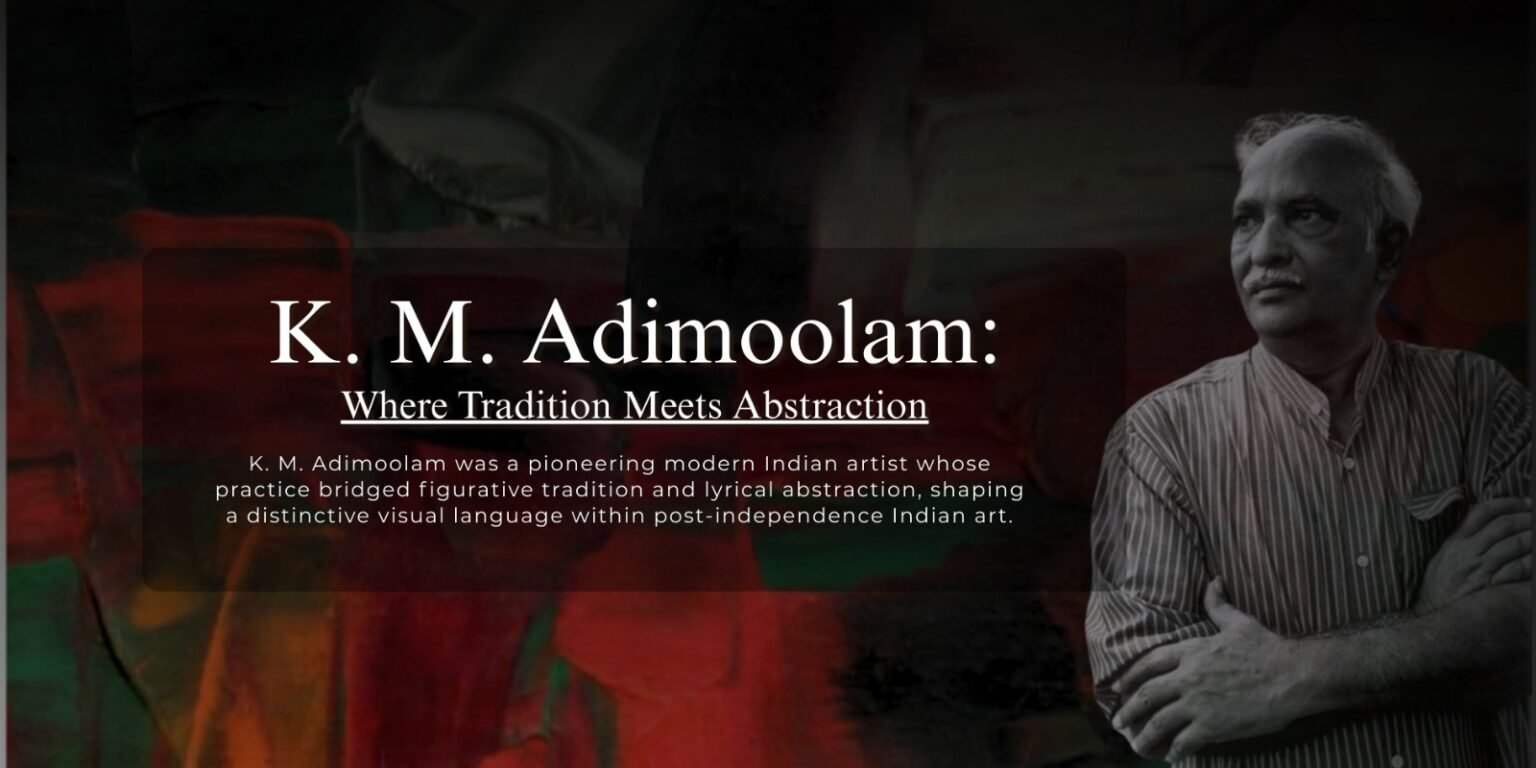

In the annals of modern Indian art, few figures embody the synthesis of local tradition and abstract expression as compellingly as K. M. Adimoolam (1938–2008). His artistic journey, from figurative portraits rooted in Indian icons to bold abstractions that traverse colour, form, and space, reflects a transformative arc in post-independence Indian visual culture. Adimoolam’s oeuvre is not merely a chronological sequence of stylistic shifts but a profound negotiation between cultural heritage and modern artistic inquiry, an interrogation that continues to resonate in contemporary practices.
Born in 1938 in Tiruchirapalli, Tamil Nadu, Adimoolam’s early aptitude for drawing emerged from his rural surroundings and an intrinsic fascination with visual expression. Supported by family and community advocates, he moved to Chennai in 1959 to pursue formal art training at the Government School of Arts and Crafts, a crucible for many artists associated with the Madras Art Movement. It was here, under the influence of the sculptor Dhanapal and within a milieu animated by modern Indian art thinkers, that Adimoolam developed a foundation in figurative drawing before gradually charting his own expressive path.
Early Practice and Figurative Foundations
Adimoolam’s early work is characterised by meticulous attention to line, composition, and narrative presence. One of his most celebrated projects, 100 Drawings on Mahatma Gandhi (1969) underscores his capacity to render the life of a national icon with both reverence and interpretive depth. Working in black and white, he produced nearly a hundred portraits tracing Gandhi’s six decades of life, not as mere likeness but as an exploration of humanity, introspection, and moral gravitas. These drawings demonstrate not only technical proficiency but a humanistic engagement with Indian socio-cultural identity at a pivotal historical moment.
Simultaneously, Adimoolam’s involvement with the Modern Tamil Writer’s Group expanded his artistic terrain into literary culture. His illustrations, cover designs, and typographic innovations for magazines and books positioned him within a broader intellectual network that bridged visual art and Tamil literature. His graphic contributions enhanced the visibility of modern art aesthetics within a regional cultural discourse, bringing avant-garde visual language into contact with vernacular narratives.
Abstraction as Vision:
A Turn Toward the Transcendent
Around the mid-1970s, Adimoolam’s practice underwent a decisive transformation. Moving beyond figurative representation, he began to engage with colour and form in novel ways, a shift that culminated in his abstract paintings. Colour, in his own words, became not a tool of mimicry but a vehicle for perceptual and conceptual liberation: My canvases mirror my mind’s journey through Nature, not as realistic landscapes or seascapes but planes of colours creating an esoteric aura on a transcendental level.” His abstraction did not attempt to literalise the visible world; rather, it sought to evoke the unseen rhythms of experience, to convey felt realities rather than empirical scenes.
This phase of his work is characterised by vibrant chromatic interplay, dynamic spatial tension, and textural modulation, elements that defy easy categorisation within any prescriptive formal school. Here, Adimoolam’s canvases become meditative spaces where colour assumes psychological and spiritual valences, inviting listeners to perceive art as a sensory and philosophical encounter. These abstract works resonate as contemplative landscapes where viewer engagement becomes an act of experiential discovery.

Position within the Madras Art Movement
Adimoolam’s development must be understood within the broader frame of the Madras Art Movement (1960s–1980s), a regional modernist effort that sought to establish an Indian artistic idiom informed by indigenous forms, mythologies, and local aesthetics. Associated with artists such as K. C. S. Paniker and others, Adimoolam contributed to this synthesis of modernist thought and Indian sensibility, situating his work in a lineage that resisted mere replication of Euro-American abstraction while embracing global currents of innovation.
Unlike abstraction that privileges pure formalism, his work reflects a dialectical engagement with tradition, the spiritual, the literary, the philosophical, and modernist abstraction. His canvases may gesture toward international idioms, but they are deeply rooted in a cultural matrix that is Indian in spirit and human in scope.
Institutional Recognition and Global Presence
Adimoolam’s contributions were acknowledged widely during his lifetime. He was a recipient of prestigious honours from institutions including the Lalit Kala Akademi (both Chennai and New Delhi), the Bombay Art Society, and the Academy of Fine Arts, Kolkata. He also served as a jury member for national exhibitions and represented India as Commissioner at the Third Ankara Biennial in Turkey (1990). His work was featured in solo and group exhibitions across India and abroad, including shows in New Delhi, Mumbai, Bangalore, London, and Hong Kong.
These recognitions affirm not merely artistic merit but the receptivity of global audiences to his unique visual lexicon, a lexicon that eloquently navigates the interplay of cultural specificity and universal expressivity.
Legacy: Between Tradition and Innovation
K. M. Adimoolam’s legacy extends beyond galleries and auction squares; it inhabits the evolving discourse on how Indian modernism might acknowledge tradition without reverting to literal representation. His early figurative works and later abstractions both articulate a deep sense of continuity, a refusal to sever the roots of cultural memory even as he embraced innovation. By engaging with literary circles, embodying literary-visual synergies, and advancing a colour-centric abstraction, he contributed to a reimagined artistic identity for Indian art in the twentieth century.
For art advisers, curators, and collectors, Adimoolam’s practice underscores a crucial insight: that the most enduring art evolves at the intersection of tradition, personal vision, and cultural context. His work invites sustained scholarly attention not simply as aesthetic artefacts but as living archives of artistic thought that bridge the historical and the contemporary.