





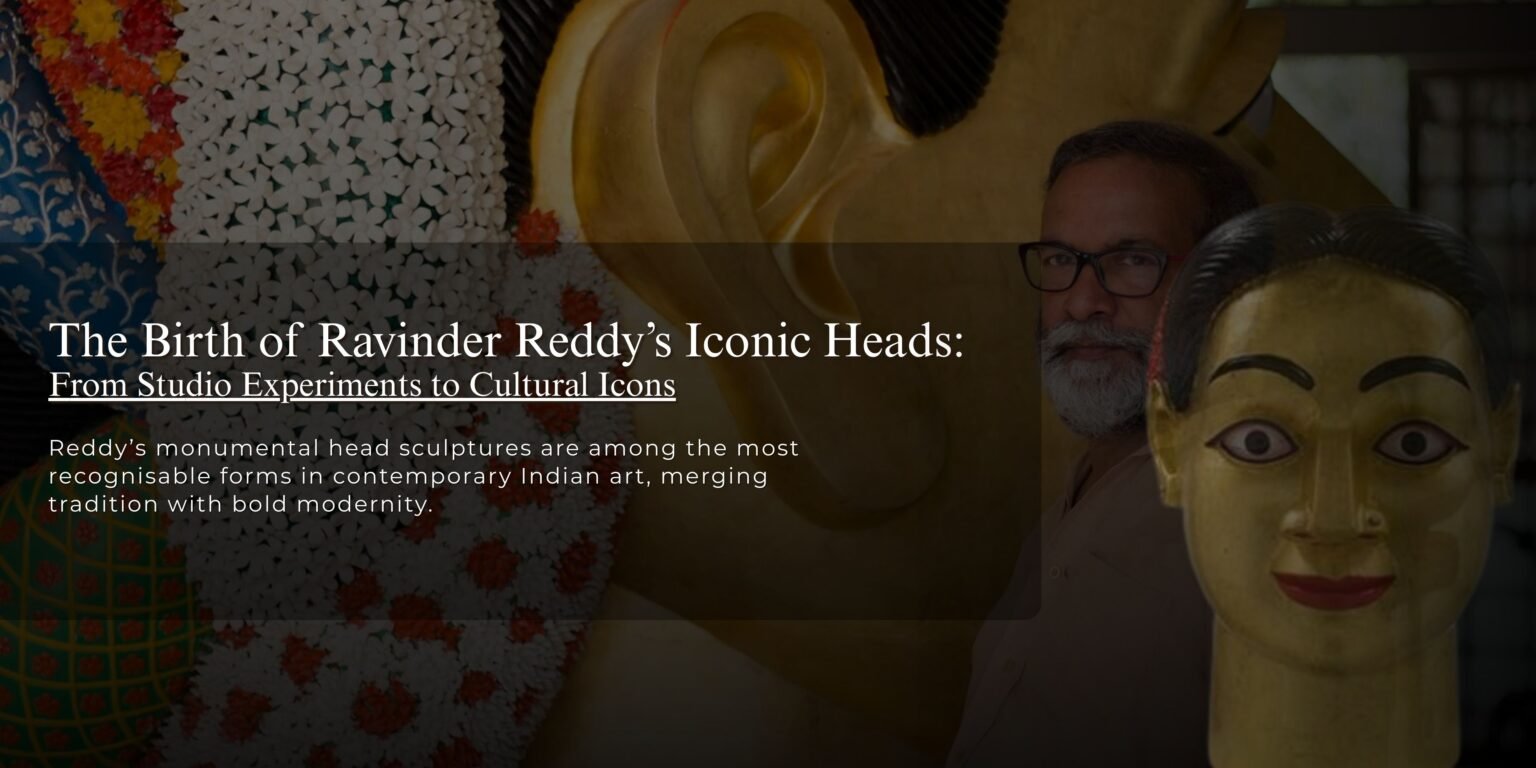

In the tapestry of contemporary Indian art, few works have achieved the enduring resonance and symbolic density of G. Ravinder Reddy’s monumental head sculptures. These towering visages, gilded, vividly coloured, and arresting in their frontal gaze, stand as some of the most recognisable artistic achievements of the late 20th and early 21st centuries. Once nascent studio explorations, they now inhabit the living spaces of premier collectors and public galleries alike, forming a defining axis in the narrative of Indian contemporary sculpture.
Ravinder Reddy was born in 1956 in Suryapet, Andhra Pradesh, and from early on, exhibited an instinctive affinity for representational form. After completing his studies at the M.S. University, Baroda, Reddy pursued further training in London, an experience that catalysed his aesthetic evolution. He combined exposure to diverse sculptural traditions, from African and Egyptian forms to Indian temple sculpture, with a resolute belief that art should be comprehensible and immediate to audiences beyond formal art milieus. This belief became the conceptual cornerstone of his oeuvre.
Genesis of the Head
The line of inquiry that would ultimately define Reddy’s career emerged in the 1990s, when he cast his first oversized head, a three-foot bust titled Devi that would later feature in international exhibitions. Prior to this, Reddy had experimented with figurative sculpture, including full-bodied figures like Girl with Umbrella (1981), which drew inspiration from the kinetic vitality of urban life. But it was the head, a concentrated, elevated fragment of human presence, that captured his intellectual and artistic imagination.
For Reddy, the head was an archetype, a universal signifier deeply embedded in the collective visual consciousness. As he himself reflected, “the head is the immediate recognisable form for any human being.” Its universality allows it to convey a spectrum of meanings, identity, presence, emotion, without recourse to narrative figuration or abstraction.
The line of inquiry that would ultimately define Reddy’s career emerged in the 1990s, when he cast his first oversized head, a three-foot bust titled Devi that would later feature in international exhibitions. Prior to this, Reddy had experimented with figurative sculpture, including full-bodied figures like Girl with Umbrella (1981), which drew inspiration from the kinetic vitality of urban life. But it was the head, a concentrated, elevated fragment of human presence, that captured his intellectual and artistic imagination.
Material and Monumentality
The physical realisation of these forms, especially in fibreglass and resin, was both strategic and emblematic. Unlike traditional materials such as bronze, wood, or stone, fibreglass offered Reddy an unencumbered medium, one devoid of historical baggage and capable of accommodating his conceptual ambitions. Light yet robust, it allowed for works of extraordinary scale, some towering well over human height, without the logistical limitations of conventional sculpture. This choice reflected a larger philosophical stance: form and idea should supersede material constraints.
Indeed, it was this veritable marriage of scale, colour, and cultural iconography that enabled Reddy’s sculptures to transcend the gallery and enter broader cultural consciousness. Rendered in gold leaf, vibrant primary pigments, and intricate hair ornamentation, his heads evoke associations ranging from religious idol images and folk traditions to global pop art sensibilities. This synthesis of references is central to their potency: they are at once deeply Indian in visual lineage and universally legible.
Iconography and Cultural Dialogue
Reddy’s heads are not mere formal exercises; they engage actively with the socio-cultural transformations of modern India. Their expressive features, kohl-lined eyes, prominent noses, and richly adorned coiffures, suggest not only an aesthetic rooted in indigenous visual economies, but also a commentary on identity, migration, and evolving notions of beauty. In works like Portrait of a Migrant, the monumental head becomes a mirror to the lived experiences of individuals navigating rapid societal flux, particularly the migration from rural to urban spaces.
This narrative complexity is part of what makes his sculptures intellectually compelling. While their surface allure might be immediate, their visual grammar invites interpretation. The monumental heads embody what one critic characterised as a dialogue between tradition and contemporary life, synthesising elements from temple iconography, tribal art, and everyday lived experience into a new sculptural idiom.
Collectors and Cultural Capital
From the margins of the studio to the forefront of the art market, Reddy’s heads have been embraced by an array of distinguished collectors, signalling their ascent into cultural capital. Versions of his Devi have entered the private collections of India’s elite, including Nita Ambani, Shah Rukh Khan, Anupam Poddar, and Minal Vazarani, a testament to the broad appeal and investment value of his work.
Moreover, beyond traditional art connoisseurs, his works have entered the visual ecologies of popular culture. In recent years, a Ravinder Reddy head became recognizable in mainstream social discourse after gaining visibility through association with personalities such as Shalini Passi, a prominent patron and cultural figure known for her engagement with contemporary practices, a confluence of high art and contemporary social visibility that underscores how these sculptures have become symbols of taste, aspiration, and cultural discourse.
Iconicity and Legacy
Today, Ravinder Reddy’s heads stand not only as sculptural masterpieces but as cultural artefacts of India’s contemporary moment. Their evolution, from early studio experiments to monumental works housed in prestigious collections, reflects broader shifts in how Indian art is produced, collected, and interpreted on both national and global stages.
What differentiates Reddy’s oeuvre is not merely the scale or colour of his forms, but their capacity to encapsulate the complex dialogues of tradition, identity, and modernity. In an age where art must constantly negotiate between commercialisation, cultural specificity, and global discourse, Reddy’s heads remain uniquely positioned: firmly rooted in their local idioms, yet universally expressive.