




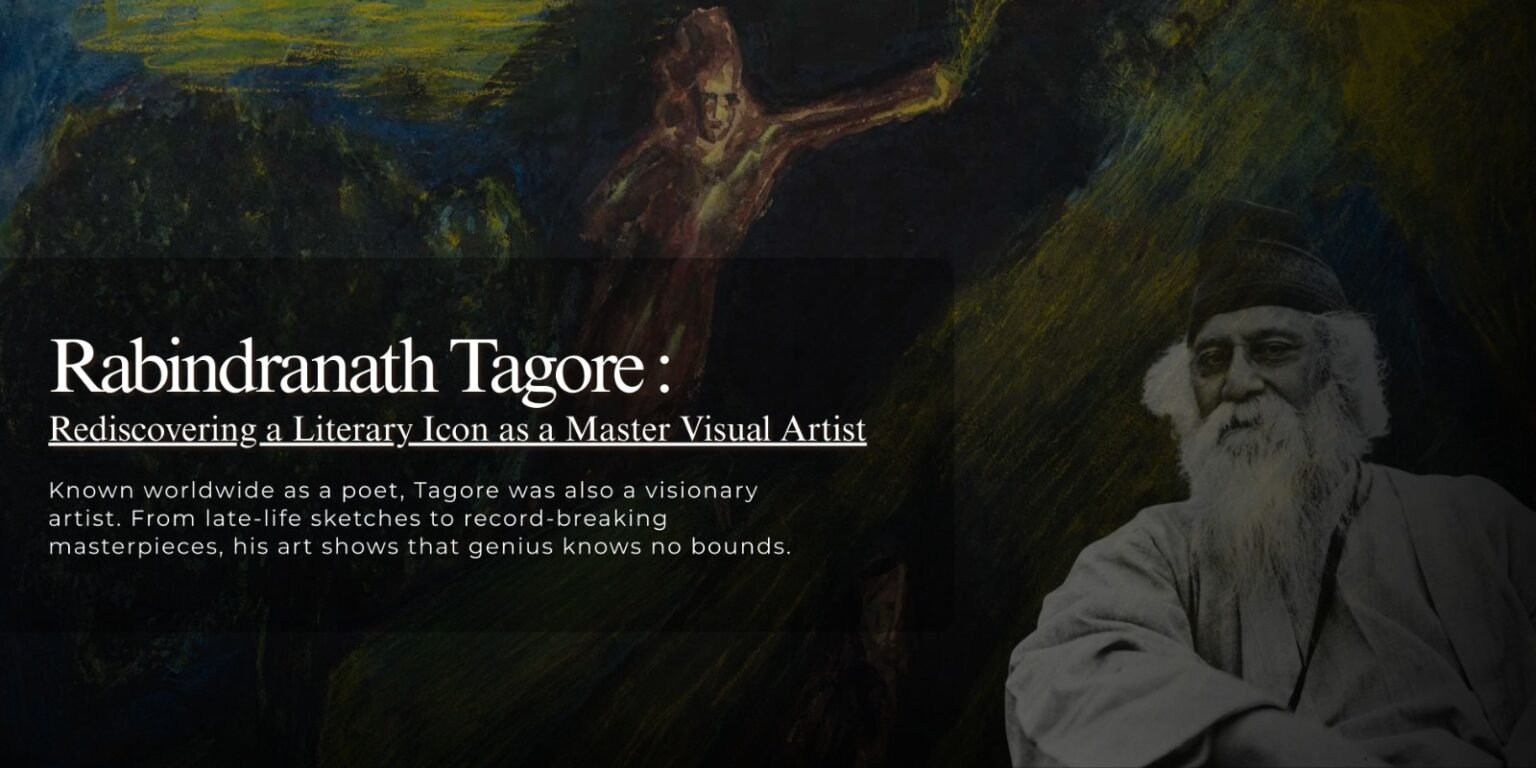

Rabindranath Tagore is one of the most celebrated cultural figures in modern history, renowned globally as a poet, playwright, musician, philosopher, and the first Non‑European Nobel laureate in Literature. What many people do not immediately associate with the Nobel laureate is his extraordinary body of work as a visual artist, a pursuit he took up relatively late in life. Over the past few years, however, Tagore’s artworks, once rare at auction, have begun to attract renewed collector interest, culminating in record‑breaking sales that affirm his artistic vision beyond words.
A Late Bloomer in the Visual Arts
Tagore began painting only around the age of sixty, long after he had already secured international fame for his writing and philosophical contributions. His early visual works started as sketches and doodles in the margins of his manuscripts, but what began as casual drawing soon developed into a distinctive, expressive idiom. These works frequently explore dream‑like figures, brooding landscapes, and abstracted human forms that convey emotion and introspection in ways distinct from his literary voice.
Unlike many formally trained artists, Tagore’s approach to painting was intuitive and experimental. He drew from a wide range of visual influences encountered during his travels, from Japanese woodcuts to Pacific Island carvings, and blended them with a deeply personal creative impulse. His works often seem to emerge from an interior world rather than from the external observation of nature, giving them a haunting, timeless quality.
Early Auction Appearances and Rising Market Value
For decades, Tagore’s paintings were rarely seen in the secondary market. Many of his artworks are preserved in institutions such as Visva‑Bharati University and the National Gallery of Modern Art, and a significant number are protected as national treasures under Indian law, making them seldom available for public sale.
2021 marked a significant turning point. One of his large mixed‑media works, Untitled (Couple), painted around 1930, came to auction at Christie’s in New York. The piece was one of the largest Tagore paintings ever offered and was executed during his European period, when he sought to expand his artistic vocabulary through international exposure. It sold for approximately $637,500 (about ₹4.7 crore), establishing an early benchmark for his market value.
In October 2023, his Untitled (Three Bauls), a lyrical composition in watercolour, ink, and pastel, was sold at Sotheby’s London for roughly $772,546 (around ₹5.7 crore). This result demonstrated solid growth from the earlier record and confirmed consistent collector interest in Tagore’s unique visual voice.
Beyond Paintings: Letters and Sculptural Rarities
As Tagore’s auction presence expanded, collectors also began to prize material beyond his paintings. In June 2025, an archival collection of 35 handwritten letters by Tagore, addressed to his close associate Dhurjati Prasad Mukherji, fetched ₹5.9 crore at an online AstaGuru sale. These documents, classified as national art treasures, gave buyers insight into his intellectual world and emotional life, adding both historical and monetary value. Shortly after, Tagore’s only known sculpture, titled The Heart, was sold at auction for just over ₹1 crore, are exceeding pre‑sale estimates. This rare three‑dimensional work, thought to be dedicated to Kadambari Devi, the wife of Tagore’s brother, reveals another dimension of his creative exploration in form and material.
A Record‑Breaking Moment: From Across the Dark
The most remarkable milestone in recent years came with the December 2025 sale of From Across the Dark, a 1937 work painted during Tagore’s final and most introspective creative period. Offered at AstaGuru’s Historic Masterpieces auction, this piece fetched a staggering ₹10.7+ crore, surpassing all his previous auction records.



Executed in ink, poster colour, and crayon on cardboard, the artwork was painted during Tagore’s extended stay in Almora in the Himalayan foothills, a time marked by deep reflection as he navigated advanced age, solitude, and personal loss. The composition’s brooding atmosphere, featuring figures emerging from shadow and light, embodies this emotional intensity.
Interestingly, the painting was auctioned on its first public offering, far exceeding the estimated pre‑auction range of roughly ₹2–3 crore, and resold with its original handwritten card inscribed with the Bengali title and its English translation, a rarity that enhanced provenance and appeal.
What the Market Momentum Means
Tagore’s recent auction trajectory illustrates more than just financial appreciation; it reflects a reassessment of his artistic identity. For decades, his visual works existed in the shadow of his immense literary legacy. But the successive record sales, spanning paintings, letters, and sculpture, suggest that collectors and scholars alike are increasingly valuing his oeuvre on its own terms.
His paintings do not mimic traditional Indian or European styles but instead convey a deeply personal visual language. This uniqueness, paired with rarity in the market and strong provenance, contributes to the high demand. In art market parlance, a “white‑glove” sale, where all lots are sold, as happened at the Historic Masterpieces event, signals robust confidence among buyers in the quality and significance of the works offered.
A Statement Through Art
The story of Tagore’s ascent in the art market is not merely about high prices, it is about rediscovery and recognition. His visuals offer fresh windows into the psyche of a man already celebrated for his poetry and philosophical insights. Through layers of shadow and form, his canvases and drawings echo themes of solitude, spirituality, and introspection that complement his literary ethos.
In the end, Tagore’s growing market presence sends a powerful message: great art transcends medium. Whether through verse or visual expression, Tagore’s creativity continues to resonate across generations, engaging hearts and minds in ways that defy the constraints of time and discipline